










India’s catering market gets 80-83% of its value from weddings
Key highlights
- Wedding catering was valued at Rs 2,15,350 crore in FY26 and accounts for 80-83% of India’s catering market.
- India’s total catering market, including organized and unorganized providers, was estimated at Rs 2,62,630 crore in FY26.
- Organized catering is forecast to grow from Rs 1,60,200 crore in FY26 to Rs 2,83,520 crore in FY30 at a 15.3% CAGR.
- MICE events are projected to increase from 669 in CY2024 to 1,066 in CY2029.
powered by IRIS
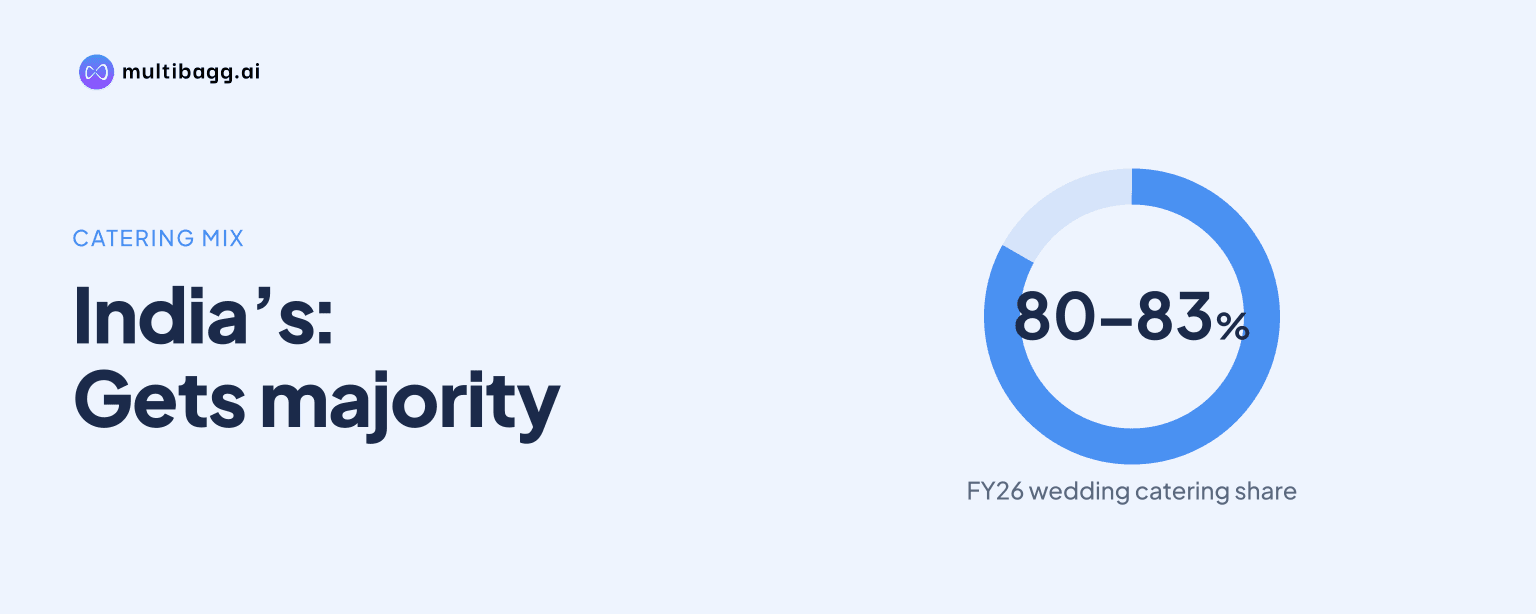
India’s catering market drew 80-83% of its FY26 value from wedding events, with wedding catering estimated at Rs 2,15,350 crore within a Rs 2,62,630 crore total market. Regional cuisines, hyper-local suppliers, cold-chain gaps and venue-access processes make the catering market difficult to standardise nationally.
Why do weddings account for 80-83% of the catering market?
Weddings account for 80-83% of the catering market because wedding catering was valued at Rs 2,15,350 crore of the Rs 2,62,630 crore total catering market in FY26. Wedding occasions were substantially larger than every other stated category, including personal celebrations at Rs 21,010 crore and Meetings, Incentives, Conferences, and Exhibitions, or MICE, at Rs 15,760 crore.
The concentration reflects the size of India’s wedding economy and food spending at multi-day events. India records an estimated 4.86 million to 6.62 million weddings annually, with total wedding spending of Rs 8,00,000 crore to Rs 16,00,000 crore. Luxury, ultra-luxury and premium weddings account for 55-67% of wedding-market spending, making expenditure in those segments material to catering demand.
Wedding catering was more than 10 times the FY26 sports-catering value of Rs 7,880 crore and more than 81 times the Rs 2,630 crore entertainment-catering value. This comparison means a change in wedding expenditure would affect a much larger part of the catering market than an equivalent movement in one smaller event category.
How large is the organized catering opportunity?
Organized catering, defined as vendors registered under the goods and services tax, or GST, was estimated at Rs 1,60,200 crore in FY26 and is forecast to reach Rs 2,83,520 crore by FY30. It accounted for 32-35% of the organized foodservice market in FY26, linking its expansion to both formalization and growth in wedding and event spending.
The source projects a 15.3% compound annual growth rate, or CAGR, for organized catering from FY26 to FY30. That rate exceeds the 9.3% CAGR projected for casual dining and the 14.1% CAGR for quick-service restaurants, or QSRs, over the same period. The source does not provide a separate FY30 forecast for the wedding share of catering.
Growth in tax-registered catering providers would occur alongside a large unorganized foodservice segment. Unorganized foodservice was estimated at Rs 3,56,640 crore in FY26 and is projected to reach Rs 5,13,220 crore by FY30, although its market share is expected to decline from 42.9% to 39.8%.
Why is national scaling difficult for the catering market?
National scaling is difficult because regional cuisines require hyper-local suppliers, separate logistics, staff training and quality-assurance checks when menus change. A caterer seeking multi-city service must preserve local culinary preferences while maintaining consistent operations, rather than relying on one uniform national menu.
Cold-chain gaps create an additional constraint outside major metros. Inconsistent refrigeration and transport networks can increase spoilage and require last-mile air-freight spending, affecting procurement and menu execution for time-sensitive events. These risks matter in a FY26 catering market worth Rs 2,62,630 crore, where wedding, corporate and sports orders can require high-volume preparation on fixed dates.
Demand peaks also complicate capacity planning. Weddings, corporate functions and sports events can produce unpredictable surges, while the absence of real-time analytics can result in excess inventory and waste or emergency procurement. Five-star hotels, stadiums and convention centres may also use exclusivity agreements and digital-compliance portals that can extend caterer onboarding to months.
MICE venue data illustrates this access requirement. Five-star hotels hosted 37% of MICE activity in CY2024, followed by four-star hotels at 29% and convention centres at 25%. Providers at these sites must support boxed meals, buffets and self-service kiosks while maintaining food quality and rapid service for large audiences.
Got a follow-up? Ask IRIS
Can cloud kitchens reduce catering-market fragmentation?
Cloud kitchens can reduce some fragmentation by giving caterers compact production facilities in key metropolitan areas and enabling local ingredient sourcing. The source identifies local procurement of ingredients such as Kerala coconut and Kashmiri saffron as a way to retain regional authenticity without some of the cost and complexity of long-haul transport.
City-level production can support menu customization and faster turnaround for weddings, corporate events and large gatherings. It does not remove the need for local supplier relationships, staff training and quality controls, so its effectiveness depends on building operational capabilities in each served city.
Cloud kitchens are the fastest-growing foodservice format in the source data, projected to grow from Rs 7,080 crore in FY26 to Rs 17,250 crore in FY30 at a 24.9% CAGR. That forecast supports the relevance of decentralised production, but it does not establish that national catering standardisation has already been achieved.
What non-wedding demand can diversify the catering market?
MICE is the clearest disclosed non-wedding diversification channel, valued at Rs 15,760 crore in the FY26 catering snapshot. The number of MICE events is projected to rise from 669 in CY2024 to 1,066 in CY2029, a stated CAGR of 8-10% supported by urbanization, corporate spending and expanding infrastructure.
MICE activity is geographically concentrated. Delhi NCR accounted for 20% of Indian MICE events in CY2024, followed by Mumbai at 15%, while Chennai and Bengaluru each accounted for 11%. Caterers pursuing corporate-event volumes can focus on these hubs, but growth outside them requires capabilities suited to local markets and venue conditions.
Personal celebrations and sports provide additional occasion-based demand, although at smaller scale. Personal celebrations were estimated at Rs 21,010 crore in FY26, while sports catering was valued at Rs 7,880 crore in the FY26 market snapshot. Neither category approaches wedding catering’s Rs 2,15,350 crore value, leaving the catering market principally exposed to wedding activity.
Conclusion
India’s catering market combines a large FY26 value of Rs 2,62,630 crore with concentrated demand, as weddings account for 80-83% of the market. Organized catering is projected to reach Rs 2,83,520 crore by FY30, but regional menus, local procurement, cold-chain constraints, variable event demand and venue access create barriers to replicating service nationally.
The disclosed indicators to watch are whether organized catering sustains its 15.3% FY26-FY30 CAGR, whether luxury, ultra-luxury and premium weddings retain their 55-67% share of wedding spending, and whether MICE events reach 1,066 in CY2029. Cloud kitchens’ projected 24.9% CAGR will also indicate whether city-level production can improve turnaround while preserving regional menu requirements.