










Integris: six Dehradun materials rely on sole suppliers
Key highlights
- Integris says six critical materials at its Dehradun plants were exclusively sourced from single suppliers as of the Draft Red Herring Prospectus date.
- Integris’s top 10 suppliers accounted for Rs 149.73 crore, or 47.14%, of purchases in the three months ended June 30, 2025.
- The top-10 supplier purchase share rose from 44.36% in Fiscal 2024 to 47.26% in Fiscal 2025.
- Integris reported no significant or prolonged supply disruption in the June 2025 quarter or Fiscal 2025, Fiscal 2024 and Fiscal 2023.
powered by IRIS
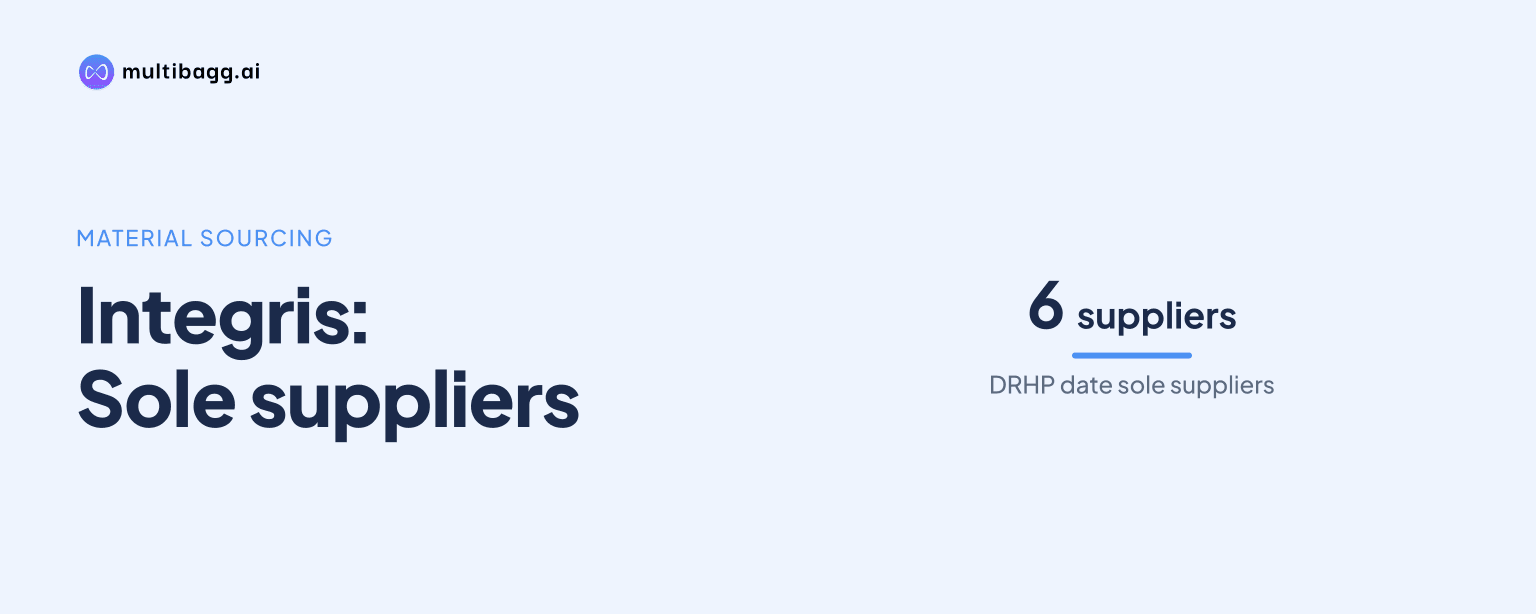
Integris reports that six critical materials at its Dehradun manufacturing facilities were sourced exclusively from single suppliers as of its Draft Red Herring Prospectus, while its top 10 suppliers accounted for 47.14% of purchases in the three months ended June 30, 2025. The dependency could affect cardiovascular-device output if a supplier cannot meet quality, volume, compliance or delivery requirements.
Which Dehradun materials does Integris source from single suppliers?
Integris says it had nine principal raw-material suppliers for its Dehradun, India facilities as of the Draft Red Herring Prospectus date, including six critical materials sourced exclusively from single suppliers. The disclosure names balloon forming tube, sirolimus drug, everolimus drug, resomer drug, probocol drug, sheaths and shellac excipient as key single-sourced materials used in the specialised supply chain for drug-eluting stents and related cardiovascular products.
The disclosure has a count difference that remains unexplained. Integris states that six critical materials are single-sourced but lists seven material descriptions in the same statement. It does not say whether sheaths and shellac excipient are treated as one category or whether another grouping produces the stated total of six. Cobalt chromium tubes are separately sourced from two suppliers, rather than one.
A single-sourced material is available to Integris from only one supplier instead of from alternative qualified vendors. In a regulated medical-device supply chain, an alternate source may need testing, qualification and production ramp-up before it can be used. Integris says suitable substitutes may not be available, or may not become operational quickly enough to prevent a supply interruption.
How concentrated are Integris’s supplier purchases?
Integris’s top 10 suppliers accounted for Rs 149.73 crore, or 47.14%, of total purchases in the three months ended June 30, 2025. Its top five suppliers accounted for Rs 102.45 crore, or 32.25%, and its largest supplier represented Rs 35.81 crore, or 11.27%. These figures cover group purchases rather than only Dehradun procurement or the six critical materials.
The top-10 share increased by 2.90 percentage points from 44.36% in Fiscal 2024 to 47.26% in Fiscal 2025, and was 47.14% in the June 2025 quarter. The largest supplier’s share rose from 7.19% in Fiscal 2024 to 11.27% in Fiscal 2025 and the three months ended June 30, 2025. Purchase concentration and single sourcing are different measures: a high-spend supplier may not be the only qualified source, while a low-spend supplier can still be essential if no substitute has been approved.
Why do Integris’s single-sourced Dehradun materials matter?
Integris says its cardiovascular segment depends on reliable and timely supplies of components, sub-assemblies and finished goods from domestic and international suppliers. A disruption involving a single-sourced tube, drug, excipient or sheath could constrain manufacturing capacity or delay order fulfilment even when other vendors are operating normally. The company identifies capacity constraints, quality or compliance issues, insolvency, commercial changes and strategic withdrawal as possible supplier risks.
The effect of a disruption depends on whether Integris can qualify an alternative before inventory or committed supplies are exhausted. Integris says delays in alternative-supplier qualification or ramp-up can prevent a timely response. It also says shortages, logistics failures, strikes, non-compliance and quality defects could delay deliveries, increase costs, create contractual penalties, affect product safety or quality, and strain customer relationships.
The issue is relevant to drug-eluting stents because their materials are specialised and regulated. Cardiovascular stents in India are included in the National List of Essential Medicines and are subject to price ceilings under the National Pharmaceutical Pricing Authority and the Drugs (Prices Control) Order, 2013. If a supply disruption increases input costs, Integris’s ability to recover those costs may be constrained where regulated price limits apply.
Got a follow-up? Ask IRIS
Does Integris have supplier dependencies outside Dehradun?
Integris says Translumina GmbH in Germany receives certain critical inputs, including sirolimus drug and catheter with stent, from one or a limited number of qualified suppliers. Integris says it is actively working to qualify alternates, but does not disclose a completion date, number of approved backup vendors or expected production capacity from any alternative source.
Integris says it had no comparable critical dependency on a particular supplier at its Netherlands and Chennai, India manufacturing operations as of the Draft Red Herring Prospectus date. This is a location-specific disclosure, not a commitment that dependencies cannot emerge. The company states that future dependencies at either site could adversely affect operations.
Integris also sources a small portion of in vitro diagnostic equipment supplied in India from original equipment manufacturers, or OEMs, in China. Revenue from China-sourced OEM equipment was Rs 1.36 crore in Fiscal 2025, equal to 1.10% of lab-solutions revenue, compared with Rs 1.02 crore, or 1.03%, in Fiscal 2024. This is a separate contract-manufacturing exposure rather than a Dehradun raw-material dependency.
What mitigation and disruption history has Integris disclosed?
Integris says it is working to qualify alternative suppliers for limited-source materials, but it does not disclose inventory buffers, dual-sourcing targets, supplier contracts or a timetable for Dehradun qualifications. The mitigation depends on technically suitable suppliers becoming qualified and operational before a supply interruption. The same limitation applies to the stated effort to qualify alternates for Translumina GmbH’s German inputs.
Integris reported no significant or prolonged supply disruptions during the three months ended June 30, 2025, or Fiscal 2025, Fiscal 2024 and Fiscal 2023. It also reported no operational failure by a third-party OEM that affected its business, and no OEM supplier change, during those periods. The company nevertheless states that future mitigation measures may not always be effective.
For supplier concentration to decline, Integris would need to spread purchasing across additional vendors or reduce dependence on its largest suppliers. For single-source risk to reduce, prospective alternatives must complete qualification and ramp-up for the relevant cardiovascular materials. The reported 47.14% top-10 purchase share does not establish whether any one of those suppliers provides one of the six disclosed Dehradun materials.
Conclusion
Integris has disclosed a specific manufacturing-chain vulnerability at Dehradun: six critical materials are exclusively sourced from single suppliers, while the top 10 suppliers represented 47.14% of purchases in the June 2025 quarter. The named material list contains seven descriptions despite the stated six-material count, leaving the scope of the dependency partly unreconciled. Supplier spending concentration and the absence of qualified alternatives should be assessed separately.
The next disclosed matter to watch is Integris’s effort to qualify alternate suppliers for Dehradun and Translumina GmbH in Germany. Integris provides no completion target, approved-vendor count or inventory-cover measure, so subsequent disclosures on qualified alternatives, supply disruptions, purchase concentration or production effects would indicate whether the dependence is changing.