










Translumina made Das CEO, founders became non-executive
Key highlights
- Probir Das became Translumina Executive Director and Group Chief Executive Officer on August 8, 2025 for five years.
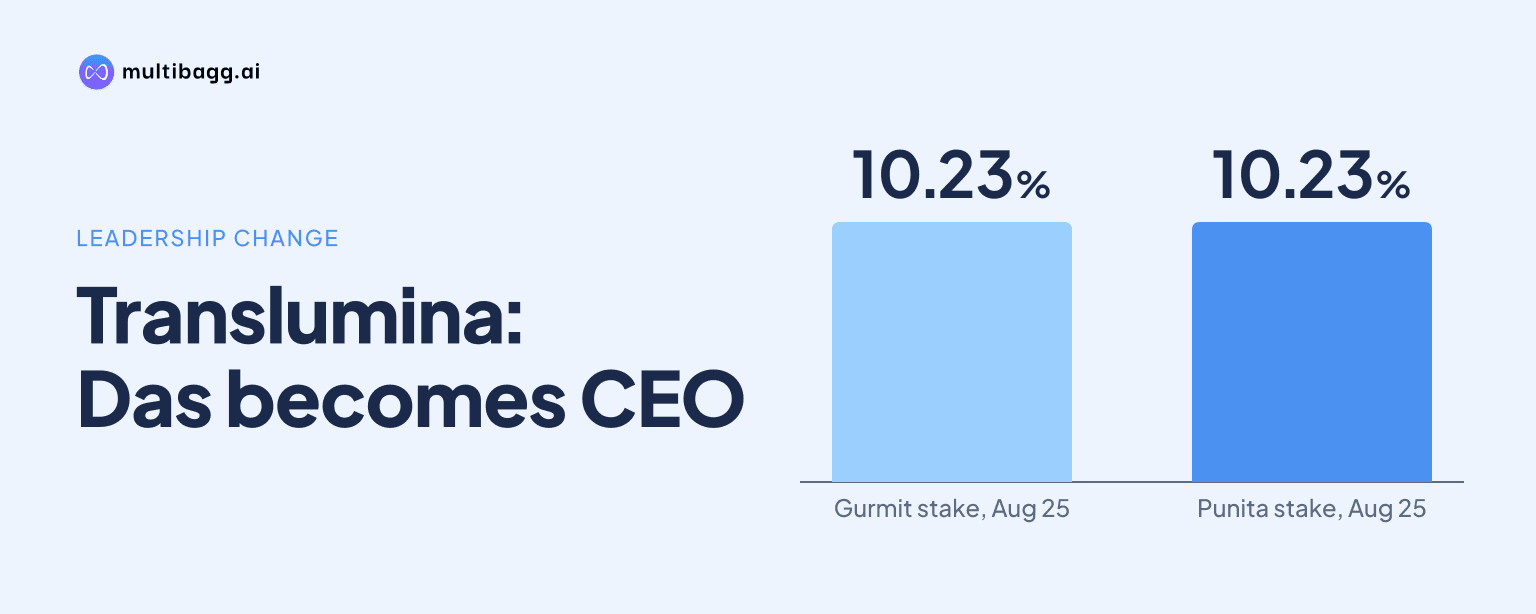
- Gurmit Singh Chugh and Punita Sharma became Non-Executive Directors on August 25, 2025 and each holds 10.23% of pre-offer fully diluted equity.
- Das’s approved annual fixed compensation is Rs 5 crore, with a performance-linked bonus of up to Rs 4.2 crore.
- Translumina’s nine-member board includes three independent directors and three nominee directors.
powered by IRIS
Translumina made Probir Das Executive Director and Group Chief Executive Officer for five years from August 8, 2025, while promoter-directors Gurmit Singh Chugh and Punita Sharma became Non-Executive Directors on August 25, 2025. Das’s approved annual fixed compensation is Rs 5 crore, with a performance-linked bonus of up to Rs 4.2 crore.
Why did Translumina change its leadership structure in 2025?
Translumina changed its leadership structure by moving its two promoter-directors from executive to non-executive roles in August 2025 and assigning the principal executive role to Das. Chugh and Sharma both changed from Executive Director to Non-Executive Director on August 25, 2025, while Das became Executive Director and Group Chief Executive Officer on August 8, 2025. The disclosed board-change record identifies the changes in designation, rather than resignations from the board, as the reason for the two promoters’ transition.
The new structure places one Executive Director, Das, on a nine-member board that also includes two Non-Executive Directors, three Non-Executive Nominee Directors and three Non-Executive Independent Directors, including one woman independent director. This differs from the prior structure because the two directors identified as promoters now serve in non-executive capacities, while the chief executive role is assigned to Das.
Das had first been appointed an additional director on June 10, 2025, before the August 8 executive appointment. Shareholders approved his appointment on September 29, 2025, after board resolutions dated June 10 and September 26, 2025. His five-year term runs from August 8, 2025, and he is not liable to retire by rotation, giving the chief executive office a defined tenure.
Who is Probir Das and what experience does he bring?
Das is Translumina’s Executive Director and Group Chief Executive Officer, with more than 22 years of managerial experience disclosed in the prospectus. Before joining Translumina as chief executive officer on November 18, 2024, he worked with Terumo India Private Limited, Terumo Asia Holdings Pte. Ltd. and Terumo Corporation, Japan, including as chairman for Asia Pacific and India, managing director, and group executive officer.
Das also previously worked at Becton Dickinson India Private Limited as director for strategic key accounts and diagnostics systems. His disclosed education includes a bachelor’s degree in science with physiology from the University of Calcutta and a diploma in marketing and sales management from Bharatiya Vidya Bhavan, Mumbai. The appointment brings medical-device and diagnostics management experience to Translumina’s executive role.
Translumina formalised Das’s board position in stages. He was an additional director from June 10, 2025, became Executive Director and Group Chief Executive Officer from August 8, 2025, and holds neither Indian nor foreign company directorships other than his Translumina role according to the board table. That contrasts with Chugh, whose disclosed directorships include nine Indian companies and two foreign companies, and Sharma, whose disclosed Indian directorships include six companies.
What will Translumina pay Probir Das as group CEO?
Translumina has approved annual fixed compensation of Rs 5 crore for Das, with a performance-linked bonus of up to Rs 4.2 crore subject to performance criteria, adequacy of profits and board determination. The remuneration terms are effective for three years from August 8, 2025, under board approval dated September 26, 2025 and shareholder approval dated September 29, 2025, although his Executive Director and Group Chief Executive Officer term is five years.
The package also permits annual increments of up to 20% in each financial year over his last-drawn remuneration during the five-year tenure. It includes house-rent allowance, monthly bonus, provident-fund contribution, gratuity, medical insurance, personal accident cover and one-time relocation expenses under company policies. Das is also eligible for stock options under the employee stock option scheme, with the perquisite value upon exercise excluded from the stated fixed pay, variable pay and other benefits.
The difference between reported Financial Year 2025 pay and the new annual arrangement is one of timing and definition. Translumina reported Rs 1.69 crore of remuneration for Das in Financial Year 2025, excluding remuneration paid by subsidiary Everlife Holdings Pte. Ltd.; Everlife Holdings separately paid Rs 1.75 crore. The Rs 5 crore fixed annual amount is an approved prospective arrangement from August 2025, while the Financial Year 2025 amounts are reported remuneration for the preceding year.
Got a follow-up? Ask IRIS
How much influence do Translumina’s founders retain?
Translumina’s two promoter-directors retain a combined 20.46% of pre-offer equity share capital on a fully diluted basis, despite no longer being Executive Directors. Chugh holds 11,189,331 equity shares, or 10.23%, and Sharma holds the same number and percentage. The shareholding disclosure therefore shows equal stakes for the two promoters and makes their combined holding the disclosed director-shareholding total of 22,378,662 shares.
Das held no equity shares as of the prospectus date, but had 320,000 employee stock options. The prospectus states that post-offer percentages are subject to finalisation of the offer price and basis of allotment, and assumes exercise of all outstanding vested options under the Integris ESOP Scheme. This distinguishes promoter ownership from the incoming chief executive’s option-based potential interest.
The promoters also remain represented in formal board processes. Chugh chairs the Stakeholders’ Relationship Committee, whose five members include Das, independent director Ramesh Subrahmanian and nominee directors Arjun Oberoi and Vishal Omprakash Goenka. The committee role maintains a governance position for Chugh, whereas executive leadership is disclosed under Das’s Group Chief Executive Officer designation.
How did the wider board change alongside the CEO appointment?
Translumina added independent and nominee representation alongside the executive transition in 2025. Annaswamy Vaidheesh joined as Chairperson and Non-Executive Independent Director on August 26, 2025 for two years, while Rajani Kesari and Ramesh Subrahmanian joined as Non-Executive Independent Directors on August 1, 2025 for three years each. Arjun Oberoi was appointed Non-Executive Nominee Director on September 29, 2025.
The resulting board has three independent directors, or one-third of its nine members, and three nominee directors. Avnish Mehra, Oberoi and Goenka are nominee directors of Evercure Holdings Pte. Ltd. under the Restated Shareholders’ Agreement, according to the prospectus. The prospectus also says no directors are related to one another or to key managerial personnel and senior management.
Board remuneration further separates the executive and non-executive positions. Non-Executive Directors and Non-Executive Nominee Directors are not entitled to remuneration, while independent directors and the chairperson are entitled to annual remuneration of Rs 50 lakh, including sitting fees, under approvals made during July and August 2025. The board and shareholders also approved remuneration exceeding 11% of net profits on September 26 and 29, 2025, respectively, in accordance with applicable law.
Conclusion
Translumina’s 2025 changes created a defined division between founder ownership and executive management. Chugh and Sharma remain directors, promoters and equal 10.23% shareholders, but Das holds the sole Executive Director role, a five-year chief executive mandate and a pay structure combining Rs 5 crore fixed compensation with a bonus opportunity of up to Rs 4.2 crore.
The next matters to watch are the operation of Das’s performance criteria and profit-adequacy condition for the variable bonus, any annual pay increments of up to 20%, and the exercise of his 320,000 employee stock options. The Nomination and Remuneration Committee is also tasked with developing and regularly reviewing succession plans for senior management and key managerial personnel.