








Integris: Europe at 39%-57%, Dehradun topped 97% in FY25

Find your next multibaggerBe a Pro Investor
Research stocks and track your picks on the go. Download the app.
Key highlights
- Integris’s Germany facility operated at 39.37% utilisation in FY25, producing 18,898 units against 48,000 units of available capacity.
- Integris’s Netherlands facility operated at 56.64% utilisation in FY25, with output of 33,981 units against 60,000 units of available capacity.
- Dehradun bare-metal sheets, drug-eluting stents and vascular accessories operated at 98.94%, 97.86% and 97.25%, respectively, in FY25.
- Germany’s utilisation fell from 96.15% in FY24 to 39.37% in FY25 as available capacity rose from 36,000 to 48,000 units.
powered by IRIS
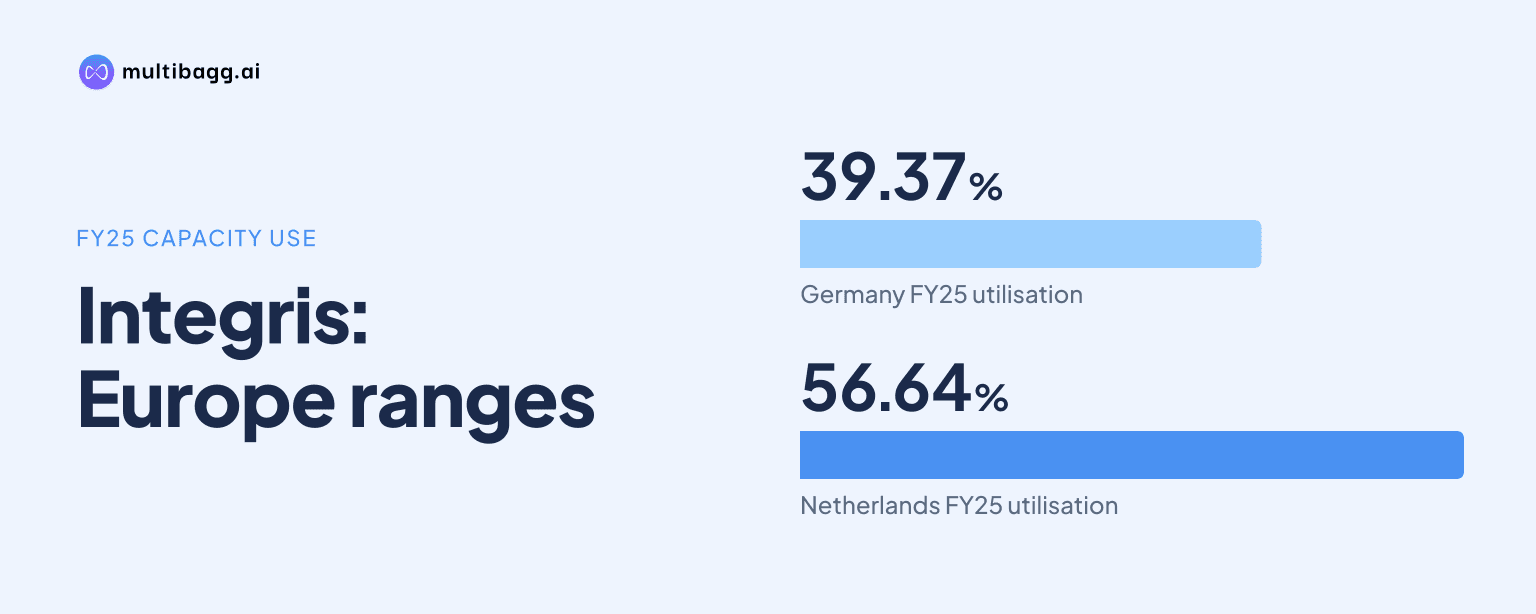
Integris reported sharply different factory utilisation in the fiscal year ended March 31, 2025: its Germany facility ran at 39.37% and its Netherlands facility at 56.64%, while Dehradun bare-metal sheets, drug-eluting stents and vascular accessories operated at 98.94%, 97.86% and 97.25%, respectively.
Why did Integris’s European factories run at 39%-57% in FY25?
Integris’s Germany facility recorded 39.37% utilisation in FY25 because it produced 18,898 units against annual average available capacity of 48,000 units. The Hechingen, Germany facility makes stent-related products and balloon products, and its installed as well as available capacity increased to 48,000 units in FY25 from 36,000 units in FY24, while total production declined from 34,615 units to 18,898 units.
The Netherlands facility recorded a higher, but still materially lower than its prior peak, utilisation of 56.64% in FY25. Its Helmond factory produced 33,981 units against annual average available capacity of 60,000 units, comprising 10,264 drug-coated balloons, or DCBs, and 23,717 percutaneous transluminal coronary angioplasty, or PTCA, products. Available capacity remained 60,000 units for each of FY23, FY24 and FY25, so the FY25 movement reflects lower production rather than a change in the annual capacity denominator.
Which Dehradun lines exceeded 97% utilisation in FY25?
Integris had three Dehradun product categories above 97% utilisation in FY25: bare-metal sheets at Unit I reached 98.94%, drug-eluting stents at Unit III reached 97.86%, and vascular accessories at Unit III reached 97.25%. Unit I made 296,831 bare-metal sheet units against 300,000 units of average available capacity, while Unit III made 259,850 drug-eluting stents against 265,525 units of available capacity.
Vascular accessories added a third highly utilised Dehradun line, with output of 803,592 units against available capacity of 826,327 units in FY25. The category’s utilisation improved from 91.64% in FY24 and 95.48% in FY23. Drug-eluting stent utilisation also rose from 96.16% in FY24, although its available capacity increased by 64,639 units in FY25 after Integris recruited more labour, according to the capacity note.
The concentration of high utilisation was not uniform across Dehradun. Unit II, which manufactures PTCA catheters and crimped catheters, operated at 57.62% in FY25, producing 235,108 units against 408,000 units of annual average available capacity. That was above Unit II’s 53.17% in FY24, but 41.32 percentage points below Unit I’s bare-metal sheet utilisation in the same fiscal year.
Got a follow-up? Ask IRIS
How did European factory utilisation change from FY23 to FY25?
Integris’s Germany utilisation fell by 63.35 percentage points from 102.72% in FY23 to 39.37% in FY25. Germany produced 36,979 units against 36,000 units of available capacity in FY23, 34,615 units against 36,000 units in FY24, and 18,898 units against 48,000 units in FY25. The FY25 result therefore combines a 47.16% year-on-year production reduction with a 33.33% increase in available capacity.
The Netherlands facility followed a different pattern: its available capacity stayed at 60,000 units, while production reduced from 53,811 units in FY23 to 41,025 units in FY24 and 33,981 units in FY25. Consequently, utilisation declined from 89.69% in FY23 to 68.38% in FY24 and 56.64% in FY25. The facility had 26,019 units of unused annual average available capacity in FY25 under Integris’s stated calculation.
The contrast with Dehradun is most visible in drug-eluting stents. Dehradun Unit III produced 259,850 drug-eluting stents in FY25, compared with Germany’s combined 10,874 DES CES units and 749 DES SS units, although the two facilities’ reported product mixes are not identical. Germany’s total also includes 7,275 OBL balloon units; Integris reports the facility total, rather than a separate utilisation percentage for each individual product category.
What does Integris’s capacity utilisation measure?
Integris defines capacity utilisation as actual production in the relevant period divided by annual average available capacity, not simply installed machinery capacity. Annual average available capacity reflects assumptions about working days, shifts, hours, scheduled preventive maintenance, machine availability and labour availability. This distinction matters because a factory can have more machinery installed than the capacity considered available for production.
The Dehradun disclosures illustrate that distinction. Unit III’s installed capacity for drug-eluting stents was 900,000 units in FY25, but its annual average available capacity was 265,525 units and its output was 259,850 units, producing the stated 97.86% utilisation. Integris said 10 machines had been added in FY23 and validated by June 2023, while the available-capacity increase in FY25 was linked to additional labour recruitment.
For the three months ended June 30, 2025, the reported figures moved higher at both European factories, but they cover a shorter period and use pro-rata capacity. Germany recorded 65.96% utilisation from 3,298 units of output and 5,000 units of available capacity, while the Netherlands recorded 88.73% from 17,303 units and 19,500 units. These quarterly figures cannot be treated as a full-year result because Integris calculates installed capacity for the period on a pro-rata basis.
Conclusion
Integris’s FY25 operating data shows that utilisation was uneven by facility and product category rather than consistently represented by one company-wide measure. Dehradun Unit I and Unit III were close to their reported available capacity in bare-metal sheets, drug-eluting stents and vascular accessories, whereas Germany had 29,102 units of unused available capacity and the Netherlands had 26,019 units under the stated annual calculation.
The next operating point to watch is whether the June 30, 2025 improvement at the two European facilities persists over a full fiscal year, while the three high-utilisation Dehradun categories remain near their available capacity. Integris disclosed no facility-specific utilisation target or European expansion plan in the supplied material; changes in production, labour availability, maintenance downtime and available capacity will therefore determine whether the FY25 gap narrows or continues.

