










Khandsari Production Fell 89% While Instant Food Rose 48%
Key highlights
- Khandsari production fell from 530,000 tonnes in FY2020-21 to a 60,000-tonne forecast for FY2025-26.
- Khandsari output dropped 85% from 500,000 tonnes in FY2022-23 to 75,000 tonnes in FY2023-24.
- Instant premix and ready-to-eat output rose 48% from 494,368 tonnes in 2020 to 733,339 tonnes in 2025.
- India’s FY2026 sugarcane production is estimated at 5,002 lakh tonnes, up from 4,546 lakh tonnes in FY2025.
powered by IRIS
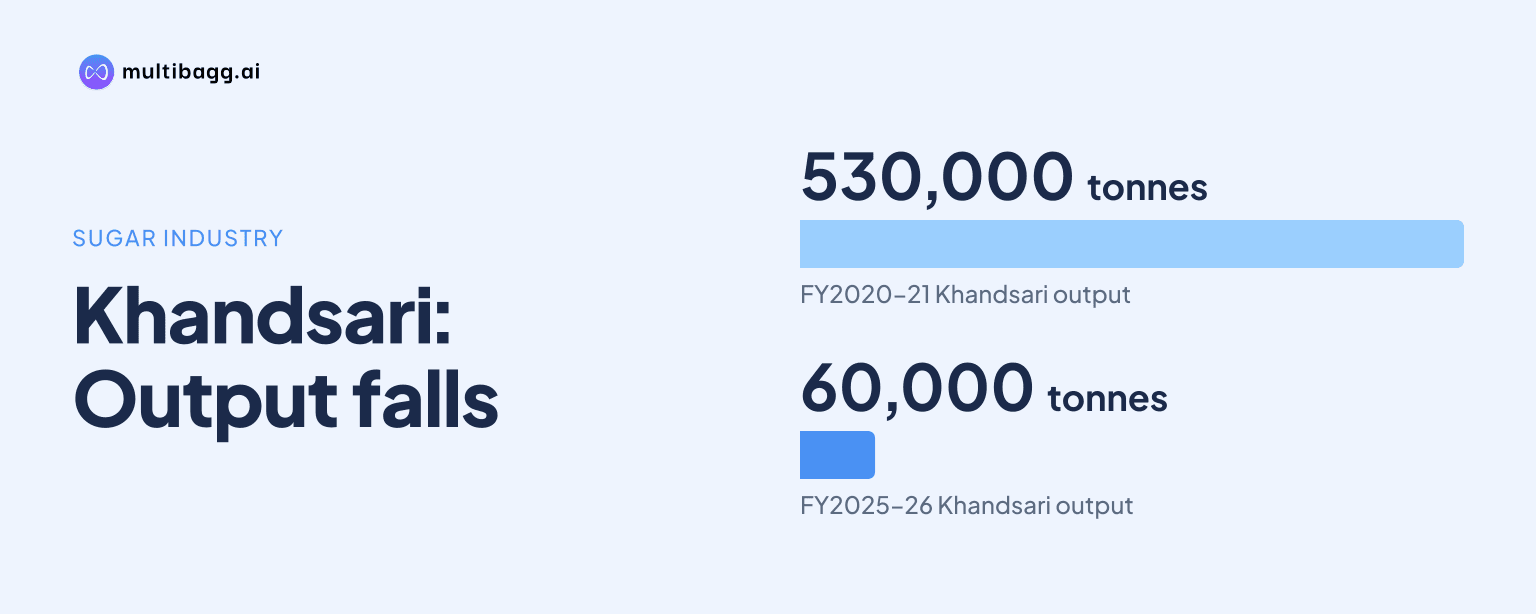
Khandsari production fell 89% from 530,000 tonnes in FY2020-21 to a forecast 60,000 tonnes in FY2025-26, while India’s instant premix and ready-to-eat output increased 48% from 494,368 tonnes in 2020 to 733,339 tonnes in 2025. The reported series show lower Khandsari volumes alongside sustained expansion in convenience-oriented food output.
How far did Khandsari production fall?
Khandsari production fell by 470,000 tonnes between FY2020-21 and the FY2025-26 forecast. Khandsari is a traditional, partially refined sugar produced from sugarcane juice through clarification, boiling and crystallisation rather than full-scale refining into plantation white sugar. Its output declined from 530,000 tonnes in FY2020-21 to 500,000 tonnes in both FY2021-22 and FY2022-23.
Most of the decline occurred in FY2023-24, when Khandsari production dropped to 75,000 tonnes from 500,000 tonnes in FY2022-23. Output then moved to 60,000 tonnes in FY2024-25 and is forecast at the same 60,000 tonnes in FY2025-26. The forecast is therefore 89% below FY2020-21, while the fall from FY2022-23 to FY2023-24 alone was 425,000 tonnes, or 85%.
Why did Khandsari production move to lower levels?
Khandsari production moved lower as the industry report cites changing consumer preferences, greater health consciousness, and demand for jaggery powder and specialty sugarcane-based products. Khandsari has an off-white to light-brown colour, residual molasses and relatively coarse crystals, characteristics that distinguish it from fully refined sugar. The disclosed production figures show that this conventional format contracted sharply after FY2022-23.
The report also says industry participants are focusing on higher-margin value-added products, product diversification and organised processing capabilities. Jaggery powder can be consumed captively in premix manufacturing, while instant premixes may combine jaggery powder, Khandsari, coffee, tea, milk solids, cocoa, spices, flavouring agents or nutraceutical ingredients. That downstream model depends on controlled moisture, microbial quality, uniform blending and packaging that supports product stability.
How quickly did instant food output expand?
Instant premix and ready-to-eat output increased by 238,971 tonnes, or 48%, between 2020 and 2025. Instant premixes are semi-processed food products requiring minimal cooking or additions such as water or milk, whereas ready-to-eat products are fully processed and packaged for direct consumption. Combined production rose from 494,368 tonnes in 2020 to 524,462 tonnes in 2021 and 621,225 tonnes in 2022.
The series continued upwards from 644,887 tonnes in 2023 to 687,737 tonnes in 2024 and 733,339 tonnes in 2025. Output did not decline in any year shown. The largest annual increase was between 2021 and 2022, when production rose by 96,763 tonnes, or about 18%; subsequent annual increases were about 4% in 2023 and 7% in both 2024 and 2025.
Got a follow-up? Ask IRIS
What does sugarcane supply mean for Khandsari and instant food?
Khandsari and jaggery-based instant premix manufacturing depend on sugarcane because both Khandsari and jaggery are made from freshly extracted cane juice. Sugarcane availability, quality and pricing therefore directly affect production capacity, cost structure and profitability. India’s sugarcane production rose from 4,395 lakh tonnes in FY2022 to 4,905 lakh tonnes in FY2023, then declined to 4,532 lakh tonnes in FY2024 before reaching 4,546 lakh tonnes in FY2025.
FY2026 second advance estimates place sugarcane production at 5,002 lakh tonnes, the highest level in the FY2022-FY2026 series. Yield is estimated at 85,495 kilograms per hectare in FY2026, compared with 78,953 kilograms per hectare in FY2024, while cultivation area is estimated at 58.51 lakh hectares, versus 54.50 lakh hectares in FY2025. The FY2026 estimate must be realised for the reported improvement in cane availability to support processors.
Which conditions could sustain the Khandsari production shift?
The lower Khandsari production and higher instant-food output can persist only if processors meet the product and distribution requirements identified in the report. Instant premixes are blended through automated mixing systems, tested for homogeneity, moisture content and stability, and packed in sachets, pouches or bulk formats. Organised retail, e-commerce, quick commerce and direct-to-consumer channels are also identified as routes that can expand access for branded jaggery, Khandsari and premix products.
The transition remains exposed to sugarcane price volatility, input, packaging and logistics costs, food-safety compliance and regional taste differences. Moisture-sensitive jaggery, Khandsari and premixes can face quality deterioration, microbial spoilage and shorter shelf life without appropriate processing and packaging. The Production Linked Incentive Scheme for Food Processing Industry runs from 2021-22 to 2026-27, while a Rs 2,000 crore special fund through the National Bank for Agriculture and Rural Development supports food parks, agro-processing units and related infrastructure.
Conclusion
Khandsari production and instant-food output moved in opposite directions in the reported data. Khandsari declined from 530,000 tonnes in FY2020-21 to a 60,000-tonne FY2025-26 forecast, while instant premix and ready-to-eat output rose from 494,368 tonnes in 2020 to 733,339 tonnes in 2025. The industry report attributes the divergence to diversification towards value-added products and demand for convenient, ready-to-use formats.
The next disclosed milestones are the FY2025-26 Khandsari forecast of 60,000 tonnes, the FY2026 second advance estimate of 5,002 lakh tonnes of sugarcane, and the 2026-27 end date of the Production Linked Incentive Scheme for Food Processing Industry. Cane availability, quality control, packaging and distribution will determine whether processors can continue expanding instant-food production while conventional Khandsari output remains lower.