










Shellz Revenue Was 95.91% Dependent on Super Stockists
Key highlights
- Super stockists generated Rs 184.74 crore, or 95.91%, of Shellz's Rs 192.62 crore Fiscal 2026 channel revenue.
- Online platforms contributed Rs 3.62 crore, or 1.88%, of Shellz's Fiscal 2026 channel revenue.
- Shellz's super-stockist share rose from 94.39% in Fiscal 2024 to 95.91% in Fiscal 2026, despite falling from 96.32% in Fiscal 2025.
- Shellz expects installed production capacity at Sonipat to increase from about 17,100 MTPA to about 34,500 MTPA.
powered by IRIS
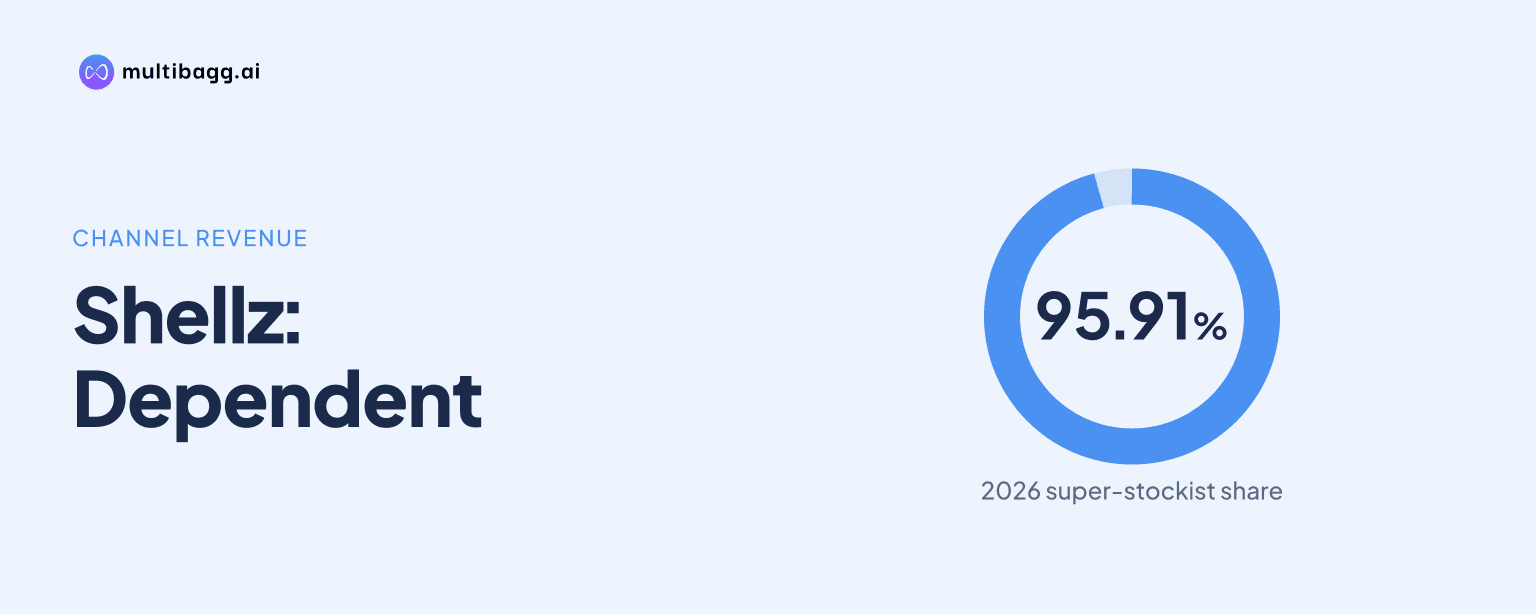
Shellz generated 95.91% of its Fiscal 2026 revenue from super stockists, making the intermediary-led general-trade route its overwhelmingly dominant sales channel. Super stockists contributed Rs 184.74 crore of Rs 192.62 crore in Fiscal 2026 channel revenue, while online platforms, exports, modern trade and private-label manufacturing together accounted for 4.10%.
How dependent was Shellz revenue on super stockists in Fiscal 2026?
Shellz revenue was 95.91% dependent on super stockists in Fiscal 2026. The channel generated Rs 184.74 crore from total Fiscal 2026 channel revenue of Rs 192.62 crore, based on the company's restated standalone financial information. A super stockist buys products in bulk from Shellz and then supplies distributors, which in turn supply wholesalers, intermediaries and kirana stores.
Shellz's four other goods channels remained individually small in Fiscal 2026. Online platforms produced Rs 3.62 crore, or 1.88% of revenue; private-label manufacturing produced Rs 2.01 crore, or 1.05%; modern trade produced Rs 1.20 crore, or 0.63%; and exports produced Rs 1.03 crore, or 0.54%. Together, these channels accounted for 4.10% after adding the reported percentages.
What changed in Shellz's channel mix from Fiscal 2024 to Fiscal 2026?
Shellz's super-stockist share increased by 1.52 percentage points between Fiscal 2024 and Fiscal 2026, rising from 94.39% to 95.91%. The Fiscal 2026 share was 0.41 percentage points below Fiscal 2025's 96.32%, but remained above the Fiscal 2024 level. Revenue through super stockists rose from Rs 153.30 crore in Fiscal 2024 to Rs 180.09 crore in Fiscal 2025 and Rs 184.74 crore in Fiscal 2026.
Total channel revenue increased from Rs 162.41 crore in Fiscal 2024 to Rs 186.97 crore in Fiscal 2025 and Rs 192.62 crore in Fiscal 2026. The increase in super-stockist revenue accounted for most of the growth over the two-year period, while the channel's share of sales remained above 94% in all three fiscal years. This means that higher revenue did not coincide with a material shift away from the intermediary-led route.
Shellz's smaller channels changed unevenly. Online-platform revenue increased from Rs 2.97 crore in Fiscal 2024 to Rs 3.62 crore in Fiscal 2026, but its share changed only from 1.83% to 1.88%. Modern-trade revenue declined from Rs 3.23 crore, or 1.99%, in Fiscal 2024 to Rs 1.20 crore, or 0.63%, in Fiscal 2026, while export revenue fell from Rs 2.91 crore, or 1.79%, to Rs 1.03 crore, or 0.54%.
Private-label manufacturing became more visible but remained limited in scale. Fiscal 2026 revenue from this channel was Rs 2.01 crore, or 1.05%, compared with Rs 37.36 lakh, or 0.20%, in Fiscal 2025; no such revenue was reported for Fiscal 2024. Shellz defines private-label manufacturing as producing goods to third-party specifications for brands that market the products under their own labels, using spare manufacturing capacity.
Why do super stockists determine Shellz's market reach?
Shellz's super-stockist model determines its market reach because the channel connects the company to several downstream trade layers. In Fiscal 2026, Rs 184.74 crore moved through super stockists before reaching distributors, wholesalers, intermediaries and kirana stores. Shellz states that this structure supports product availability across key markets, a relevant consideration for confectionery products sold through general trade.
Shellz says the model allows it to service multiple markets through local channel relationships and downstream market knowledge, without a field-intensive retail sales structure. For this route to sustain its Fiscal 2026 contribution of 95.91%, super stockists must continue purchasing in bulk, distributors must move stock onward, and retail outlets must maintain availability. Any disruption in these stages could affect a large share of Shellz's goods sales.
The concentration is in a route to market rather than one stated product category. Shellz manufactures baked treats, choco delights, jellies, and panned and sugar candies at its Samaiipur, Delhi facility, alongside food and bakery ingredients. Its multi-stock-keeping-unit, or SKU, portfolio can therefore cover several formats, but the Fiscal 2026 channel mix shows that most formats still reached consumers through the same intermediary-led chain.
Got a follow-up? Ask IRIS
Can online, modern trade, exports and private labels reduce Shellz's concentration?
Shellz's disclosed plans could add sales outlets, but Fiscal 2026 results do not show a substantial reduction in dependence on super stockists. The company sells through Amazon, Flipkart, Meesho, Kirana Club and Swiggy Instamart, with orders fulfilled through central warehouses or marketplace fulfilment services. These online platforms generated Rs 3.62 crore in Fiscal 2026, compared with Rs 184.74 crore through super stockists.
Shellz plans to expand its Tosca brand through modern trade, e-commerce and other organised retail formats. It also plans to deepen Hugs distribution by onboarding additional super stockists and widening the assortment available at retail outlets. These plans point in two directions: developing channel-specific sales for Tosca while increasing the scale of the existing super-stockist network for Hugs.
Exports and private-label manufacturing have separate requirements. Shellz states that exports must comply with destination-country import regulations, packaging norms and labelling requirements; the channel generated Rs 1.03 crore in Fiscal 2026. Private-label manufacturing depends on spare capacity and customer specifications, while Shellz is consolidating operations at Sonipat, Haryana, where total installed production capacity is expected to rise from about 17,100 metric tonnes per annum, or MTPA, to about 34,500 MTPA.
What does the period ended June 30, 2026 show about Shellz's mix?
The period ended June 30, 2026 also showed a super-stockist-led sales mix. Super stockists generated Rs 44.59 crore, or 94.38%, of consolidated channel revenue of Rs 47.24 crore. Online platforms generated Rs 91.88 lakh, or 1.94%, and private-label manufacturing generated Rs 1.23 crore, or 2.59%.
Modern trade and exports were smaller in the period ended June 30, 2026, contributing Rs 4.61 lakh, or 0.10%, and Rs 24.38 lakh, or 0.52%, respectively. The period also included Rs 22.12 lakh of service revenue from Sheller Overseas Private Limited, Shellz's subsidiary. Shellz states that the comparable period is not relevant because of a share-capital reorganisation, so this partial-period mix should not be read as a directly comparable quarterly trend.
Conclusion
Shellz's Fiscal 2026 channel data shows that its stated multi-channel model remained concentrated in one route: super stockists generated 95.91% of channel revenue. Online-platform share was broadly stable over three fiscal years, while modern trade and exports represented smaller shares in Fiscal 2026 than in Fiscal 2024; private-label manufacturing expanded but contributed only 1.05%.
The next development to watch is Shellz's stated consolidation and capacity expansion at Sonipat from about 17,100 MTPA to about 34,500 MTPA. The company plans to build online, modern-trade, export and private-label opportunities, but it also plans to add super stockists for Hugs, so the concentration outcome will depend on whether the smaller channels grow faster than the core network.