










Shree Siddhivinayak Greentech: five buyers drove 97.45% revenue
Key highlights
- Shree Siddhivinayak’s top five customers generated 97.45% of Rs 35.01 crore revenue from operations in the period ended July 31, 2026.
- Shree Siddhivinayak’s top 10 customers accounted for 99.92% of July-period revenue from operations, or Rs 34.99 crore.
- Jaggery powder contributed 94.46% of Shree Siddhivinayak’s July-period product sales, and the top 10 customers generated 100.00% of that category’s sales.
- Madhya Pradesh accounted for 79.11% of Shree Siddhivinayak’s revenue from operations in the period ended July 31, 2026.
powered by IRIS
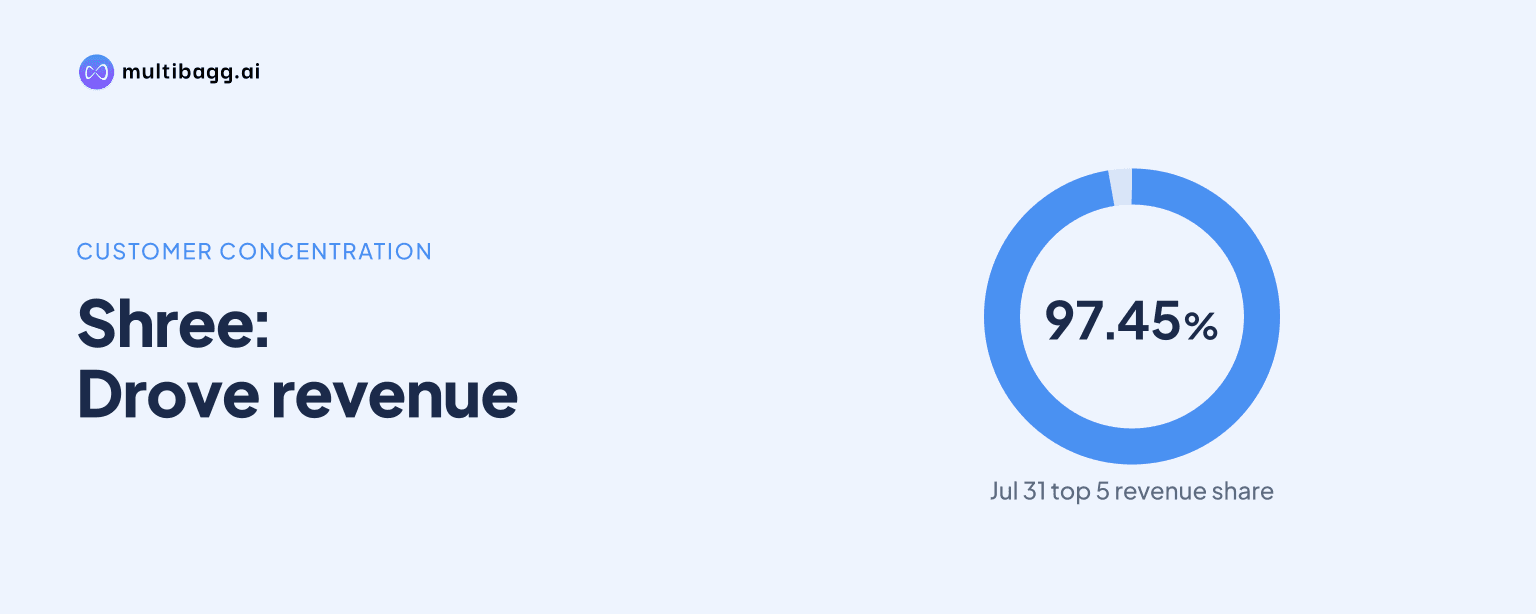
Shree Siddhivinayak Greentech generated 97.45% of its Rs 35.01 crore revenue from operations from five customers in the period ended July 31, 2026, while its top 10 customers accounted for 99.92%. Jaggery powder, which supplied 94.46% of product sales, derived 100% of its sales from the top 10 customers.
How concentrated was Shree Siddhivinayak’s July 2026 revenue?
Shree Siddhivinayak generated Rs 34.12 crore, or 97.45% of revenue from operations, from its five largest customers in the period ended July 31, 2026. Its top 10 customers generated Rs 34.99 crore, or 99.92%, leaving Rs 2.72 lakh of the Rs 35.01 crore total outside the 10-customer group.
The filing identifies this as a risk because a few clients may represent a larger part of the customer portfolio, potentially increasing volatility in results. Shree Siddhivinayak says it cannot assure investors that it will generate the same volume of business, or any business, from these customers, so revenue continuity depends on retaining a limited group of buyers.
The concentration figures use revenue from operations across products rather than sales of one product line. The period ended July 31, 2026 was a stub period, while FY 2025-2026 covered 12 months, meaning the disclosed revenue values do not provide a like-for-like measure of annual customer demand.
How did Shree Siddhivinayak’s customer concentration change over time?
Shree Siddhivinayak’s top-five customer share rose by 33.78 percentage points to 97.45% in the period ended July 31, 2026 from 63.67% in FY 2025-2026. The top-10 share increased by 20.51 percentage points to 99.92% from 79.41%, concentrating nearly all reported stub-period revenue among 10 customers.
The disclosed history shows that the proportion has varied across financial years. The top five customers accounted for 83.94% of revenue from operations in FY 2024-2025 and 71.57% in FY 2023-2024, while the top 10 accounted for 94.49% and 90.96%, respectively.
Absolute sales and concentration moved differently in FY 2024-2025 and FY 2025-2026. The top five generated Rs 49.16 crore in FY 2024-2025, above Rs 47.92 crore in FY 2025-2026, even as their revenue share fell 20.27 percentage points to 63.67%; total revenue from operations therefore expanded beyond the five-customer group in FY 2025-2026.
Got a follow-up? Ask IRIS
Which Shree Siddhivinayak products rely most on large customers?
Shree Siddhivinayak’s jaggery powder sales were fully accounted for by its top 10 customers in the period ended July 31, 2026. The category generated Rs 33.07 crore, equal to 94.46% of total product sales, with the top 10 generating the full Rs 33.07 crore and the top five generating Rs 33.07 crore, or 99.98%.
Jaggery powder was also the largest disclosed product category in each of the preceding three financial years, contributing 86.28% of product sales in FY 2025-2026, 86.73% in FY 2024-2025 and 90.96% in FY 2023-2024. The top 10 accounted for 92.04% of jaggery-powder sales in FY 2025-2026, compared with 100.00% in the July 2026 stub period.
Other July-period product lines also had high customer concentration, but were materially smaller than jaggery powder. The top five customers accounted for all Rs 83.47 lakh of khandsari sugar sales and all Rs 106.92 lakh of by-product sales, while the top 10 represented 85.85% of Rs 3.64 lakh in jaggery-based pre-mix sales.
Cane seeds had a different reported customer profile in FY 2025-2026, when they generated Rs 5.66 crore in sales. The top five accounted for Rs 41.37 lakh, or 7.30%, and the top 10 for Rs 72.45 lakh, or 12.79%; Shree Siddhivinayak reported no cane-seed sales for the period ended July 31, 2026.
What could reduce or worsen Shree Siddhivinayak’s customer-concentration risk?
Shree Siddhivinayak can reduce dependence on a few customers only if additional customers contribute a material portion of sales. The company says customer composition and revenue from customers may change as it adds buyers in the ordinary course of business, but it provides no numerical diversification target or timetable.
Retaining major customers also depends on product demand, product quality and delivery performance. The filing says regional tastes, consumer preferences, delays in delivery and quality issues can affect demand and customer loyalty, particularly relevant because jaggery powder represented Rs 33.07 crore of July-period sales.
Geographic concentration creates a related dependency because Madhya Pradesh accounted for Rs 27.70 crore, or 79.11%, of July-period revenue from operations. Maharashtra accounted for the remaining Rs 7.32 crore, or 20.89%, while Madhya Pradesh represented 83.75% of jaggery-powder sales, exposing the concentrated customer base to regional disruptions and policy changes.
Conclusion
Shree Siddhivinayak reported a highly concentrated sales profile in the period ended July 31, 2026: five customers generated 97.45% of revenue from operations and 10 generated 99.92%. The dependence is most pronounced in jaggery powder, which represented 94.46% of product sales and was sold entirely to the top 10 customers.
The next reported periods will show whether new customers make a material contribution, as Shree Siddhivinayak says the customer mix may change but discloses no diversification target. The company’s seasonal crushing cycle had not commenced by July 31, 2026, making later sales disclosures relevant for assessing whether the July concentration persists.