










SME IPO places 98.94% of net issue with non-QIB bidders
Key highlights
- The SME IPO has a 62.66 lakh-share net issue after a 3.30 lakh-share market-maker reservation.
- Non-institutional applicants and individual investors each receive at least 31.00 lakh shares, or 49.47% of the net issue.
- QIBs can receive no more than 66,000 shares, equal to 1.05% of the 62.66 lakh-share net issue.
- The minimum application exceeds Rs 2 lakh for at least two lots, while the trading lot is 1,000 shares.
powered by IRIS
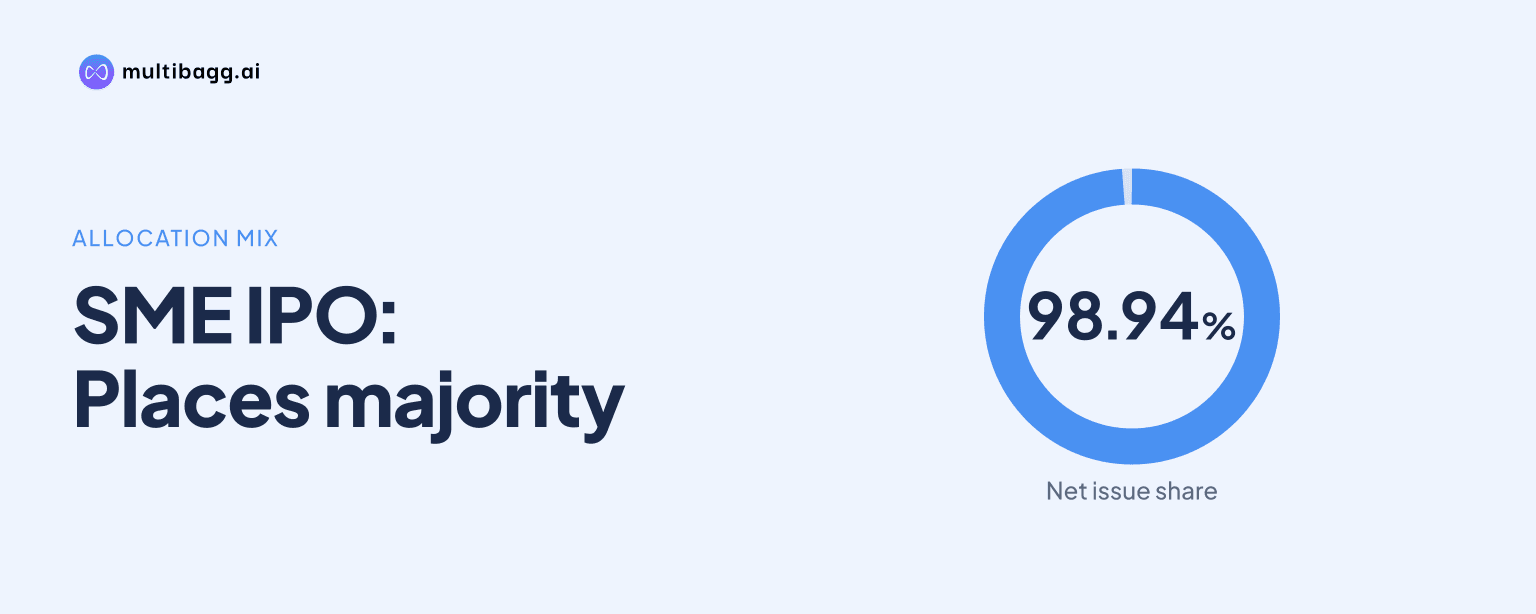
The small and medium enterprise initial public offering (SME IPO) makes at least 98.94% of its 62.66 lakh-share net issue available to non-institutional applicants and individual investors, while qualified institutional buyers (QIBs) can receive no more than 66,000 shares, or 1.05%. The allocation structure therefore limits the shares available for institutional bidding.
How is the SME IPO allocation divided among bidders?
The SME IPO consists of up to 65.96 lakh equity shares with a face value of Rs 10 each, including 3.30 lakh shares reserved for the designated market maker and 62.66 lakh shares offered as the net issue to the public. The total issue represents 35.00% of post-issue paid-up equity share capital, while the net issue represents 33.25%.
The SME IPO makes at least 31.00 lakh shares available to non-institutional applicants and at least 31.00 lakh shares available to individual investors. Each category accounts for at least 49.47% of the 62.66 lakh-share net issue, meaning the two non-QIB categories together account for at least 62.00 lakh shares, or 98.94%.
The 3.30 lakh shares reserved for the market maker are outside the 62.66 lakh-share net issue. The SME IPO is proposed to list on NSE Emerge, where compulsory market making applies for a minimum of three years from listing, or for another period prescribed by the stock exchange.
Why is the SME IPO QIB allocation capped at 1.05%?
The SME IPO caps QIB allocation at 66,000 shares, equal to no more than 1.05% of the net issue, although the offer document says the cited framework permits up to 50% of a net issue to be allocated to QIBs. The disclosed issue structure therefore uses substantially less than the stated regulatory maximum for institutional allocation.
QIBs are qualified institutional buyers, a category that includes public financial institutions, scheduled commercial banks, mutual funds registered with the Securities and Exchange Board of India (SEBI), foreign portfolio investors other than individuals, alternative investment funds and insurance companies. Within the 66,000-share QIB portion, up to 4,000 shares are available proportionately to mutual funds only and up to 62,000 shares are available proportionately to all QIBs, including mutual funds.
The SME IPO also states that up to 6% of the net QIB portion is available to mutual funds, and any unsubscribed mutual-fund allocation will be added to the remaining QIB portion. A shortfall in QIB demand cannot be filled through spill-over from the non-institutional or individual categories, so the 1.05% QIB ceiling does not expand through allocations from those categories.
How is the SME IPO non-institutional portion split?
The SME IPO reserves at least 31.00 lakh shares for non-institutional applicants, with 10.33 lakh shares assigned to bids above two lots and up to Rs 10 lakh, and 20.67 lakh shares assigned to bids above Rs 10 lakh. These two subcategories represent one-third and two-thirds, respectively, of the disclosed non-institutional allocation.
Non-institutional applicants may include resident Indian individuals, eligible non-resident Indians, Hindu undivided families applying through the karta, companies, corporate bodies, scientific institutions, societies, family offices, trusts and certain foreign portfolio investors. If either the up-to-Rs 10 lakh band or the above-Rs 10 lakh band is undersubscribed, the unallocated shares may be allotted to bidders in the other non-institutional band.
Allotment in the non-institutional category must be at least the minimum application size, subject to share availability, with remaining shares allotted proportionately under the SEBI Issue of Capital and Disclosure Requirements Regulations. The minimum application in the SME IPO is above Rs 2 lakh and requires at least two lots, setting a disclosed threshold for both non-institutional and individual bidding.
Got a follow-up? Ask IRIS
How are individual investors allotted shares in the SME IPO?
The SME IPO makes at least 31.00 lakh shares, or 49.47% of the net issue, available to individual investors applying for the minimum application size. Eligible individual investors include resident Indian individuals, Hindu undivided families applying through the karta and eligible non-resident Indians.
Individual allotment is on a proportionate basis, subject to a minimum allotment of 2,000 equity shares and further allotment in multiples of 1,000 shares. The trading lot is 1,000 shares for all bidder categories, and the stated two-lot minimum means an individual application must exceed Rs 2 lakh.
Individual bidders may use Applications Supported by Blocked Amount (ASBA), under which the full bid amount is blocked in the designated bank account, or a Unified Payments Interface (UPI) identification for payments up to Rs 5 lakh. The offer document cites SEBI requirements that individual IPO applications up to Rs 5 lakh use UPI and that ASBA applications are processed only after confirmation that funds have been blocked.
What happens if SME IPO bidder categories are undersubscribed?
The SME IPO permits under-subscription in categories other than QIBs to be met through spill-over from another category or a combination of categories, at the company’s discretion in consultation with the book running lead manager and the designated stock exchange. As a result, the 49.47% allocations are stated minimum availability levels rather than a statement that final allotments will necessarily remain at those percentages.
The QIB category has a different treatment because QIB under-subscription cannot be met by spill-over from other bidder groups. The issue is also not subject to a stated minimum subscription level and is 100% underwritten under Regulation 260(1) of the SEBI ICDR Regulations; if 100% subscription is not received through bids and underwriter devolvement, subscription money must be refunded under applicable law.
The SME IPO must have at least 200 prospective allottees under Regulation 268(1) of the SEBI ICDR Regulations. If the price band is revised, the bid period must be extended by at least three working days, while the total bid period cannot exceed 10 working days; the floor price cannot fall below the Rs 10 face value.
Conclusion
The SME IPO concentrates its disclosed public allocation in non-institutional applicants and individual investors, which together receive at least 98.94% of the 62.66 lakh-share net issue. QIBs have access to no more than 66,000 shares, or 1.05%, while the 3.30 lakh-share market-maker reservation sits outside the net issue and supports the NSE Emerge trading arrangement.
The next disclosed variables are whether both non-institutional application-value bands receive bids, whether the 66,000-share QIB portion receives valid bids at or above the issue price, and whether non-QIB categories require spill-over. A price-band revision of up to 20% on either side of the floor price would also add at least three working days to the bid period, subject to the 10-working-day limit.