










IRM Q2 profit stays flat as total income rises 14% year on year
Key highlights
- IRM reported Q2 FY27 total income of Rs 67.9 crore, up 14% from Rs 59.62 crore in Q2 FY26.
- IRM reported Q2 FY27 PAT of Rs 5.15 crore versus Rs 5.25 crore a year earlier.
- IRM’s Q2 FY27 EBITDA was Rs 15.25 crore, with a 22.46% EBITDA margin.
- IRM reported H1 FY27 finance cost of Rs 8.69 crore, compared with Rs 3.3 crore in H1 FY26.
powered by IRIS
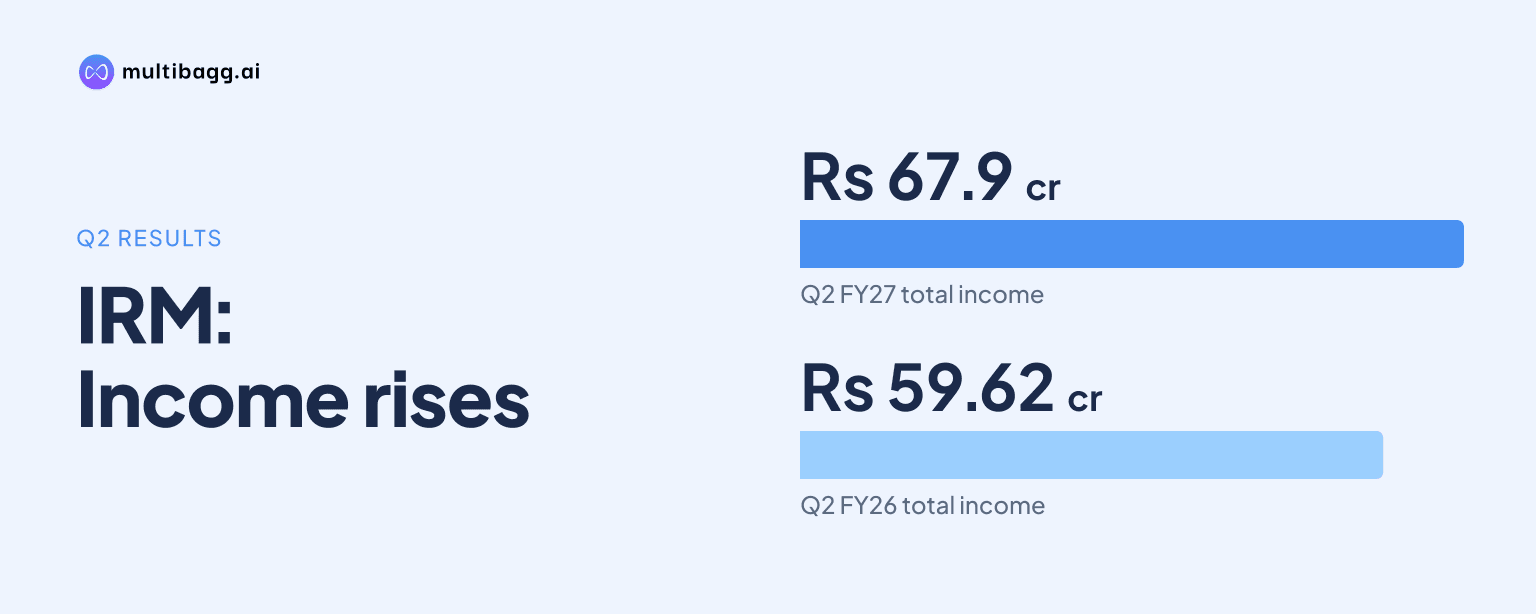
IRM Holdings’ Q2 FY27 profit after tax was Rs 5.15 crore, compared with Rs 5.25 crore a year earlier, even as total income rose 14% to Rs 67.9 crore; EBITDA increased to Rs 15.25 crore, while the detailed EBITDA margin eased to 22.46% from 23.19%.
Know IIRM Holdings India inside out
Results, valuation, peers and who's buying, in one view.
What were IRM’s Q2 FY27 financial results?
IRM’s Q2 FY27 total income rose from Rs 59.62 crore in Q2 FY26 to Rs 67.9 crore, while operating expenses increased from Rs 45.79 crore to Rs 52.66 crore. EBITDA consequently increased by Rs 1.43 crore to Rs 15.25 crore, but PAT declined by Rs 0.10 crore on the detailed quarterly statement. The presentation’s rounded Q2 highlights show PAT at Rs 5.2 crore in both periods.
IRM reported an EBITDA margin of 22.46% in Q2 FY27, compared with 23.19% in Q2 FY26, while its presentation rounds both periods to 23%. PAT margin was 8% in Q2 FY27 against 9% a year earlier. Higher income and EBITDA therefore did not translate into higher reported PAT in the quarter.
Why did IRM’s higher income not lift Q2 profit?
IRM’s quarterly figures show finance cost rose by Rs 2.62 crore year on year to Rs 4.69 crore in Q2 FY27, exceeding the Rs 1.43 crore increase in EBITDA. Depreciation and amortization fell from Rs 4.53 crore to Rs 3.89 crore, partly offsetting the higher finance cost, but PBT still declined from Rs 7.23 crore to Rs 6.66 crore.
Sequentially, Q2 FY27 was lower than Q1 FY27 on the reported quarterly figures. Total income moved from Rs 73.74 crore in Q1 FY27 to Rs 67.9 crore in Q2 FY27, EBITDA fell from Rs 18.32 crore to Rs 15.25 crore, and EBITDA margin declined from 24.84% to 22.46%. PAT moved from Rs 7.83 crore to Rs 5.15 crore, while finance cost increased from Rs 4 crore to Rs 4.69 crore.
What drove IRM’s premium growth and Q3 outlook?
IRM recorded 9% premium growth in Q2 FY27, compared with 2% growth in Q2 FY26, and management said this was broadly in line with overall industry growth of about 8%. Management attributed lower reported premium values and slower headline growth to lower Property premium rates. It identified Reinsurance and Personal Lines as the growth drivers despite that rate effect.
For Q3 FY27, management said growth momentum should continue with Reinsurance and Personal Lines leading the business. Management also said improved brokerage yields across most business lines supported Q2 profitability and should support stable earnings in Q3. This is management’s outlook rather than a numerical forecast, as the presentation gives no Q3 target for income, EBITDA or PAT.
Got a follow-up? Ask IRIS
What does IRM’s H1 FY27 performance show?
IRM’s H1 FY27 total income increased to Rs 141.64 crore from Rs 127.65 crore in H1 FY26, while EBITDA rose to Rs 33.56 crore from Rs 29.88 crore. PBT, however, fell to Rs 17.02 crore from Rs 17.57 crore, and PAT was nearly unchanged at Rs 12.98 crore compared with Rs 12.89 crore. The half-year results also show income and EBITDA growth without a comparable increase in bottom-line profit.
H1 FY27 premium growth was 14%, compared with 5.2% in H1 FY26, while revenue growth was 11% against 12% a year earlier. EBITDA margin improved to 24% from 23%, according to the presentation’s rounded half-year metrics. PAT margin declined to 9% from 10%, alongside finance cost rising from Rs 3.3 crore to Rs 8.69 crore.
How is IRM’s premium portfolio split by geography and business?
IRM’s H1 FY27 gross written premium mix was 97% India, 2% Sri Lanka and 1% Maldives. The underlying location-wise premium table shows India at Rs 403.7 crore, Sri Lanka at Rs 7.57 crore and Maldives at Rs 3.43 crore, for a total of Rs 414.7 crore in H1 FY27.
IRM’s H1 FY27 line-of-business mix was led by Reinsurance at 36%, followed by Health at 32% and Motor at 19%; Property and Engineering represented 8%. By strategic business unit, Commercial Lines accounted for 43% of premium, Reinsurance for 41% and Personal Lines for 16%. This portfolio mix provides context for management’s Q3 view that Reinsurance and Personal Lines should drive growth.
What regulatory timing could affect IRM’s operating context?
IRM said final regulations under the Insurance Regulatory and Development Authority of India consultation on recalibrating insurance-distribution economics are still awaited. Its view is that some moderation from the original proposals is expected, but it did not state a final outcome. The presentation identifies 1 January 2027 and 1 April 2027 as two plausible effective dates, while saying implementation timing remains uncertain.
The consultation covers mis-selling, customer outcomes, insurance penetration and distribution costs rising faster than premium growth. Broker feedback cited by IRM supports uniform principles but opposes identical prescriptions across life and non-life, corporate, retail and fintech models. IRM’s stated takeaway is that reform is likely to continue, with calibration, transition arrangements and the implementation date unresolved.
Conclusion
IRM’s Q2 FY27 result shows a split between operating growth and bottom-line performance: total income rose 14% to Rs 67.9 crore and EBITDA increased to Rs 15.25 crore, but PAT was Rs 5.15 crore versus Rs 5.25 crore a year earlier. H1 FY27 showed the same pattern, as total income reached Rs 141.64 crore while PAT was nearly unchanged at Rs 12.98 crore and finance cost increased.
The next disclosed points to watch are whether Reinsurance and Personal Lines deliver the Q3 growth momentum management expects and whether improved brokerage yields support stable earnings. Final insurance-distribution regulations also remain relevant, particularly their transition framework and whether implementation is set for 1 January 2027 or 1 April 2027.