










Isgec targets 15%-17% FY27 growth on Rs 8,757 crore orders
Key highlights
- Isgec expects standalone FY27 revenue growth of about 15%-17%.
- Standalone orders in hand reached a record Rs 8,757 crore at September 30, 2026.
- Standalone revenue from operations rose 35% year on year to Rs 3,010 crore in H1 FY27.
- Standalone net borrowings fell Rs 175 crore to Rs 206 crore during H1 FY27.
powered by IRIS
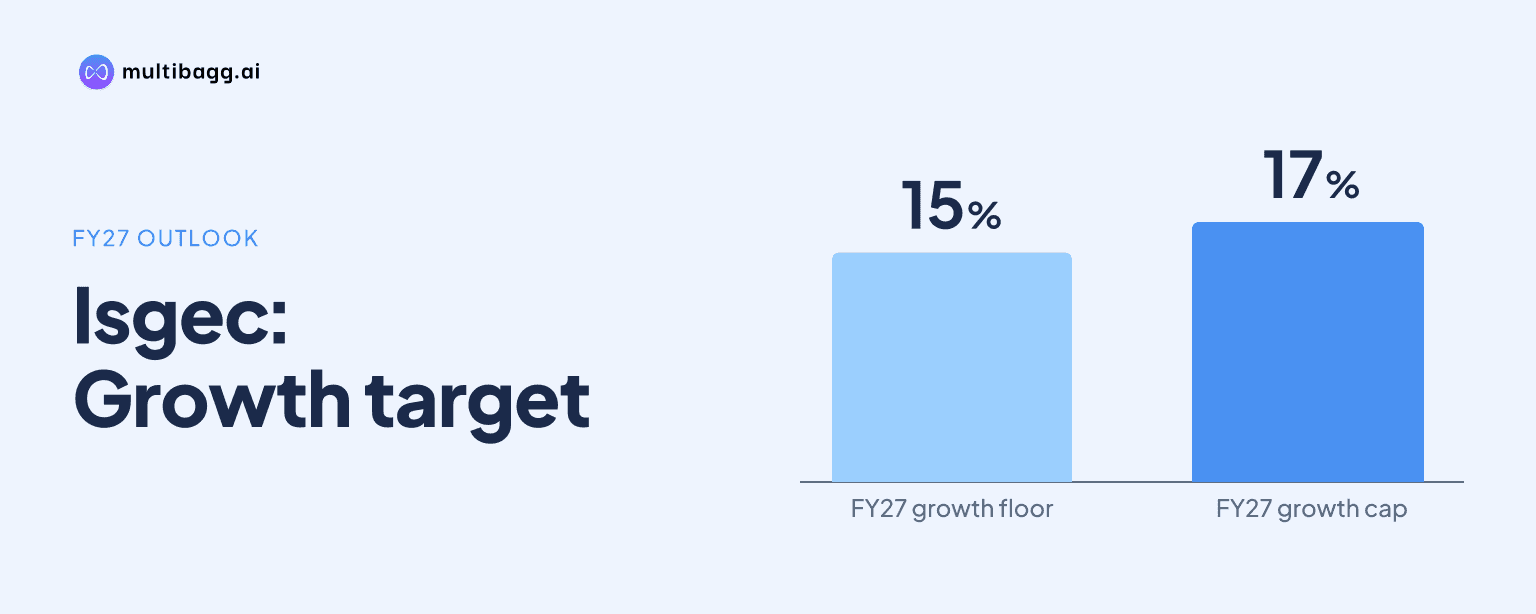
Isgec Heavy Engineering Limited expects standalone revenue to grow about 15%-17% in FY27, supported by a record Rs 8,757 crore order book at September 30, 2026 and Rs 3,010 crore of first-half revenue, up 35% year on year. Management said the outlook assumes modest second-half growth after a higher prior-year base.
Know ISGEC Heavy Engineering inside out
Results, valuation, peers and who's buying, in one view.
What supports Isgec’s FY27 revenue-growth target?
Isgec’s stated FY27 standalone revenue-growth target is 15%-17%, underpinned by orders in hand, new bookings and an expected contribution from added manufacturing capacity. The company booked Rs 4,844 crore of standalone orders in the six months ended September 2026, while revenue from operations reached Rs 3,010 crore. Management said domestic demand was strong across product lines and export enquiries from Latin America and Africa remained healthy.
Management explained that first-half growth does not mean a flat second half. In the prior year, standalone revenue was Rs 2,200 crore in the first half and Rs 3,000 crore in the second half. This year’s first-half revenue was already Rs 3,000 crore, and management said its 15%-17% outlook implies second-half revenue of about Rs 3,200 crore to Rs 3,300 crore. It described the current order book as providing visibility, while noting that revenue from many large first-half orders will primarily be recognised in later years.
How did standalone earnings and margins change?
Isgec’s standalone operating performance improved in the September 2026 quarter, with profit from business operations rising 38% to Rs 124 crore from Rs 90 crore a year earlier. This measure excludes subsidiary-related transactions, including dividends, interest on loans to subsidiaries, foreign-exchange movements on those loans and associated expected credit-loss provisions. Reported profit before tax, or PBT, rose 39% to Rs 154 crore from Rs 111 crore.
For the six months ended September 2026, profit from business operations increased 44% to Rs 244 crore from Rs 169 crore, while reported PBT increased 24% to Rs 277 crore from Rs 223 crore. The difference reflects the items excluded from the operational measure. Revenue from operations increased 17% in the quarter and 35% in the first half, while total income, including other income, was Rs 1,521 crore in the quarter and Rs 3,106 crore in the half year.
Manufacturing earnings before interest and tax, or EBIT, margin was 13.7% in the quarter, exceeding management’s earlier 12%-13% range. Projects EBIT margin was 5.7%, compared with management’s around-6% target by the end of FY27. Management linked the projects improvement to its approach of avoiding very long-duration work and pursuing shorter-cycle, technology-oriented projects rather than contracts dominated by civil works.
How large is Isgec’s order book and where is demand coming from?
Isgec’s standalone orders in hand reached an all-time high of Rs 8,757 crore at September 30, 2026, while consolidated orders in hand were Rs 10,273 crore. The standalone figure covers the company’s own business, whereas the consolidated figure includes subsidiaries. Management said execution was proceeding in both industrial projects and manufacturing, although the timing of converting the backlog into revenue depends on the nature and delivery schedules of individual orders.
Export revenue was Rs 172 crore in the September quarter, or about 11% of total income, versus Rs 90 crore in the same quarter of FY26. First-half export revenue rose to Rs 557 crore, or about 18% of total income, from Rs 425 crore a year earlier. Management expects exports to remain a significant part of revenue, but said the quarterly share may change with shipment timing.
At the consolidated level, management said products accounted for 38% of the order book, compared with the 25%-28% range cited by an analyst for earlier periods. Orders came from automobiles, oil and gas, petrochemicals, cement and steel, according to management. Isgec Hitachi Zosen had Rs 1,161 crore of orders in hand, including about Rs 800 crore of export orders, which adds to the consolidated product mix but is separate from Isgec’s standalone Rs 8,757 crore backlog.
Got a follow-up? Ask IRIS
What could affect Isgec’s margins and execution?
Isgec said geopolitical developments had not affected order booking or execution as of the November 5, 2026 call, but had raised some input costs and created a small adverse effect on profitability. Steel, copper, aluminium and nickel prices showed fluctuations of up to 10% during the quarter, though management said they had eased somewhat in October. The company expects to absorb most increased costs through normal contingency provisions.
Export and import logistics also faced delayed shipments, reduced ship and container availability, and higher freight rates and surcharges. Management reported no significant supply disruption, but these conditions can affect execution timing and costs. The weaker Indian rupee was described by management as supporting competitiveness in export markets, while the same export exposure means the share of overseas revenue can vary from quarter to quarter.
Isgec’s standalone net borrowings fell by Rs 175 crore in the first half to Rs 206 crore at September 30, 2026, from Rs 381 crore at March 31, 2026. That reduction came despite cumulative capital expenditure of Rs 199 crore on a planned Rs 502 crore manufacturing expansion, funded from internal accruals. Lower net borrowing changes the funding position, but management did not provide a further debt target for FY27.
How will manufacturing expansion affect Isgec’s growth?
Isgec expects its Rs 502 crore manufacturing-capacity programme to contribute to growth, with some new facilities progressively completing during FY27. The programme covers presses and machine building at Bhartoli in Haryana, skids and modules at Dahej in Gujarat, casting-factory capacity and machining, tube and piping shops at Rattangarh, and standard mechanical presses at Bawal. Management said these projects were largely on schedule.
Management expects only a small contribution, below Rs 100 crore, from the expansion during the current year. It expects the major revenue contribution in the following year and the year after that. In the call, management said the programme should support about Rs 1,200 crore of additional revenue, though this is a management expectation rather than reported revenue.
The company is also taking certain orders in anticipation of the expansions being completed. Management said it did not see significant delays in customer commitments at that point, because the facilities were largely on schedule. This links a portion of backlog execution to commissioning progress, making the timing of the new production lines relevant to the later-year revenue opportunity.
Conclusion
Isgec’s FY27 15%-17% standalone growth outlook rests on measurable first-half momentum: revenue from operations rose 35% to Rs 3,010 crore, business-operating profit rose 44% to Rs 244 crore, and orders in hand reached Rs 8,757 crore. Manufacturing margins of 13.7% and projects margins of 5.7% show improvement across both major standalone businesses, while net borrowings declined to Rs 206 crore.
The next items to watch are the pace of second-half revenue toward management’s Rs 3,200 crore to Rs 3,300 crore indication, manufacturing capacity commissioning during FY27, and the effect of commodities and freight on margins. Management also expects a larger share of the Rs 1,200 crore potential expansion-led revenue to arrive in the following two years, rather than in the current year.