








IVP footwear contributes 60-65% of disclosed revenue mix
MAX Plan at ₹4,999/yr

Find your next multibaggerBe a Pro Investor
Research stocks and track your picks on the go. Download the app.
Key highlights
- IVP reports footwear polyurethane at 60-65% of disclosed revenue contribution.
- Foundry applications contribute 30-40%, while flexible-packaging adhesives contribute 5-10%.
- Tarapur has stated installed capacity of 50,000 tonnes per annum on a 12-acre site.
- Bengaluru manufactures foundry coatings and has stated capacity of 500 tonnes per month.
powered by IRIS
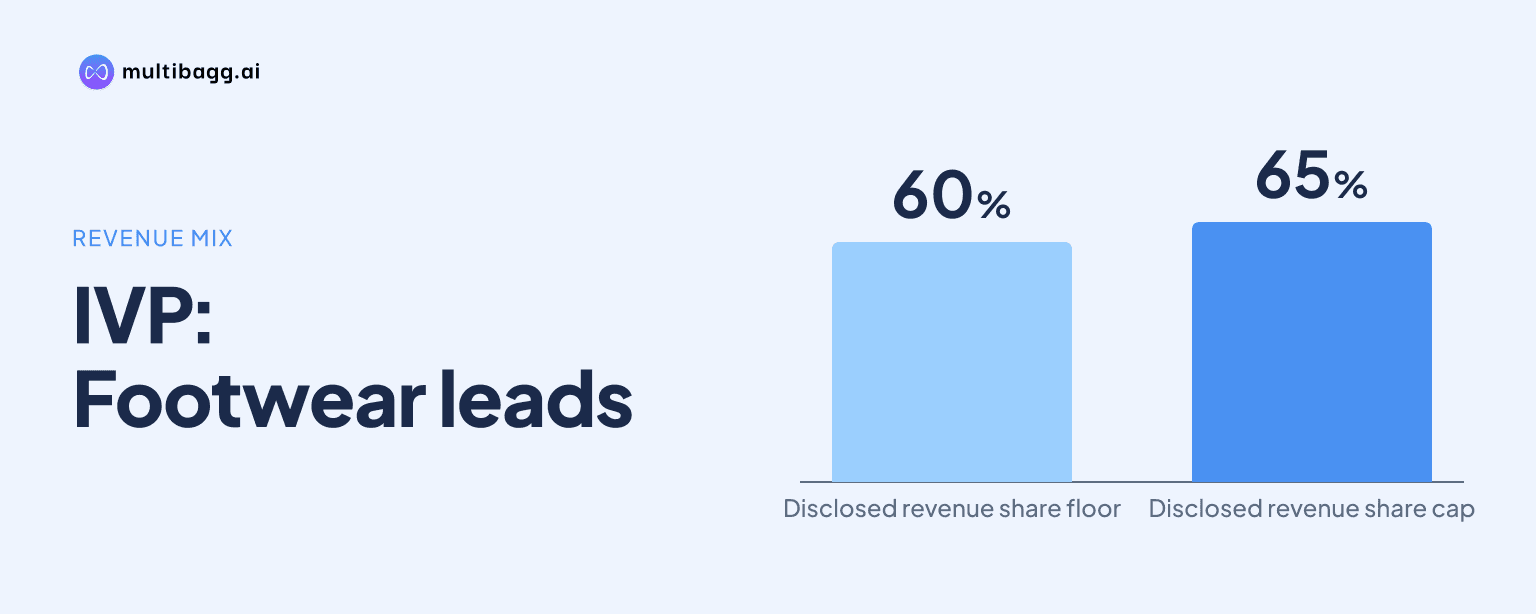
In its investor presentation, IVP Limited reports that footwear polyurethane contributes 60-65% of its disclosed revenue mix, compared with 30-40% for foundry applications and 5-10% for flexible-packaging adhesives. The disclosed ranges place shoe-sole foam solutions at the centre of IVP’s two core chemicals verticals and application mix.
Know IVP inside out
Results, valuation, peers and who's buying, in one view.
What is IVP's revenue mix by application?
IVP’s disclosed application mix is led by footwear solutions at 60-65%, followed by foundry applications at 30-40% and flexible packaging at 5-10%. The presentation identifies Phenolic Resins and Polyurethane Resins as its two core business verticals and provides these three revenue-contribution ranges within that structure.
The footwear range is at least 20 percentage points above foundry’s 40% upper end and at least 50 percentage points above flexible packaging’s 10% upper end. The three ranges add to 95-115% rather than one fixed total, so IVP does not provide a precise reconciled split, segment revenue amount or reporting period for the application figures.
What does IVP supply to footwear manufacturers?
IVP supplies polyurethane, or PU, foam solutions primarily for footwear, describing materials intended for different types of shoes. Its clientele slide labels the offer as “PU System for Shoe – Soles”, connecting the 60-65% contribution range to shoe-sole applications.
IVP names aeroblu, Ajanta Shoes, Bairathi, Condor and Tata International in its PU-system-for-shoe-soles clientele list. The presentation does not disclose sales by any of these five companies, contract durations, order values or the percentage of footwear revenue associated with an individual customer.
IVP entered the polyurethane market in 2018, according to its corporate timeline. That followed the 2017 modernisation of its Tarapur and Bengaluru plants, which included a new coating plant at Tarapur and enhanced research and development to broaden the chemical portfolio.
How large is IVP's flexible-packaging adhesives business?
IVP’s flexible-packaging PU adhesives contribute 5-10% of disclosed revenue, making flexible packaging the smallest of the three application categories shown. The product range includes solventless and solvent-based two-component adhesive systems and solventless one-component adhesives for laminating flexible packaging materials.
The adhesive systems are used with combinations of printed, plain and metallised plastic films, aluminium foils and paper. IVP launched polyurethane adhesives for flexible food packaging in 2019, one year after its 2018 polyurethane-market entry.
IVP lists Amcor, Constantia Flexibles, Shrinath Rotopack, Plasto and Oswal Extrusion in its PU-adhesives-for-flexible-film-packaging clientele list. The presentation does not state which adhesive type each of the five companies buys, nor does it disclose a revenue-growth target for the 5-10% application category.
Got a follow-up? Ask IRIS
What does IVP's foundry business contribute?
IVP’s foundry applications contribute 30-40% of disclosed revenue, placing them between footwear and flexible packaging in the presentation’s application mix. The business uses phenolic resins in moulds and cores for metal-casting processes, with the presentation citing thermal stability, mechanical strength and resistance to moisture and chemicals.
The product-offerings page includes foundry chemicals, refractory and powder resin, composites and insulation alongside footwear and flexible packaging. IVP’s timeline records progressive expansion into foundry chemicals from 1974 to 1989, followed by the discontinuation of the Jamshedpur foundry-chemicals business during 2006-2013 as it focused on core chemical products.
IVP names Tata Steel, Ashok Leyland, Nelcast, Texmaco Rail & Engineering and Sanmar in its foundry clientele list. Its Bengaluru facility manufactures foundry coatings for metal castings and has stated production capacity of 500 tonnes per month, identifying coatings as part of the foundry manufacturing footprint.
Where does IVP manufacture its chemicals?
IVP operates two manufacturing sites, at Tarapur and Bengaluru, and states annual production capacity of 50,000 tonnes across more than 150 products. The company profile also reports more than 200 employees and more than 500 clients, without allocating capacity, employees or clients between footwear, foundry and flexible-packaging applications.
Tarapur Industrial Area produces foundry binders, coatings and polyurethane on a 12-acre site with 50,000 tonnes per annum of installed capacity. IVP lists steam boilers, thermic heaters, tank farms, a nitrogen plant, power generation, water reuse and effluent-management systems at the site.
Bengaluru Industrial Sector manufactures foundry coatings for metal castings with stated capacity of 500 tonnes per month. IVP lists a warehouse, tank farm, hydrant system and dust-extraction equipment there, alongside initiatives to reduce the plant’s environmental footprint and improve health, safety and environment practices.
What management-system certifications cover IVP's operations?
IVP holds International Organization for Standardization, or ISO, 9001:2015, ISO 14001:2015 and ISO 45001:2018 management-system certifications from Intertek. The certifications cover business development, supply-chain management and logistics controls for coating chemicals, binder resins and polymer resins.
All three certificates were issued on 22 May 2024 and are valid until 21 March 2027, with an initial certification date of 22 March 2012 and a certificate decision date of 1 February 2023. The presentation does not provide product-level certification status for footwear foam, flexible-packaging adhesives or specific foundry materials.
Conclusion
IVP’s presentation shows an application mix concentrated in footwear polyurethane at 60-65% of disclosed revenue contribution, with foundry applications at 30-40% and flexible-packaging adhesives at 5-10%. Tarapur combines polyurethane production with foundry binders and coatings, while Bengaluru is dedicated to foundry coatings with capacity of 500 tonnes per month.
The next disclosed date to watch is 21 March 2027, when IVP’s ISO 9001:2015, ISO 14001:2015 and ISO 45001:2018 certificates are due to expire. The presentation records the 2018 PU entry and 2019 flexible-packaging adhesive launch, but does not disclose segment margins, a capacity-expansion schedule, a growth target or a more precise revenue split.

