










JFL: Domino’s India LFL reaches 4.1% on delivery growth
Key highlights
- JFL’s Domino’s India LFL growth rose to 4.1% in Q2FY27 from 2.5% in Q1FY27 and 0.2% in Q4FY26.
- Domino’s India revenue increased 9.2% year on year to ₹1,792.2 crore, while delivery revenue grew 11.3%.
- DITA revenue rose 2.4% year on year, and upgrades were completed at about 20% of identified DITA-heavy stores.
- JFL added 108 net stores in Q2FY27 and ended the quarter with 3,820 stores worldwide.
powered by IRIS
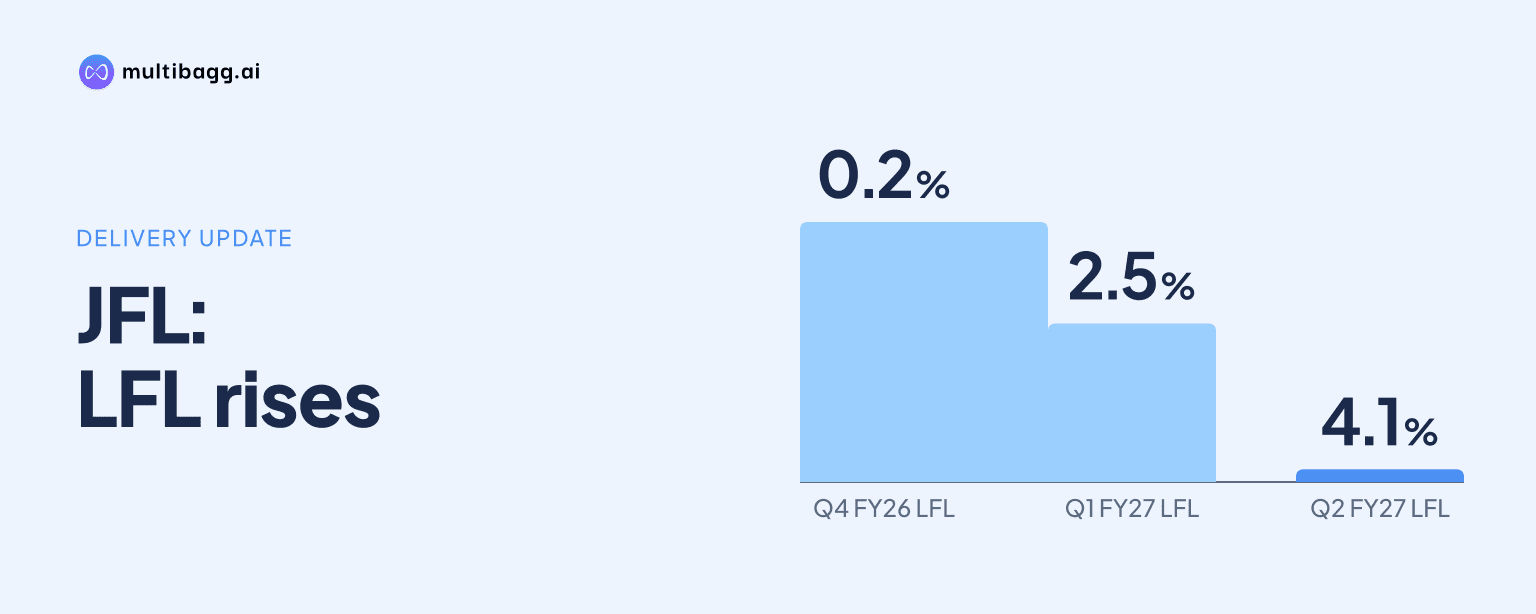
In Q2FY27, Jubilant FoodWorks Limited lifted Domino’s India like-for-like (LFL) sales growth to 4.1%, from 2.5% in Q1FY27 and 0.2% in Q4FY26, supported by 11.3% growth in delivery revenue, late-night service at more than 90% of the network and 2.4% Dine-In and Takeaway (DITA) revenue growth.
Know Jubilant Foodworks inside out
Results, valuation, peers and who's buying, in one view.
Why did Domino’s India LFL growth reach 4.1%?
Domino’s India’s LFL growth reached 4.1% because delivery momentum continued while DITA showed early recovery. Revenue grew 9.2% year on year to ₹1,792.2 crore in Q2FY27, and orders increased 6.3%. JFL calculates Domino’s India LFL on 1,797 stores opened before the prior financial year, after excluding split stores.
The result improved across three reported quarters. LFL growth rose from 0.2% in Q4FY26 to 2.5% in Q1FY27 and 4.1% in Q2FY27. Average daily sales (ADS) were ₹81,400 in Q2FY27, lower than ₹82,200 in Q1FY27 but above ₹78,200 in Q2FY26.
Delivery was the larger growth contributor in Q2FY27, with revenue rising 11.3% year on year and representing 75.8% of Domino’s India revenue. That rate exceeded the brand’s 9.2% overall revenue growth, while DITA revenue increased 2.4%, showing that the recovery was led by delivery rather than the store-based channel.
How is late-night delivery supporting Domino’s India growth?
Late-night delivery is supporting incremental orders by opening another consumption occasion, with more than 90% of Domino’s India’s network serviceable until 3 AM in Q2FY27. JFL said it expanded the late-night offering over the preceding six to nine months and identified the day-part as a strong performer during the quarter.
Product launches added to sales per order in Q2FY27. JFL said beverage and dessert launches in Q1FY27 improved attachment rates, while menu mix supported higher bills per order. The Maxxx range, Double Cheese Burst, Cold Coffee and Mousse broadened the menu, and management said Cold Coffee and Mousse are margin-accretive products that raise sides attachment.
Network expansion also added sales capacity. Domino’s India added 88 net stores in Q2FY27, taking the estate to 2,601 stores across 587 cities, including entry into 47 new cities during the quarter. The reported 4.1% LFL growth measures the comparable estate, separating it from sales generated by new stores.
Domino’s India gross margin was 75.8% in Q2FY27, compared with 74.6% in Q2FY26 and 75.9% in Q1FY27. The year-on-year gain was 121 basis points, while the sequential movement was a decline of 10 basis points. A basis point is one-hundredth of a percentage point.
Is the DITA turnaround gaining traction?
The DITA turnaround is gaining early traction, with channel revenue growing 2.4% year on year in Q2FY27. JFL said the programme centres on improving experiences in stores with higher DITA potential, upgrading infrastructure, improving takeaway value relative to delivery, and using customer relationship management and local-store marketing for dine-in demand.
JFL had completed infrastructure upgrades at about 20% of identified DITA-heavy stores by Q2FY27 and plans upgrades in more than 100 stores. It is also expanding artificial-intelligence-enabled surveillance for guest service, cleanliness, footfall tracking and bill compliance, which are operating measures within the store turnaround plan.
My Meal at ₹119 was rolled out nationally, while certain best-value offers were reserved for in-store takeaway. JFL said those propositions are helping drive incremental store footfall and improve ticket size. Management said its FY27 priority is to build a stronger DITA foundation, noting that restoring customer habits and the in-store experience takes time.
Management has described a 5% to 7% medium-term LFL range for Domino’s India. The 4.1% Q2FY27 outcome was below that range, although it improved by 1.6 percentage points from Q1FY27. JFL did not disclose a date by which it expects to reach the stated range.
Got a follow-up? Ask IRIS
How does Domino’s India compare with JFL’s other businesses?
Domino’s India remained JFL’s largest disclosed India brand in Q2FY27, reporting revenue of ₹1,792.2 crore against ₹75.9 crore for Popeyes. Popeyes grew revenue 121.9% year on year and recorded 53.0% LFL growth, but ended the quarter with 99 stores, compared with Domino’s India’s 2,601 stores.
Popeyes added 11 stores in Q2FY27 and reported system ADS of ₹90,300, above Domino’s India ADS of ₹81,400. Popeyes gross margin rose 149 basis points year on year to 68.5%, compared with Domino’s India’s 75.8%. Management said it aims to build Popeyes into a ₹1,000 crore brand over the next three to four years.
At the standalone level, JFL reported revenue growth of 11.5% to ₹1,885 crore in Q2FY27. Earnings before interest, tax, depreciation and amortisation (EBITDA) rose 12.4% to ₹372.4 crore, and EBITDA margin expanded 16 basis points to 19.8%; profit after tax margin, however, declined 14 basis points to 3.8%.
JFL attributed a 110-basis-point expansion in standalone gross margin to 75.5% partly to sourcing efficiencies, despite about 200 basis points of pressure from liquefied petroleum gas, minimum wages and raw-material costs. Its stated response includes procurement measures, calibrated pricing, menu mix management, reduced wastage, personalised discounts and technology-led operating efficiencies.
What do JFL’s cash flow and investment plans show?
JFL’s consolidated free cash flow to firm rose 22.2% year on year to ₹154.7 crore in H1FY27, from ₹126.6 crore in H1FY26. Cash flow from operations increased to ₹641.5 crore from ₹606.6 crore over the same period, with both measures reported after repayment of lease liabilities under Ind AS 116.
Standalone free cash flow to firm increased 21.8% to ₹23.1 crore in H1FY27, compared with ₹19 crore a year earlier. JFL defines free cash flow to firm as cash flow from operations minus net capital expenditure on a cash basis rather than an accrual basis.
Management retained annual capital-expenditure guidance of ₹750 crore to ₹900 crore for FY27 and the next few years, focused on network expansion and technology. JFL said its supply-chain backend is designed for 4,500 to 5,000 stores, against the group’s 3,820 worldwide stores at the end of Q2FY27 after 108 net additions in the quarter.
Conclusion
JFL’s Q2FY27 figures show a Domino’s India recovery led by 11.3% delivery revenue growth and supported by 4.1% LFL growth, up from 2.5% in Q1FY27. DITA has returned to 2.4% revenue growth, but it remains below delivery’s rate and only about 20% of identified DITA-heavy stores had completed infrastructure upgrades.
The next disclosures should show whether DITA upgrades progress beyond the 20% completed level, whether more than 90% late-night serviceability continues to generate incremental orders, and how quickly Domino’s India approaches management’s 5% to 7% medium-term LFL range. JFL also plans annual capital expenditure of ₹750 crore to ₹900 crore for FY27 and subsequent years, principally for expansion and technology.