










Jubilant FoodWorks defers faster Popeyes rollout for profits
Key highlights
- Popeyes delivered 53.0% like-for-like growth in Q2FY27, its fourth consecutive quarter above 40%.
- Popeyes revenue grew 121.9% year on year to Rs 75.9 crore in Q2FY27.
- Popeyes added 11 stores in Q2FY27, ending the quarter with 99 stores in 25 cities.
- Popeyes gross margin increased 150 basis points year on year to 68.5% in Q2FY27.
powered by IRIS
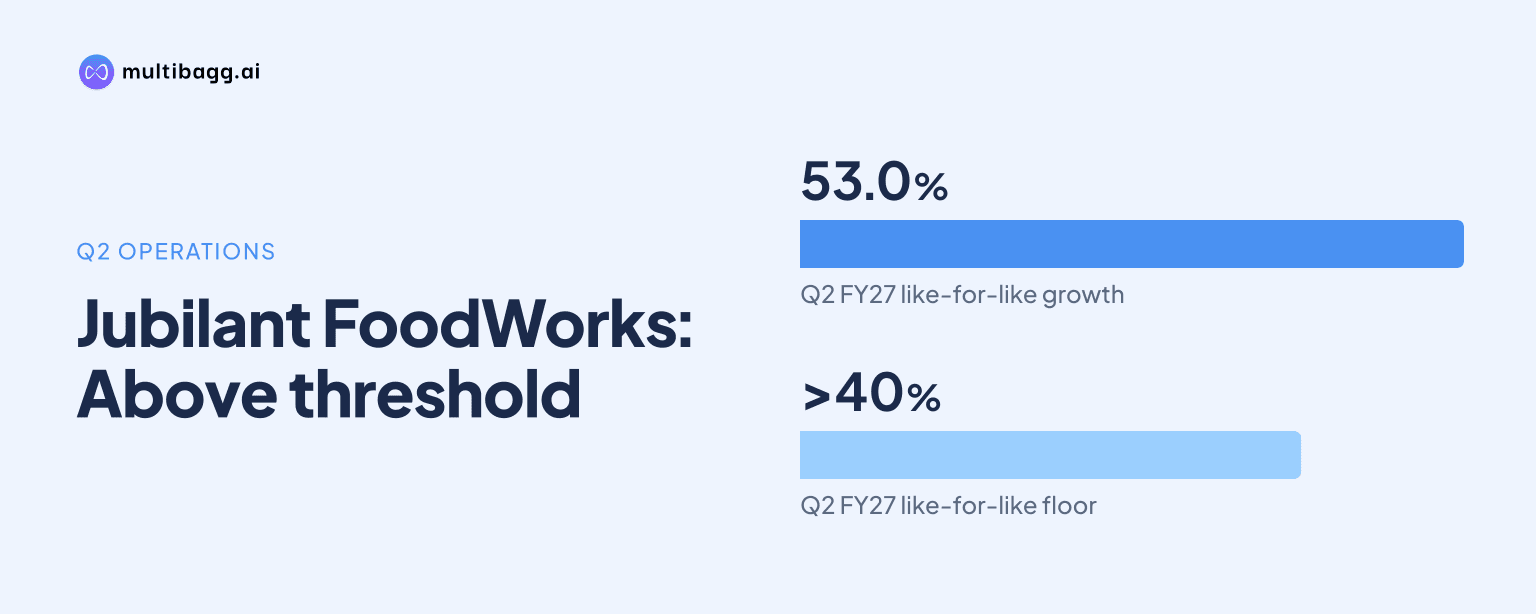
Jubilant FoodWorks reported 53.0% Popeyes like-for-like growth in Q2FY27, but will defer a faster rollout until brand-level profitability improves and new stores meet return thresholds. Popeyes revenue rose 121.9% year on year to Rs 75.9 crore, while the network added 11 stores to reach 99 locations.
Know Jubilant Foodworks inside out
Results, valuation, peers and who's buying, in one view.
Why is JFL delaying faster Popeyes store openings?
JFL is delaying a faster Popeyes rollout because brand-level profitability is not yet achieved, despite 53.0% like-for-like growth in Q2FY27. Management said expansion will be assessed against customer experience, gross margin, store productivity and unit economics in the markets where Popeyes operates, rather than sales growth alone.
Management said Popeyes’ system average daily sales, or ADS, were broadly comparable with established players in most markets, but still had headroom to rise. It also said the brand’s gross margin was approaching the range in which the industry operates, while retaining an indicated 200 to 300 basis points of further opportunity.
The network reached 99 stores in 25 cities at the end of Q2FY27, compared with 88 stores at the end of Q1FY27 and 68 a year earlier. Management said each new store must be located in the right micro-market, maintain store-level economics and meet JFL’s return thresholds before the company increases the pace of openings.
How quickly did JFL’s Popeyes business grow in Q2FY27?
JFL’s Popeyes business delivered 53.0% like-for-like, or LFL, growth in Q2FY27, its fourth consecutive quarter above 40%. LFL growth increased from 45.1% in Q1FY27 and 24.5% in Q2FY26, while revenue grew 121.9% year on year to Rs 75.9 crore.
Revenue rose from Rs 34.2 crore in Q2FY26 and Rs 70.3 crore in Q1FY27, reflecting both comparable-store sales growth and a larger network. The brand added 11 stores during Q2FY27 and 31 over the preceding 12 months, ending the quarter with 99 stores.
System ADS reached Rs 90,300 in Q2FY27, up from Rs 60,500 a year earlier but down from Rs 96,100 in Q1FY27. Popeyes calculates ADS at the system level, while its LFL measure covers stores opened before the previous financial year, so the two measures capture different parts of the operating base.
Popeyes gross margin rose 150 basis points year on year to 68.5% in Q2FY27, from 67.0% in Q2FY26. The margin was also 120 basis points above 67.3% in Q1FY27, although management said the brand had not yet reached brand-level profitability.
How does JFL’s Popeyes scale compare with Domino’s India?
JFL’s Popeyes grew faster than Domino’s India in Q2FY27 but remained much smaller in revenue and store count. Popeyes generated Rs 75.9 crore of revenue and operated 99 stores, while Domino’s India generated Rs 1,792.2 crore and operated 2,601 stores.
Popeyes reported Rs 90,300 in system ADS and 53.0% LFL growth in Q2FY27. Domino’s India reported ADS of Rs 81,400 and LFL growth of 4.1%; however, its ADS and LFL calculations applied to 1,797 qualifying stores opened before the prior financial year and excluded split stores.
Domino’s India added 88 stores in Q2FY27, compared with 11 additions for Popeyes. Its network reached 587 cities after entering 47 new cities during the quarter, whereas Popeyes was present in 25 cities, showing the different scale and maturity of JFL’s two Indian restaurant businesses.
Domino’s India revenue grew 9.2% year on year in Q2FY27, while Popeyes revenue grew 121.9% from a lower base. Management described Popeyes as a meaningful second growth engine, but said the operating priority was to convert customer acceptance and sales momentum into a profitable national network.
Got a follow-up? Ask IRIS
What is JFL’s plan to make Popeyes profitable?
JFL’s plan is to close the Popeyes margin gap, improve store-level unit economics and then expand faster from a profitable network. Management said brand-level profitability was “within sight” in Q2FY27, but had not yet been reached, making it a stated condition for accelerated expansion.
The company said it had optimised capital expenditure, staffing and other operating costs at Popeyes. It expects further unit-economics improvement from scale and greater store density, including lower delivery cost per order as more locations are added within operating markets.
JFL also plans to extend smart order batching to Popeyes in the coming months. The mechanism, already deployed across the Domino’s network, combines orders placed within minutes of each other for nearby addresses under one rider, which management said reduces delivery times and cost per delivery.
Product additions in Q2FY27 included five Paneer Burger flavours in the vegetarian range and the Choco Bomb chocolate dessert. Management linked product innovation, the 150-basis-point gross-margin expansion and operational changes to improving unit economics, while retaining its ambition to build Popeyes into a Rs 1,000 crore brand over the next three to four years.
What does JFL’s financial position mean for Popeyes expansion?
JFL’s wider financial performance provides cash generation and planned capital expenditure for expansion, but management continues to state that returns will guide allocation. Consolidated revenue grew 11.8% year on year to Rs 2,607.9 crore in Q2FY27, while earnings before interest, tax, depreciation and amortisation, or EBITDA, increased 7.3% to Rs 513.1 crore.
Standalone revenue grew 11.5% to Rs 1,885 crore in Q2FY27, and adjusted EBITDA rose 12.1% to Rs 233.2 crore. Standalone gross margin expanded 110 basis points to 75.5%, while the adjusted EBITDA margin increased 6 basis points to 12.4%.
Consolidated free cash flow to firm increased 22.2% year on year to Rs 154.7 crore in H1FY27, compared with Rs 126.6 crore in H1FY26. JFL defines free cash flow to firm as cash flow from operations after lease-liability repayment, less net capital expenditure on a cash basis.
Management kept annual capital-expenditure guidance unchanged at Rs 750 crore to Rs 900 crore for FY27 and the next few years, with spending focused on network expansion and technology. It also said its backend capacity was designed to support 4,500 to 5,000 stores, allowing utilisation to rise as the network expands.
Conclusion
Popeyes’ Q2FY27 performance shows rapid sales growth, with 53.0% LFL growth, Rs 75.9 crore of revenue and a 68.5% gross margin. JFL’s stated framework nevertheless places greater weight on closing the remaining margin gap, achieving brand-level profitability and meeting store-return thresholds than on matching demand momentum with faster openings.
The next indicators are whether Popeyes captures the management-indicated 200 to 300 basis points of gross-margin opportunity and progresses toward its Rs 1,000 crore ambition over three to four years. Investors can also watch the planned extension of smart order batching to Popeyes in coming months and the pace of store additions beyond the 99 locations reported at Q2FY27-end.