








Jinkushal Industries Limited uses an asset-light export model
MAX Plan at ₹4,999/yr

Find your next multibaggerBe a Pro Investor
Research stocks and track your picks on the go. Download the app.
Key highlights
- JKIPL reported Rs 187.06 crore of export value for the period ended 30 September 2026.
- JKIPL's sourcing network includes 250+ suppliers and seven designated refurbishment centres in India and the UAE.
- JKIPL operates a 60,000-square-foot refurbishment workshop with an in-house workforce of 77+.
- JKIPL launched its proprietary HexL backhoe-loader brand in 2024 using contract manufacturing.
powered by IRIS
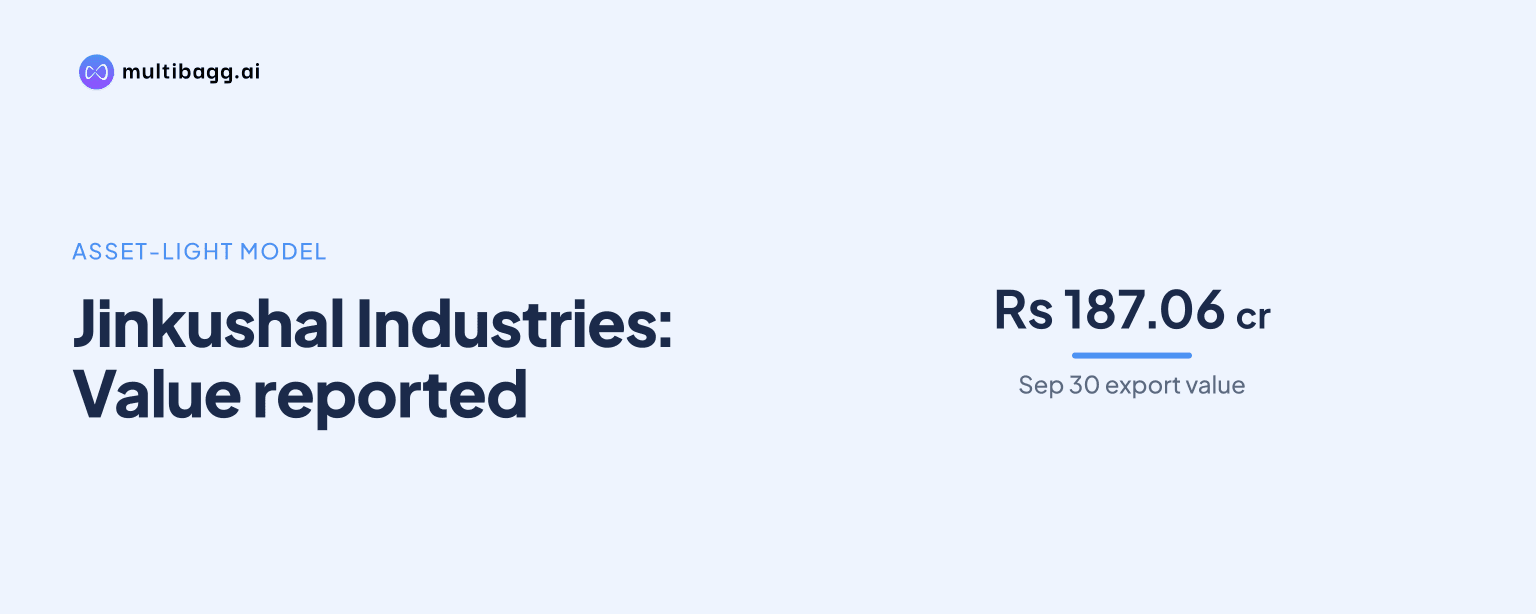
Jinkushal Industries Limited uses an asset-light construction-equipment export model, reporting Rs 187.06 crore of export value for the period ended 30 September 2026 while using contract manufacturing for HexL, refurbishment partners, 250+ suppliers and seven designated centres in India and the UAE. JKIPL combines new, refurbished and own-brand machinery sales without owning heavy manufacturing capacity.
Know Jinkushal Industries inside out
Results, valuation, peers and who's buying, in one view.
How does JKIPL combine new, used and own-brand equipment?
JKIPL combines three export verticals: new or customised construction equipment, fully refurbished construction equipment and HexL-branded backhoe loaders. Construction equipment includes machinery used in infrastructure, mining, agriculture and urban-development projects, with the wider portfolio spanning excavators, wheel loaders, bulldozers, cranes, motor graders, compactors and asphalt pavers. The new-machine vertical tailors equipment to client specifications, while the used-equipment vertical exports machinery that JKIPL describes as refurbished to as-good-as-new quality.
The three verticals use a shared sourcing, refurbishment, customisation and after-sales framework rather than separate product systems. JKIPL says its platform covers the value chain from sourcing through accessories, spare parts and technical support. This arrangement gives customers access to multiple equipment types and configurations, including machinery sourced from original equipment manufacturers such as Volvo, Komatsu, Hyundai, Hitachi, JCB, CAT and Kobelco, alongside HexL backhoe loaders launched in 2024.
The difference between the verticals is the starting point of the machine. New and customised machines are exported to stated customer specifications, refurbished machines enter the model as used equipment requiring specialised preparation, and HexL is JKIPL's proprietary brand. The HexL launch in 2024 added a product line produced to JKIPL specifications, rather than changing the multi-brand sourcing model used for other equipment categories.
How does JKIPL keep construction-equipment exports asset-light?
JKIPL keeps the HexL manufacturing model asset-light by using outsourced contract manufacturing rather than building a heavy factory. Contract manufacturers produce HexL machines to JKIPL specifications, which the company says avoids major factory capital expenditure. JKIPL retains responsibility for quality checks and continuing product improvement, including custom features and safety enhancements, even though production is outsourced.
The same asset-light principle extends to refurbishment. JKIPL has a 60,000-square-foot refurbishment workshop with an in-house workforce of 77+, but it also uses a partner network and third-party refurbishment arrangements. The company says the refurbishing model can be scaled by engaging additional workshops, creating capacity beyond the company-operated workshop without requiring equivalent fixed infrastructure at every location.
This combination means JKIPL owns and operates a defined refurbishment capability while relying on partners for broader manufacturing and refurbishing capacity. The seven designated centres in India and the UAE support the network model, and the 250+ supplier base provides equipment sourcing breadth. In contrast with a fully integrated manufacturer, JKIPL's stated approach places technical control, supplier coordination and customer specifications at the centre of operations.
Got a follow-up? Ask IRIS
How do JKIPL's supply chain and digital systems support the model?
JKIPL supports its export model through a supply-chain process that runs from preparation and loading to transportation to port, customs clearance, port handling, shipping documentation, sailing and payment terms, final inland transport, and destination import and delivery. This eight-stage sequence connects equipment procurement and refurbishment with cross-border delivery. It is particularly relevant to an exporter serving 35+ countries across the Middle East, Europe, Africa, Latin America and South-East Asia.
Digital operations are intended to manage inventory, order tracking and supply-chain management across those stages. JKIPL says it has implemented modern information-technology systems to reduce cycle times and costs, though the presentation does not quantify a reduction. The operational mechanism is that equipment, orders and logistics activity can be tracked through the same system while physical work is distributed among suppliers, workshops, ports and local partners.
JKIPL also identifies after-sales parts and support as part of its end-to-end offer. This links the supply chain to repeat-service needs after delivery, rather than limiting the model to a one-time machinery export. The company reports 85+ customers in total to date, while regional hubs include Hexco Global in Dubai for the Middle East and Africa and Hexco Global in the USA for the Americas.
What gives JKIPL's refurbishment network technical control?
JKIPL says it applies specialised refurbishment processes and quality checks so that refurbished machines meet performance and safety standards. The company-operated 60,000-square-foot workshop and 77+ in-house workforce provide a direct operating base, while designated centres and partner workshops provide additional reach. This is the mechanism through which JKIPL seeks to combine a used-equipment export business with its stated as-good-as-new refurbishment standard.
Technical control also applies to HexL, despite the use of contract manufacturing. JKIPL states that it enforces quality checks and research and development activity, including ongoing product improvements, custom features and safety enhancements. Thus, the company separates physical production from product specifications and inspection: contract manufacturers build the backhoe loaders, while JKIPL defines the requirements for the HexL brand introduced in 2024.
The model's commercial reach is larger than the refurbishment footprint alone. JKIPL reported Rs 187.06 crore in export value for the period ended 30 September 2026, and its products reach 35+ countries. Local dealers and customers extend last-mile distribution and support, adding another partner layer after the seven designated refurbishment centres and the 250+ supplier sourcing network.
Conclusion
JKIPL's business model joins three equipment verticals with outsourced HexL manufacturing, a 250+ supplier base, third-party refurbishment capacity and an in-house 60,000-square-foot workshop staffed by 77+ people. The structure allows the company to offer new, customised, refurbished and own-brand equipment while keeping manufacturing capacity outside a heavy factory ownership model.
The next operating point to watch is execution of JKIPL's stated ability to scale refurbishment by engaging additional workshops, alongside its plan to add categories such as electric machinery and advanced pavers as markets evolve. The company has also built a seven-centre refurbishment network in India and the UAE, making the expansion of that network and support for customers across 35+ countries relevant measures of how the model develops.

