










Jio reaches 300 million 5G users as traffic share hits 56%
Key highlights
- Jio had 300 million 5G users as of September 2026, up 66 million from a year earlier.
- 5G carried about 56% of Jio’s wireless traffic, while total quarterly data traffic reached 71.3 billion GB in 2Q FY27.
- Jio’s customer base rose to 542.4 million and monthly ARPU increased to Rs 218.8 in 2Q FY27.
- Revenue from operations increased 11.4% to Rs 40,475 crore, while EBITDA rose 16.6% to Rs 21,879 crore in 2Q FY27.
powered by IRIS
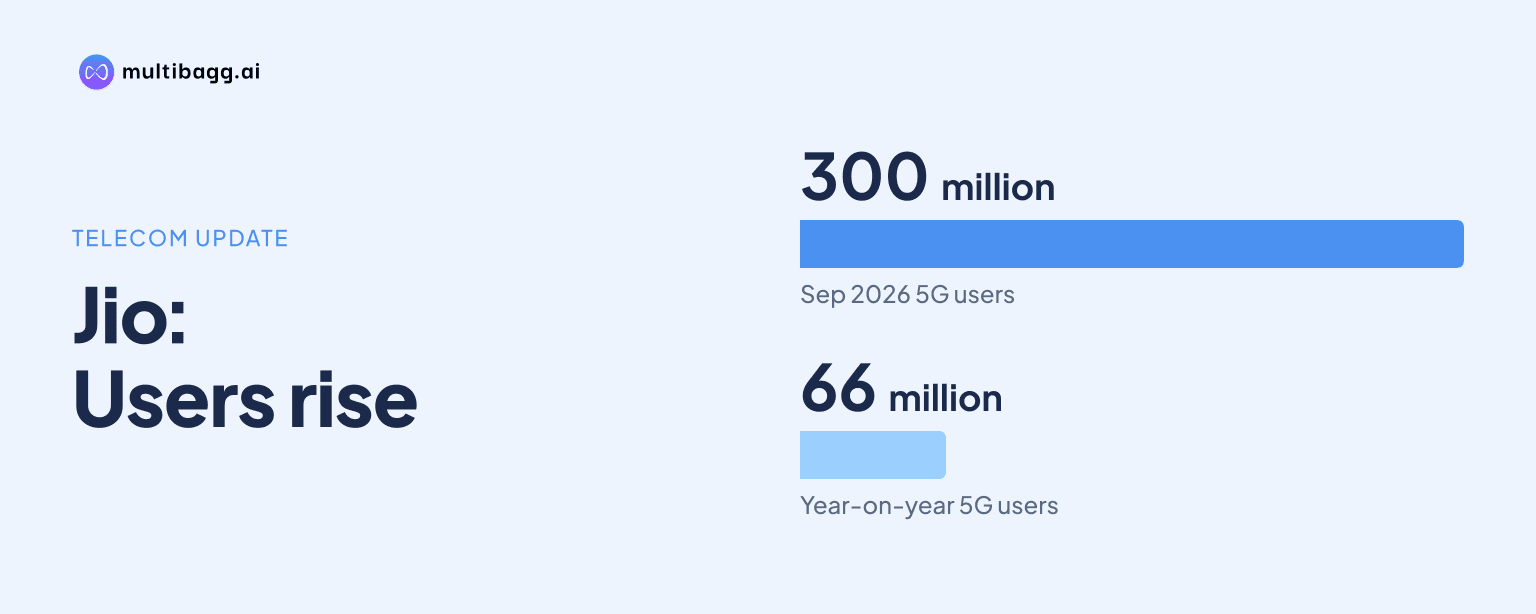
Jio Platforms Limited reported 300 million 5G users as of September 2026, 66 million more than a year earlier, with 5G accounting for about 56% of total wireless traffic. The milestone coincided with a 542.4 million customer base, quarterly data traffic of 71.3 billion GB and 22.1% year-on-year traffic growth in 2Q FY27.
Know Jio Platforms inside out
Results, valuation, peers and who's buying, in one view.
How many 5G users does Jio have?
Jio had 300 million 5G users as of September 2026, after adding 66 million users over the preceding 12 months. The company described this as an extension of its leadership in the 5G subscriber base, but did not disclose separate 5G revenue, average revenue per user or regional distribution.
The reported 5G base was recorded alongside a total customer base of 542.4 million in 2Q FY27. Total customers rose from 533.3 million in 1Q FY27 and 506.4 million in 2Q FY26, while quarterly net customer additions increased to 9.1 million from 8.9 million sequentially and 8.3 million a year earlier.
Monthly churn was 1.6% in 2Q FY27, unchanged from 1Q FY27 and below 1.9% in 2Q FY26. Jio also reported a trailing-12-month net addition of 36 million customers, indicating that the 66 million increase in 5G users occurred during a period of expansion in the overall mobile base.
What share of Jio wireless traffic runs on 5G?
5G carried about 56% of Jio's total wireless traffic as of September 2026. The disclosed share means that 5G handled more than half of wireless network usage, although Jio did not state the corresponding traffic volume in gigabytes or provide a technology-by-technology traffic split.
Total data traffic reached 71.3 billion gigabytes, or GB, in 2Q FY27, up 22.1% from 58.4 billion GB in 2Q FY26 and 2.7% from 69.4 billion GB in 1Q FY27. Monthly data consumption per customer rose to 44.2 GB from 38.7 GB a year earlier and 43.7 GB in the prior quarter.
Voice traffic was 1.52 trillion minutes in 2Q FY27, unchanged from 1Q FY27 and up from 1.50 trillion minutes in 2Q FY26. The different rates of change show that data traffic grew faster than the 7.1% year-on-year increase in the customer base, while 5G represented approximately 56% of the wireless traffic mix at the end of September 2026.
How did Jio customer additions and usage change in 2Q FY27?
Jio added 9.1 million net customers in 2Q FY27 and increased monthly average revenue per user, or ARPU, to Rs 218.8. Jio said operating revenue growth was driven by subscriber additions, higher ARPU and healthy growth in digital services, while fixed-broadband promotional schemes offset benefits from subscriber mix and increased usage.
ARPU increased by Rs 3.2 from Rs 215.6 in 1Q FY27 and by Rs 7.4 from Rs 211.4 in 2Q FY26. Monthly churn held at 1.6% quarter on quarter, while total data traffic increased 22.1% year on year, compared with the 7.1% increase in customers.
Got a follow-up? Ask IRIS
How did Jio's financial results change in 2Q FY27?
Jio reported consolidated revenue from operations of Rs 40,475 crore in 2Q FY27, up 11.4% year on year, and earnings before interest, tax, depreciation and amortisation, or EBITDA, of Rs 21,879 crore, up 16.6%. The company attributed EBITDA growth to revenue growth, operating leverage and a 250-basis-point margin expansion.
Profit after tax rose to Rs 8,387 crore from Rs 7,375 crore. Jio said higher finance costs related to 5G asset capitalisation in March 2026 partly offset EBITDA growth, while EBITDA margin, calculated on revenue from operations, rose to 54.1% from 51.6%.
For 1H FY27, EBITDA less cash capital expenditure was Rs 32,130 crore, up 98% from Rs 16,216 crore in 1H FY26. Jio defines cash capital expenditure as cash outflow for property, plant and equipment, spectrum and other intangible assets, less disposal proceeds; net leverage was 0.10 times at September 30, 2026, compared with 0.55 times a year earlier.
What fixed-broadband progress did Jio report?
Jio had 30.0 million fixed-broadband subscribers as of September 2026, after adding 7.3 million during the previous 12 months. The company crossed the 30 million fixed-broadband milestone in the same quarter as the 300 million 5G mobility-user milestone.
Jio AirFiber had 15.1 million subscribers at September 2026 and generated more than 75% of Jio's fixed-broadband additions over the preceding 12 months. The announcement does not provide a comparable prior-period AirFiber subscriber base, so the disclosed comparison is its contribution to annual fixed-broadband additions rather than its own growth rate.
Jio also said its JioGames catalogue added Final Fantasy VII, Cricket26, War Thunder and Mafia II during the quarter, with JioGames Pro Pass plans starting at Rs 48. As part of its 10th anniversary, Jio introduced JioShield, a family safety application offering location, safety and SOS alerts, screen-time and application controls, and low-battery alerts.
What did Jio disclose about its listing and technology plans?
Jio completed its initial public offering on October 28, 2026, with gross proceeds of Rs 30,188 crore after an employee discount of Rs 54 per equity share. Its shares were listed on the National Stock Exchange of India Limited and BSE Limited following a fresh issue of 27 crore equity shares at Rs 1,119 each.
Jio said Rs 27,500 crore of net proceeds had been used to prepay, fully or partly, certain external commercial borrowings of Reliance Jio Infocomm Limited, its material subsidiary. The remaining proceeds are to be used for general corporate purposes in line with the issue objectives stated in the prospectus.
At India Mobile Congress 2026, Jio showcased Jio Call Agent, which it said can transcribe and summarise calls, act as a concierge and be invoked during an ongoing call without an application download or additional number. It also unveiled JioFrames, featuring a built-in camera, voice assistance, hands-free calling, live translation across 12 languages and Unified Payments Interface payments.
Conclusion
Jio's 300 million 5G-user base and approximately 56% 5G share of wireless traffic show that 5G had become the main carrier of wireless usage by September 2026. This shift accompanied 71.3 billion GB of quarterly data traffic, 44.2 GB of monthly data consumption per customer and 11.4% growth in revenue from operations.
The next reported measures will show whether Jio sustains the 66 million annual increase in 5G users and the 7.3 million annual fixed-broadband additions. Management said it would continue building capabilities in satellite communications, 6G intellectual property and artificial intelligence embedded in core voice and data services.