










Jio Platforms Limited deploys ₹27,500 crore to subsidiary borrowings
Key highlights
- Jio Platforms used ₹27,500 crore of net IPO proceeds to prepay external commercial borrowings at Reliance Jio Infocomm.
- The IPO raised gross proceeds of ₹30,188 crore, following a fresh issue of 27 crore shares at ₹1,119 each.
- Jio Platforms reported net leverage of 0.10 times at September 30, 2026, down from 0.55 times a year earlier.
- The company’s customer base reached 542.4 million in 2Q FY27, while EBITDA rose 16.6% year on year to ₹21,879 crore.
powered by IRIS
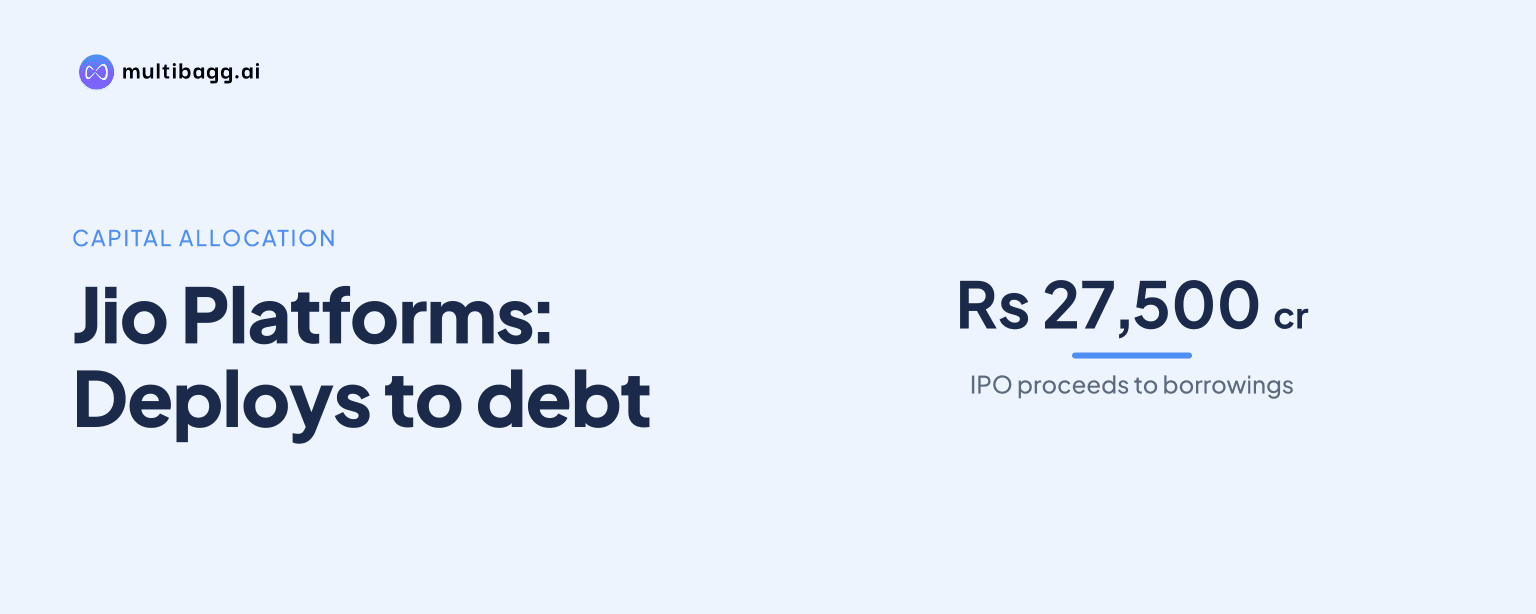
Jio Platforms has used ₹27,500 crore of net proceeds from its October 2026 initial public offering to prepay principal on certain external commercial borrowings of material subsidiary Reliance Jio Infocomm Limited. The company raised gross proceeds of ₹30,188 crore and listed on the National Stock Exchange of India and BSE Limited on October 28, 2026.
Know Jio Platforms inside out
Results, valuation, peers and who's buying, in one view.
What did Jio Platforms do with its IPO proceeds?
Jio Platforms used ₹27,500 crore of net issue proceeds to prepay, in full or in part, principal outstanding on certain external commercial borrowings availed by Reliance Jio Infocomm. The October 30, 2026 announcement identifies Reliance Jio Infocomm as a material subsidiary and states that the deployment follows the objects of the issue set out in the prospectus.
Jio Platforms said the balance of net proceeds will be used for general corporate purposes. The release does not disclose the amount of that balance, the individual borrowing facilities selected, lenders, interest rates, maturities or the dates on which the separate prepayments were made.
The stated use concerns debt principal rather than an operating expense or capital expenditure item. It was disclosed alongside a 2Q FY27 connectivity operation with 542.4 million customers, up from 506.4 million in 2Q FY26, and a customer addition of 9.1 million during the quarter.
How was the Jio Platforms IPO structured?
Jio Platforms completed a fresh issue of 27 crore equity shares at an issue price of ₹1,119 per share, and its shares began trading on NSE and BSE on October 28, 2026. Each share had a face value of ₹10 and included a securities premium of ₹1,109 per share.
Gross proceeds after accounting for an employee discount of ₹54 per equity share amounted to ₹30,188 crore. The disclosed ₹27,500 crore debt prepayment is ₹2,688 crore below gross proceeds, but Jio Platforms describes the payment as a use of net proceeds and provides no net-proceeds reconciliation in this announcement.
The issue and listing came after Jio Platforms reported gross revenue of ₹47,485 crore in 2Q FY27, up 11.3% from ₹42,652 crore in 2Q FY26. Consolidated revenue from operations rose 11.4% year on year to ₹40,475 crore, providing the operating context for the capital-market transaction.
Got a follow-up? Ask IRIS
What was Jio Platforms' reported leverage position?
Jio Platforms reported net leverage of 0.10 times at September 30, 2026, compared with 0.55 times at September 30, 2025 and 0.11 times at June 30, 2026. The company defines net leverage as net debt divided by earnings before interest, tax, depreciation and amortisation, or EBITDA, with net debt reduced by cash and marketable securities.
The September 30, 2026 leverage measure preceded both the October 28 listing and the reported use of ₹27,500 crore in IPO proceeds. It is therefore the quarter-end reported position, rather than a disclosed measurement of the borrowing prepayment's subsequent effect on Jio Platforms' leverage.
EBITDA in 2Q FY27 rose 16.6% to ₹21,879 crore from ₹18,757 crore a year earlier, while the EBITDA margin increased to 54.1% from 51.6%. Profit after tax increased 13.7% to ₹8,387 crore from ₹7,375 crore, with Jio Platforms attributing the partial offset to higher finance costs after 5G asset capitalisation in March 2026.
Jio Platforms also reported EBITDA less cash capital expenditure of ₹32,130 crore in 1H FY27, up 98% from ₹16,216 crore in 1H FY26. The company defines cash capital expenditure as cash outflow for property, plant and equipment, spectrum and other intangible assets, less proceeds from the disposal of those assets.
Which operating trends accompanied the proceeds deployment?
Jio Platforms added 9.1 million customers in 2Q FY27, compared with 8.3 million additions in 2Q FY26, taking its customer base to 542.4 million. Monthly churn was 1.6%, unchanged from 1Q FY27 and down from 1.9% a year earlier, while monthly average revenue per user rose to ₹218.8 from ₹211.4.
Data traffic increased 22.1% year on year to 71.3 billion gigabytes in 2Q FY27, while monthly data consumption per customer reached 44.2 gigabytes from 38.7 gigabytes. Voice traffic increased 1.3% to 1.52 trillion minutes from 1.50 trillion minutes, a slower rate than data traffic growth.
Jio Platforms said its 5G subscriber base reached 300 million as of September 2026, rising by 66 million over the preceding 12 months. It also said that 5G accounted for about 56% of total wireless traffic, while fixed broadband subscribers reached 30.0 million after 7.3 million additions over 12 months.
Jio AirFiber had 15.1 million subscribers and accounted for more than 75% of Jio Platforms' fixed-broadband additions during the 12 months to September 2026. The company said promotional schemes for fixed-broadband customers offset improved subscriber mix and increased usage in its reported average revenue per user.
Conclusion
Jio Platforms has disclosed an immediate use for ₹27,500 crore of its IPO net proceeds: prepayment of certain external commercial borrowings at Reliance Jio Infocomm. The deployment followed gross proceeds of ₹30,188 crore and was reported alongside 2Q FY27 EBITDA growth of 16.6% and net leverage of 0.10 times at September 30, 2026.
The next disclosed item to watch is the use of the remaining net proceeds earmarked for general corporate purposes, for which Jio Platforms provided no amount or timetable. Management also said it would continue building capabilities in satellite communications, 6G intellectual property and artificial intelligence embedded in core voice and data services after reaching 300 million 5G users in September 2026.