










JM Financial bespoke loans rise to Rs. 3,769 crore in Q2FY27
Key highlights
- JM Financial’s bespoke loans increased to Rs. 3,769 crore in Q2FY27 from Rs. 2,251 crore in Q2FY26.
- JM Financial’s non-core MSME and FIF loans declined to Rs. 170 crore in Q2FY27 from Rs. 391 crore a year earlier.
- JM Financial disbursed Rs. 977 crore in Q2FY27, primarily in bespoke loans, and Rs. 1,808 crore in H1FY27.
- JM Financial’s Private Markets borrowings declined to Rs. 5,314 crore at H1FY27 from Rs. 6,245 crore at FY26.
powered by IRIS
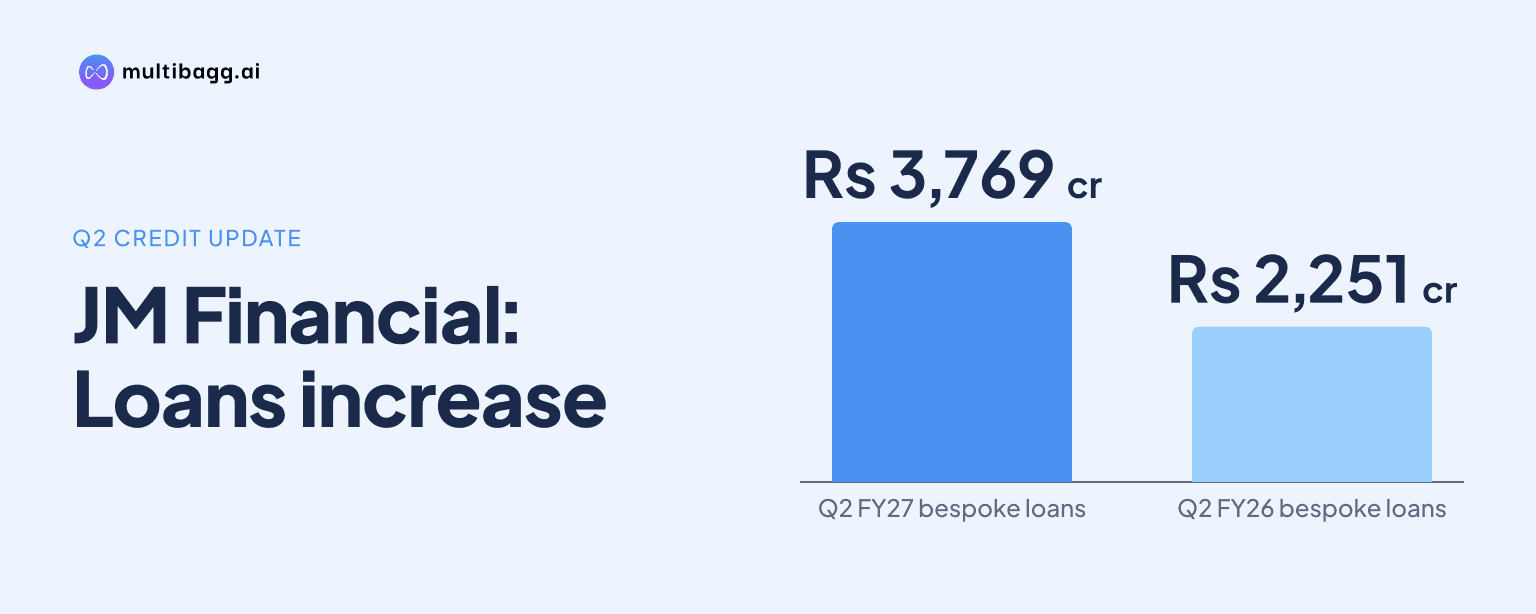
JM Financial’s Private Markets standard-loan book reached Rs. 4,748 crore in Q2FY27, led by Rs. 3,769 crore of bespoke loans, while non-core MSME and FIF exposure declined to Rs. 170 crore. Management expects the non-core loan book to substantially run down over the next nine to 12 months.
Know JM Financial inside out
Results, valuation, peers and who's buying, in one view.
How has JM Financial’s Private Markets loan mix changed?
JM Financial has increased the weight of bespoke lending within its standard-loan portfolio. Bespoke loans, including loans against securities (LAS), rose from Rs. 2,251 crore in Q2FY26 to Rs. 3,769 crore in Q2FY27, an increase of Rs. 1,518 crore. The total standard-loan book rose by Rs. 870 crore over the same period, from Rs. 3,878 crore to Rs. 4,748 crore, meaning the expansion came from bespoke lending while the other categories reduced.
The non-core portfolio, comprising micro, small and medium enterprise (MSME) and financial-inclusion finance (FIF) loans, moved in the opposite direction. It fell from Rs. 391 crore in Q2FY26 to Rs. 170 crore in Q2FY27. Real-estate loans also declined, from Rs. 1,236 crore to Rs. 809 crore, while bespoke loans increased in each reported quarter from Rs. 2,251 crore in Q2FY26 to Rs. 3,769 crore in Q2FY27.
What is JM Financial’s plan for non-core loans?
JM Financial expects its non-core loan book to substantially run down in the next nine to 12 months. That disclosed expectation follows a reduction in the MSME and FIF portfolio to Rs. 170 crore at Q2FY27 from Rs. 191 crore at Q1FY27, Rs. 228 crore at Q4FY26 and Rs. 391 crore a year earlier. The presentation does not provide a target closing balance or a detailed disposal schedule.
JM Financial’s stated Private Markets priorities include franchise-enhancing syndication with consistent risk management, co-investments, building origination capability and attracting large investors to anchor large syndicated trades. Its products include corporate, bespoke, distressed and real-estate private credit, alongside syndication and private investments. The Rs. 977 crore disbursed in Q2FY27 was primarily in bespoke lending and was described as two times year-on-year growth; H1FY27 disbursements were Rs. 1,808 crore.
JM Financial reported a yield of about 13% for the Q2FY27 loan book and security receipts. The company also said it had built a strong transaction pipeline and that recovery efforts on stressed assets were continuing. These disclosures identify bespoke origination and stressed-asset recovery as active operating mechanisms, but the presentation does not quantify future recoveries or pipeline conversion.
Got a follow-up? Ask IRIS
How did JM Financial’s Private Markets earnings perform?
JM Financial’s Private Markets revenue was Rs. 254 crore in Q2FY27, down from Rs. 287 crore in Q2FY26, while operating profit before tax increased to Rs. 107 crore from Rs. 101 crore. Operating profit after tax was unchanged at Rs. 77 crore in both quarters. For H1FY27, revenue was Rs. 850 crore, operating profit before tax was Rs. 477 crore and operating profit after tax was Rs. 305 crore.
The period comparison shows that quarterly revenue declined by Rs. 33 crore, whereas quarterly operating profit before tax rose by Rs. 6 crore. For the full-year trend, revenue decreased from Rs. 1,834 crore in FY25 to Rs. 1,298 crore in FY26, while operating profit after tax increased from Rs. 151 crore to Rs. 543 crore. The FY26 Private Markets profit included a Rs. 258 crore reversal of impairment provisions before tax, or Rs. 193 crore after tax, according to the consolidated performance disclosure.
Return on equity, annualised in the presentation, was 10.7% for H1FY27, compared with 8.3% in FY26 and 1.7% in FY25. The H1FY27 figure followed an increase in the standard-loan book from Rs. 4,010 crore at FY26 to Rs. 4,748 crore, while JM Financial reported Rs. 305 crore of Private Markets operating profit after tax.
What happened to JM Financial’s investments and balance sheet?
JM Financial’s Private Markets investments, including distressed credit, declined to Rs. 6,956 crore in Q2FY27 from Rs. 9,167 crore in Q2FY26. Distressed credit fell from Rs. 3,604 crore to Rs. 2,825 crore, alternatives fell from Rs. 2,356 crore to Rs. 1,691 crore, and group inter-corporate deposits declined from Rs. 1,882 crore to Rs. 743 crore. Equity investments increased from Rs. 908 crore to Rs. 1,003 crore over the same five-quarter comparison.
The segment’s total assets were Rs. 12,306 crore at H1FY27, compared with Rs. 13,231 crore at FY26 and Rs. 19,350 crore at FY24. Borrowings declined to Rs. 5,314 crore at H1FY27 from Rs. 6,245 crore at FY26 and Rs. 12,741 crore at FY24. Gross debt-to-equity, calculated in the presentation as gross D/E, was 0.8 times at H1FY27, down from 0.9 times at FY26 and 1.9 times at FY24.
Net worth, including non-controlling interests, was Rs. 6,756 crore at H1FY27, versus Rs. 6,578 crore at FY26. Net non-performing assets were Rs. 120 crore, compared with Rs. 130 crore at FY26 and Rs. 279 crore at FY24. Real-estate assets were broadly stable at Rs. 235 crore at H1FY27, against Rs. 236 crore at FY26, while net current assets were Rs. 247 crore versus Rs. 262 crore.
Conclusion
JM Financial’s Q2FY27 Private Markets figures show a portfolio increasingly concentrated in bespoke loans: bespoke exposure reached Rs. 3,769 crore, the main source of the Rs. 4,748 crore standard-loan book, while non-core MSME and FIF loans reduced to Rs. 170 crore. At the same time, total investments declined to Rs. 6,956 crore and borrowings fell to Rs. 5,314 crore.
The next disclosed milestone is management’s expectation that the non-core loan book will substantially run down within nine to 12 months. Investors can also track whether primarily bespoke disbursements, which were Rs. 977 crore in Q2FY27 and Rs. 1,808 crore in H1FY27, continue to support the loan-book mix, and whether recovery efforts on stressed assets produce further changes in net non-performing assets, which stood at Rs. 120 crore.