










JNK India holds 51% in Chemdist technology joint venture
Key highlights
- JNK will hold 51% and Chemdist Technology will hold 49% in the disclosed joint-venture structure.
- The venture names ethanol-to-chemicals and low-opex H₂ production as areas with a commercialisation focus.
- Advanced membrane technology for industrial-water applications is the venture’s third named focus area.
- JNK’s Mundra facility has 5,000 metric tonnes of installed fabrication capacity across 20,243 square metres.
powered by IRIS
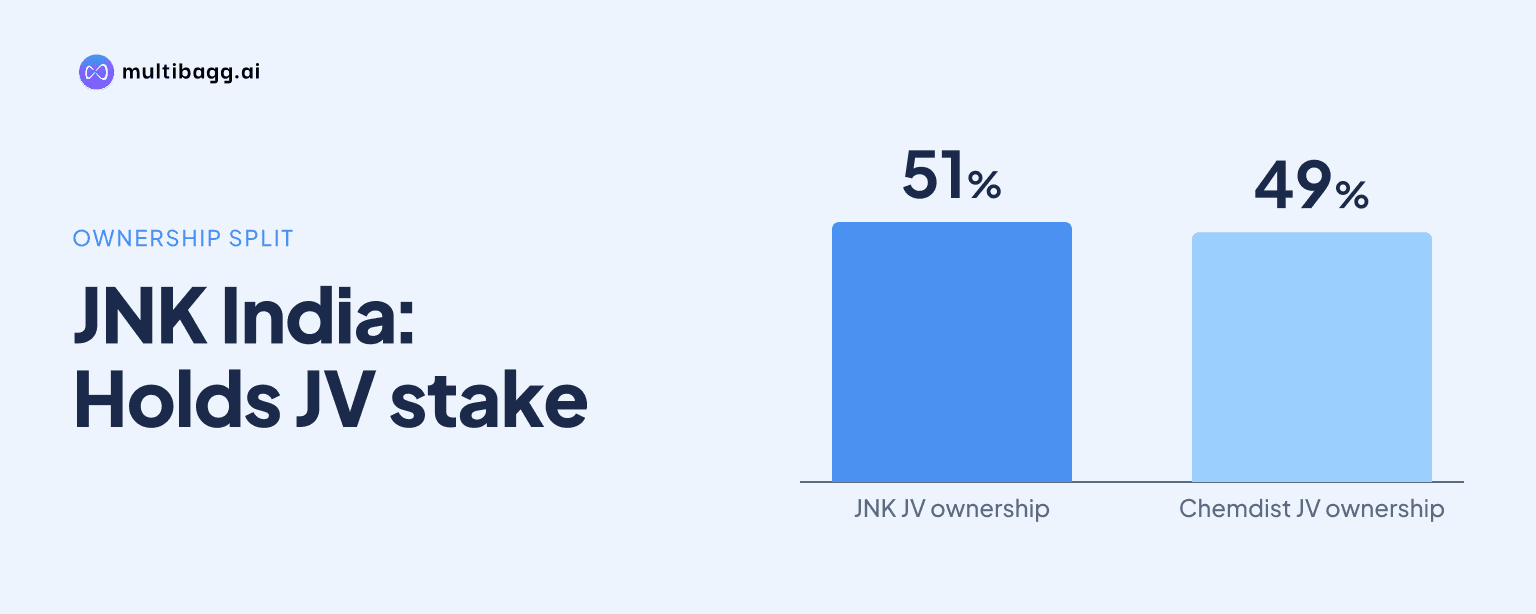
In the disclosed 51:49 Chemdist Technology joint-venture structure, JNK will hold 51% and target ethanol-to-chemicals, low-operating-expenditure hydrogen production and industrial-water technology. The presentation describes the arrangement as a technology-led growth platform, but does not disclose an investment amount, financial target, launch date or commercialisation timetable.
Know JNK India inside out
Results, valuation, peers and who's buying, in one view.
What does JNK’s 51:49 Chemdist Technology venture involve?
JNK will hold 51% of the strategic joint venture and Chemdist Technology will hold 49%, according to the presentation. JNK’s stated contribution is engineering, procurement and construction, or EPC, execution, manufacturing capability and global project execution, while Chemdist Technology contributes proprietary technologies, intellectual property and advanced research and development, or R&D, capabilities.
The presentation positions the arrangement as a technology-led growth platform intended to support diversified revenue streams and global market expansion. It identifies three focus areas: patented process scaling, advanced process-plant engineering and industrial-water solutions. It does not identify the venture’s legal name, capital contributions, directors, order pipeline, revenue outlook or expected profitability.
JNK has the larger ownership interest, while Chemdist Technology supplies the stated process-technology and innovation inputs. This differs from JNK’s established description as a design, engineering, manufacturing and EPC company with more than 15 years of experience in combustion equipment and technology-based solutions.
Which technologies will JNK and Chemdist Technology target?
JNK says the venture will focus on patented process scaling for ethanol-to-chemicals and low-opex H₂ production, with a commercialisation focus. H₂ denotes hydrogen, while opex means operating expenditure. The presentation does not specify the ethanol feedstock, chemical outputs, hydrogen-production method, plant scale, customer or location for either process.
A second area is advanced process-plant engineering through turnkey solutions for chemical, pharmaceutical and process industries. JNK’s disclosed EPC and manufacturing role provides the execution element of that offering, while Chemdist Technology’s stated inputs include proprietary technology and R&D. No chemical or pharmaceutical project, order value or addressable-market estimate is disclosed.
The third area is industrial-water solutions using advanced membrane technology for industrial-water applications. The presentation does not state whether the membrane technology will be used for wastewater treatment, water recycling, desalination or another process. It also gives no water-treatment capacity, operating-cost measure or planned deployment date.
The commercialisation wording is specifically attached to ethanol-to-chemicals and low-opex hydrogen production. The plant-engineering and membrane offerings are identified as focus areas, but the presentation does not provide separate commercial targets or scheduled milestones for them.
Got a follow-up? Ask IRIS
How does the Chemdist Technology venture fit JNK’s existing operations?
JNK’s existing combustion-equipment range includes process fired heaters, reformers and cracking furnaces, while its waste-gas systems include flares and incinerators. The presentation says reformers convert natural gas into hydrogen and synthesis gas at high temperature, linking hydrogen to JNK’s existing equipment activities before the venture’s lower-opex hydrogen-production focus.
JNK lists refining, petrochemicals, hydrogen, fertilisers and steel as end-use industries for its combustion equipment. Fired heaters heat crude oil and process streams, and cracking furnaces convert hydrocarbons into ethylene, propylene and other petrochemical products. The venture’s ethanol-to-chemicals focus therefore adds a disclosed process-technology area alongside JNK’s current hydrocarbon-processing equipment portfolio.
JNK also identifies solar photovoltaic EPC and onsite or offsite hydrogen production and distribution systems within renewable-energy systems. JNK Renewable Energy Private Limited is described as building capabilities in clean-energy infrastructure, and JNK says it has set up a hydrogen fuelling station at Indian Oil’s Faridabad R&D Centre.
JNK’s Mundra, Gujarat fabrication facility has 5,000 metric tonnes of installed fabrication capacity across 20,243 square metres. The presentation describes the site as an export-oriented modularisation hub near a deep-draft port in a multi-product special economic zone, although it does not say the Chemdist Technology venture will use the facility.
What could determine JNK’s progress with the new technology areas?
JNK’s customer-execution model requires pre-qualification, technical evaluation, commercial evaluation, vendor approval, execution and performance before repeat orders. Customer pre-qualification considers technical capability, financial strength and quality systems, while technical evaluation covers engineering capability, project experience, design methods, safety standards and regulatory compliance.
Commercial evaluation includes price competitiveness, terms and conditions, delivery schedules and risk assessment. This process is relevant because the venture identifies turnkey solutions for chemical, pharmaceutical and process industries, but the presentation does not disclose whether either of its named process technologies has secured customer qualification, approval or a project award.
Following customer approval, JNK’s model covers engineering, procurement, manufacturing, installation and commissioning. The presentation says performance is monitored on cost, quality, safety and timelines, with consistent delivery intended to support preferred-vendor status and opportunities across new projects, products and geographies.
JNK’s wider strategy includes technology leadership, deeper presence in process heaters, reformers and cracking furnaces, portfolio diversification, operational excellence and international expansion. The company names the Middle East, Africa and Southeast Asia as growth regions, but does not identify which region the Chemdist Technology venture will address first.
Conclusion
The 51:49 structure combines JNK’s disclosed EPC, manufacturing and project-execution capabilities with Chemdist Technology’s proprietary technology, intellectual property and R&D. The venture broadens JNK’s stated scope into ethanol-to-chemicals, lower-opex hydrogen production, advanced process-plant engineering and membrane-based industrial-water applications.
The next disclosed point to watch is commercialisation progress in ethanol-to-chemicals and low-opex H₂ production, as these are the two areas specifically identified with a commercialisation focus. The presentation leaves capital commitments, project awards, customer approvals, financial targets and deployment schedules unresolved.