










JNK India retains FY27 guidance despite Q2 execution delays
Key highlights
- JNK India retained FY27 guidance for 20–25% revenue growth and a 12–14% EBITDA margin.
- JNK India’s H1FY27 total operational revenue increased 30.4% year on year to Rs 370.2 crore.
- JNK India’s Q2FY27 total operational revenue increased 3.4% to Rs 187.5 crore after shipment and monsoon disruption.
- JNK India’s order book stood at Rs 1,662 crore on September 30, 2026, alongside a Rs 5,000 crore bidding pipeline.
powered by IRIS
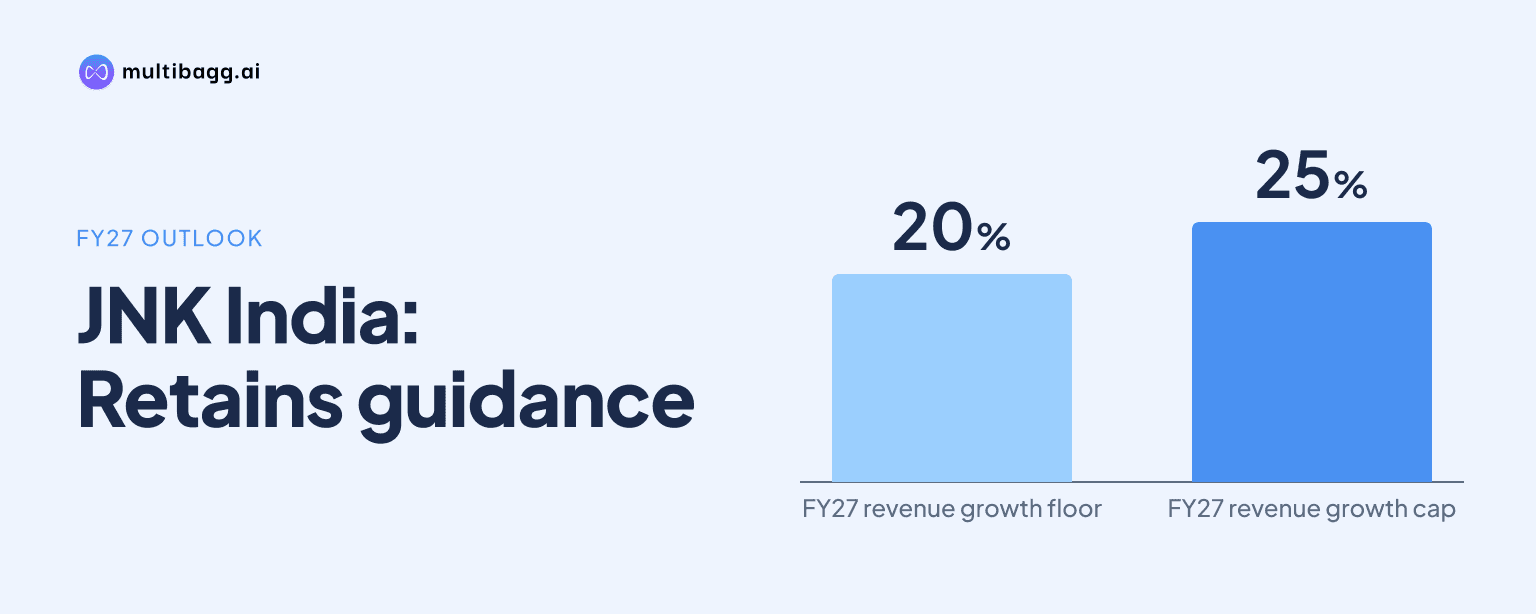
JNK India Limited retained FY27 guidance for 20–25% revenue growth and a 12–14% earnings before interest, tax, depreciation and amortisation (EBITDA) margin after Q2FY27 shipment delays and monsoon disruption, as H1FY27 total operational revenue increased 30.4% year on year to Rs 370.2 crore and management expected historically heavier H2 execution to support delivery.
Know JNK India inside out
Results, valuation, peers and who's buying, in one view.
Why did JNK India retain its FY27 guidance?
JNK India retained the guidance because management expects the traditionally execution-heavy second half to turn ongoing project progress and anticipated order conversions into revenue. Management said H2 has historically contributed around 60–70% of annual revenue in its project-based business, while maintaining FY27 revenue-growth guidance of 20–25% and EBITDA-margin guidance of 12–14%.
The quarterly revenue record shows why the H2 delivery profile is central to the outlook. Total operational revenue in H2 was Rs 348.0 crore out of Rs 482.3 crore in FY24, Rs 290.9 crore out of Rs 488.7 crore in FY25, and Rs 546.2 crore out of Rs 830.8 crore in FY26. The FY24 result was above management’s stated 60–70% historical range, while FY25 and FY26 were consistent with the company’s description of a more execution-intensive second half.
Management’s outlook rests on H1 growth and available project work rather than on a sustained Q2 pace. Revenue from operations increased 31.2% year on year to Rs 364.0 crore in H1FY27, while total operational revenue, which includes other operating income, increased 30.4% to Rs 370.2 crore. Management’s commentary describes 31.2% growth in total operational revenue, but the consolidated profit and loss statement applies that growth rate to revenue from operations.
How did JNK India perform in Q2FY27 after the disruption?
JNK India reported modest consolidated top-line growth in Q2FY27, with total operational revenue increasing 3.4% year on year to Rs 187.5 crore from Rs 181.4 crore. Management attributed temporary execution challenges during the quarter to shipment delays and monsoon-related disruption, compared with 30.4% total operational revenue growth in H1FY27.
Operating profit increased faster than total operational revenue in Q2FY27, although profit after tax rose 2.0%. Gross profit rose 15.3% to Rs 49.1 crore and gross profit margin increased to 26.2% from 23.5%. EBITDA margin rose to 11.1% from 10.8%, while finance cost increased to Rs 4.9 crore from Rs 2.8 crore and depreciation increased to Rs 3.5 crore from Rs 1.7 crore.
The Q2FY27 result differed between the consolidated and standalone statements. Consolidated revenue from operations increased 3.2% to Rs 184.0 crore, whereas standalone revenue from operations declined 3.7% to Rs 171.7 crore. Standalone EBITDA declined 9.5% to Rs 18.2 crore, compared with a 6.6% increase in consolidated EBITDA to Rs 20.8 crore.
Got a follow-up? Ask IRIS
What did JNK India’s H1FY27 profitability show?
JNK India’s consolidated H1FY27 EBITDA increased 50.0% year on year to Rs 39.4 crore, and EBITDA margin rose to 10.6% from 9.2%. This exceeded the 30.4% increase in total operational revenue to Rs 370.2 crore, as gross profit increased 44.4% to Rs 95.8 crore and gross profit margin rose to 25.9% from 23.4%.
Profit after tax increased 61.9% to Rs 22.9 crore in H1FY27 from Rs 14.1 crore in H1FY26, with the margin increasing to 6.2% from 5.0%. Profit before tax rose 62.1% to Rs 32.1 crore despite finance cost increasing to Rs 9.3 crore from Rs 6.5 crore. The 10.6% H1 EBITDA margin was below management’s 12–14% FY27 guidance range, placing emphasis on H2 profitability.
The FY26 comparison also illustrates the H2 requirement embedded in the guidance. FY26 EBITDA was Rs 104.2 crore, with a 12.5% margin on Rs 830.8 crore of total operational revenue, while H1FY27 EBITDA was Rs 39.4 crore. The presentation does not provide a revised quarterly target or a quantified H2 earnings target; management only says it expects H2 to be more execution-intensive.
Can JNK India’s order book support second-half execution?
JNK India reported an order book of Rs 1,662 crore as of September 30, 2026, which management said provides a foundation for future execution and growth. The order book was lower than Rs 1,961 crore at March 2026, but remained above Rs 1,082 crore at March 2025 and Rs 624 crore at March 2024.
The presentation identifies recently secured work that could add to the delivery schedule. An international heater-package order for a Nigeria project is worth around Rs 500 crore and has an 18-month delivery timeline. Two domestic flare-package orders aggregate Rs 30 crore with a 16-month execution timeline, covering activities from design and manufacture to installation, commissioning, performance testing and handover.
JNK India said its bidding pipeline totals around Rs 5,000 crore excluding recent order wins, split equally between domestic and export opportunities. The company is pursuing diversification across geographies and sectors, including metals and minerals, alongside renewable energy and related industries. Management expects some pipeline opportunities to convert in the coming period, but has not disclosed the value, timing or probability of those conversions.
Conclusion
JNK India’s retained FY27 guidance reflects management’s expectation that H2 project execution will offset Q2FY27 disruption from shipment delays and monsoon conditions. The reported figures show Q2 total operational revenue growth of 3.4%, while H1 total operational revenue rose 30.4% to Rs 370.2 crore and H1 EBITDA increased 50.0% to Rs 39.4 crore.
The next measures to watch are H2 delivery against management’s historical 60–70% annual-revenue contribution, execution from the Rs 1,662 crore September 2026 order book, and conversion of the Rs 5,000 crore bidding pipeline. The Nigeria heater package has an 18-month delivery schedule and the domestic flare orders have a 16-month timeline, while management has not disclosed a specific H2 revenue or profit target.