










Jubilant Adhesives Sales Rise 20% as Savli Plant Stabilises
Key highlights
- Jubilant adhesives sales rose 20% year on year to Rs 15.32 crore in Q2 FY27.
- Jubilant adhesives EBIT increased 9% year on year to Rs 1.22 crore in Q2 FY27.
- H1 FY27 adhesives revenue was Rs 30.04 crore, up 19%, while EBIT was Rs 3.1 crore, up 26%.
- Jubilant said the new Savli, Gujarat plant had stabilised well by Q2 FY27.
powered by IRIS
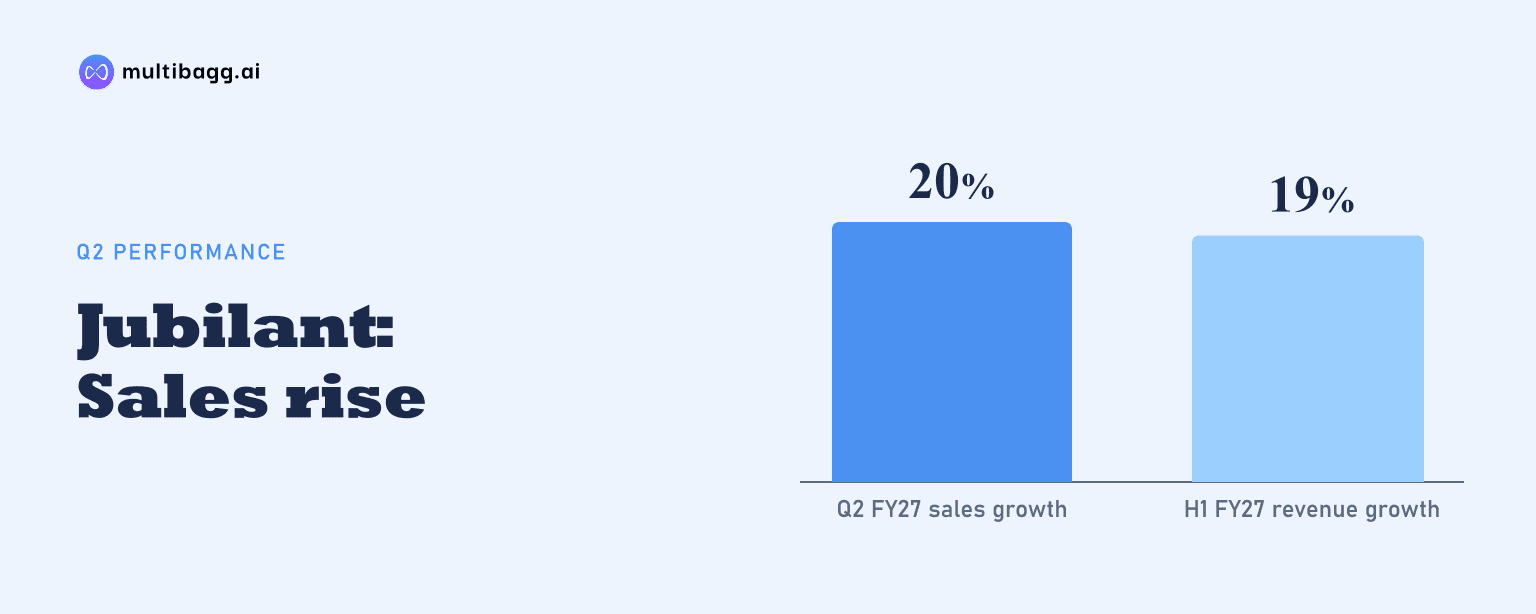
Jubilant Agri & Consumer Products reported adhesives sales of Rs 15.32 crore in Q2 FY27, up 20% year on year, while segment earnings before interest and tax (EBIT) rose 9% to Rs 1.22 crore. Jubilant attributed growth to domestic demand, market-share gains, pricing actions and the stabilised Savli, Gujarat plant.
Know Jubilant Agri & Consumer Products inside out
Results, valuation, peers and who's buying, in one view.
How did Jubilant adhesives perform in Q2 FY27?
Jubilant’s adhesives revenue reached Rs 15.32 crore in Q2 FY27, compared with Rs 12.79 crore in Q2 FY26, producing the reported 20% increase. Segment EBIT rose to Rs 1.22 crore from Rs 1.12 crore, a 9% year-on-year increase. The business therefore reported growth in both sales and EBIT during the quarter.
The H1 FY27 comparison was higher on both measures. Adhesives revenue was Rs 30.04 crore in H1 FY27, up 19% from Rs 25.19 crore in H1 FY26, while EBIT increased 26% to Rs 3.1 crore from Rs 2.46 crore. The first-half EBIT growth rate exceeded the sales growth rate, unlike in Q2 FY27, when EBIT growth trailed revenue growth.
The sequential result differed from the year-on-year comparison. Revenue rose from Rs 14.71 crore in Q1 FY27 to Rs 15.32 crore in Q2 FY27, but EBIT fell from Rs 1.87 crore to Rs 1.22 crore. Management said calibrated price increases and cost management should ease margin pressure in coming quarters, while geopolitical uncertainty and supply-chain disruption may affect input costs.
What drove Jubilant’s Q2 FY27 adhesives sales growth?
Jubilant said strong domestic demand and continued market-share gains across key adhesive categories drove the 20% Q2 FY27 revenue increase. The company identified demand-generation initiatives, deeper contractor engagement, enhanced distribution reach and improved channel penetration as the commercial mechanisms supporting its market position.
Jubilant sells the range under the JIVANJOR brand, which includes JIVANJOR, JIVANJOR imino, JIVANJOR aquabond, JIVANJOR watershield and JIVANJOR fastx. Listed product characteristics include waterproofing, anti-bubble properties, fast drying, heat resistance and PVC and acrylic applications. The presentation does not assign sales or growth figures to individual JIVANJOR products.
The business had expanded before Q2 FY27. Adhesives revenue increased from Rs 35.12 crore in FY24 to Rs 43.16 crore in FY25 and Rs 50.15 crore in FY26, while EBIT rose from Rs 2.43 crore to Rs 3.84 crore and Rs 4.59 crore, respectively. FY26 revenue was Rs 6.99 crore above FY25, and EBIT was Rs 0.75 crore higher.
Jubilant said it navigated raw-material inflation in Q2 FY27 through timely price increases. It also cited strategic sourcing, supply-chain optimisation and productivity initiatives as operating-efficiency measures. The presentation does not separate the Rs 2.53 crore year-on-year revenue increase into contributions from price, volume, products, contractor activity or distribution expansion.
Got a follow-up? Ask IRIS
What has the Savli plant changed for Jubilant?
Jubilant said its new Savli, Gujarat plant had stabilised well by Q2 FY27, unlocking operating leverage and improving operational efficiency and service levels. The company also said the location improves proximity to key markets and customer satisfaction. It did not disclose Savli’s capacity, commissioning date, investment amount or separate earnings contribution.
The plant’s stabilisation was reported alongside Q2 FY27 adhesives sales of Rs 15.32 crore and EBIT of Rs 1.22 crore. Savli was one of several stated operating mechanisms, alongside sourcing, supply-chain optimisation and productivity improvement. The presentation does not identify the plant as the sole cause of the 9% year-on-year EBIT increase.
Management said the Q3 FY27 demand outlook was stable, although a weak monsoon could affect rural demand while urban demand was expected to remain robust. This creates a split demand outlook after H1 FY27 sales of Rs 30.04 crore. Jubilant did not provide rural or urban revenue exposure for its adhesives business.
What could affect Jubilant adhesives margins after Q2 FY27?
Jubilant identified geopolitical uncertainty and supply-chain disruption as potential influences on input costs after Q2 FY27. Management said calibrated price increases and effective cost management should ease margin pressure in coming quarters. Q2 FY27 EBIT of Rs 1.22 crore remained above Rs 1.12 crore in Q2 FY26 but was below Rs 1.87 crore in Q1 FY27.
Management also said innovation and new-product introductions would help Jubilant meet consumer expectations and gain market share. These are management expectations rather than quantified forecasts, and the presentation provides no adhesives revenue or EBIT target for Q3 FY27 or FY27. The stated Q3 FY27 demand outlook remains stable.
The broader Performance Polymers & Chemicals segment, which includes adhesives, recorded Q2 FY27 sales of Rs 38.53 crore and EBIT of Rs 2.62 crore. Segment sales rose 33% from Rs 28.97 crore in Q2 FY26, while EBIT declined 33% from Rs 3.88 crore. Adhesives therefore reported a different EBIT direction, increasing 9% year on year while the wider segment’s EBIT declined.
Conclusion
Jubilant’s Q2 FY27 adhesives result combined 20% sales growth with a 9% EBIT increase, supported by domestic demand, share gains, channel activity, pricing and the stabilised Savli plant. H1 FY27 sales of Rs 30.04 crore and EBIT of Rs 3.1 crore extended the year-on-year growth comparison, although the decline in Q2 EBIT from Q1 FY27 shows the relevance of quarterly cost movements.
The next disclosed period to watch is Q3 FY27, when management expects stable demand but flags a possible weak-monsoon effect on rural demand and potential input-cost disruption. Management expects calibrated pricing, sourcing, supply-chain optimisation, productivity measures and new-product introductions to support margin easing in coming quarters.