










Juniper Hotels targets 3,941 keys with Rs 1,930 crore capex
Key highlights
- Juniper Hotels targets 3,941 keys by FY31, up from 1,895 keys in FY26.
- Juniper Hotels plans Rs 1,930 crore of capex through FY31 and estimates Rs 1,600 crore to Rs 1,800 crore of internal surplus.
- The New Delhi development is planned at about 550 luxury keys and is targeted to be operational by FY31.
- Juniper Hotels says estimated gross debt to EBITDA will not exceed 2.6 times during expansion.
powered by IRIS
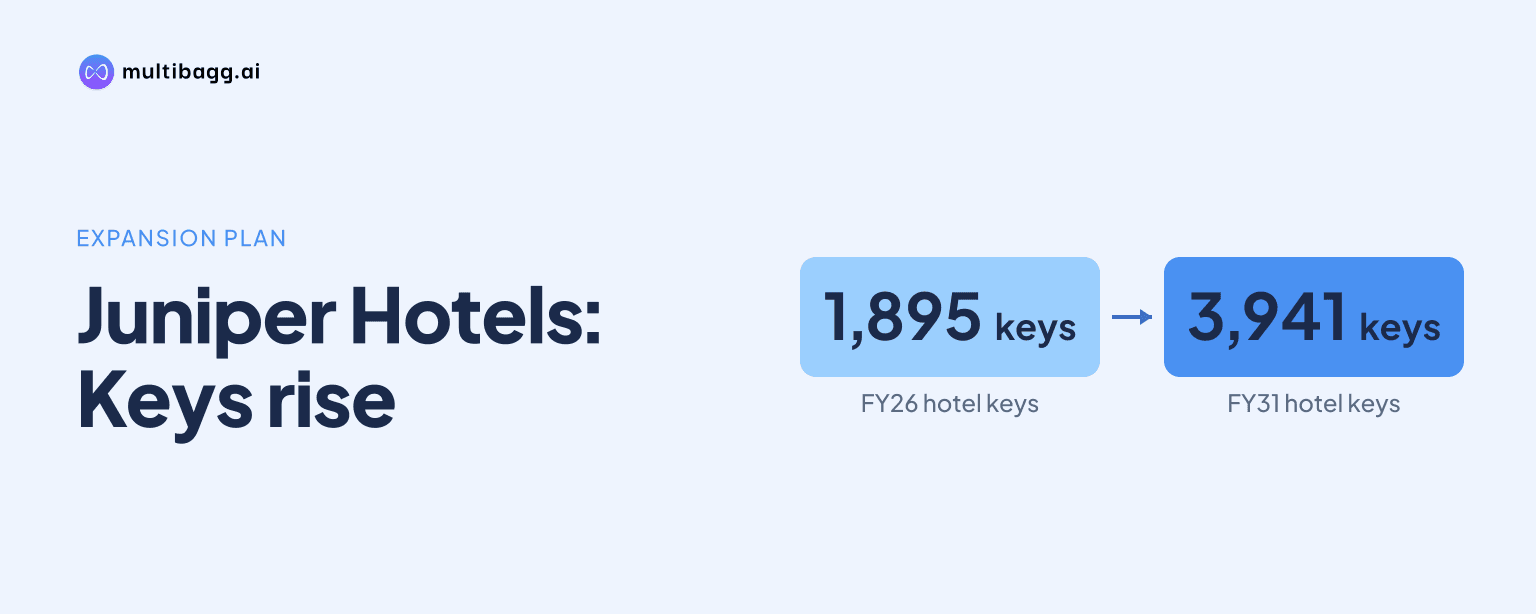
Juniper Hotels targets 3,941 keys by FY31, up from 1,895 in FY26, while planning Rs 1,930 crore of capital expenditure funded largely by estimated internal surplus of Rs 1,600 crore to Rs 1,800 crore. The roadmap covers Bengaluru, Guwahati, New Delhi and Kaziranga, alongside two brownfield acquisitions under discussion.
Know Juniper Hotels inside out
Results, valuation, peers and who's buying, in one view.
How will Juniper Hotels reach 3,941 keys by FY31?
Juniper Hotels expects its key portfolio to increase by 2,046 keys, from 1,895 in FY26 to 3,941 in FY31. Its roadmap shows 3,008 keys by FY29, followed by 106 rooms in Kaziranga, about 550 keys in New Delhi and 277 keys in Guwahati. Juniper Hotels describes the FY31 outcome as a doubling of its portfolio.
Near-term additions listed in the roadmap include Novotel Imagicaa with 287 keys and The Westin Bengaluru Phase I with 238 keys. Bengaluru Phase II is planned to add 275 keys, comprising 250 hotel keys and 25 apartments, and is targeted to be operational by FY29. The FY29 bridge also includes brownfield acquisitions and the Grand Hyatt Mumbai commercial tower, though the presentation does not assign a key count to either item.
Which projects are scheduled in Juniper Hotels’ expansion plan?
Juniper Hotels’ largest disclosed hotel addition is the New Delhi luxury development, planned at about 550 keys and targeted to be operational by FY31. The project has no upfront land cost and no licence fees during construction, according to the presentation. Juniper Hotels indicates a return on capital employed, or ROCE, of about 23%, while concept design is approved and services and structural design work is underway.
The Guwahati luxury development is planned at 277 keys, including 263 keys and 14 apartments, on 73,000 square feet of land. It is scheduled to be operational by FY31, with architectural design and development completed and structural work tendering underway. Juniper Hotels indicates ROCE of about 14% for Guwahati, compared with the indicated 23% for New Delhi.
Kaziranga is a planned 106-room luxury wildlife resort targeted for FY30 on 420,000 square feet of long-leased land in Assam. The lease can be extended up to 99 years, and boundary-wall work has been completed. Separately, the Grand Hyatt Mumbai commercial tower is planned to provide about 80,000 square feet of construction area by FY29 and is intended to generate commercial lease rentals rather than hotel-key growth.
How much will Juniper Hotels spend and how will it fund capex?
Juniper Hotels plans Rs 1,930 crore of capital expenditure through FY31, with management estimating Rs 1,600 crore to Rs 1,800 crore of internal surplus over the period. The internal-surplus range would cover most of the planned outlay, leaving Rs 130 crore to Rs 330 crore beyond that stated funding source. The FY31 portfolio outcome includes inorganic acquisitions, and Juniper Hotels says discussions to acquire two brownfield assets are at an advanced stage.
The Westin Bengaluru accounts for Rs 850 crore of estimated capital expenditure across two phases, excluding taxes, for 513 keys. Phase I is estimated at Rs 450 crore for 238 keys and Phase II at Rs 400 crore for 275 keys. The indicated cost per key declines from Rs 1.89 crore in Phase I to Rs 1.45 crore in Phase II, about 23% lower, resulting in a blended cost of Rs 1.65 crore per key.
Got a follow-up? Ask IRIS
What leverage and operating targets has Juniper Hotels set for FY31?
Juniper Hotels says estimated gross debt to earnings before interest, tax, depreciation and amortisation, or EBITDA, will not exceed 2.6 times during the expansion programme. The funding slide reports leverage of 1.4 times in September 2026. Management also states an objective to double EBITDA by FY31 while reaching more than 3,900 keys, including inorganic acquisitions.
The balance sheet as of September 30, 2026 reported borrowings of Rs 703 crore, down from Rs 739 crore on March 31, 2026. Total equity increased to Rs 2,940 crore from Rs 2,868 crore, while cash and bank balances rose to Rs 70 crore from Rs 30 crore. Capital work-in-progress increased to Rs 456 crore from Rs 345 crore, and Juniper Hotels reported net bank debt to EBITDA of 1.4 times and net debt to equity of 0.2 times.
The operating base generated EBITDA of Rs 180.3 crore in H1FY27, up 4% from Rs 173.7 crore in H1FY26, as revenue from operations rose 11% to Rs 499.1 crore. EBITDA margin declined by 2 percentage points to 35% as expenses increased 14% to Rs 330 crore. Finance costs fell 37% to Rs 33.2 crore, while profit for the period rose 173% to Rs 70.4 crore.
What further land opportunities does Juniper Hotels identify?
Juniper Hotels identifies land adjacent to Grand Hyatt Mumbai that could support about 300,000 square feet of mixed-use built-up area, subject to change and regulatory approval. It also has 17,000 square feet of existing land in Thiruvananthapuram available for further development. These opportunities are separate from the stated FY31 key roadmap and are not presented as committed additions to the 3,941-key target.
At Grand Hyatt Mumbai, Juniper Hotels also identifies a brownfield expansion of about 200,000 square feet that could add about 317 hotel keys and serviced apartments. The company says the requisite approvals, including the Intimation of Disapproval and Commencement Certificate, have been secured. The presentation does not disclose capital expenditure, timing or an operational target for this potential 317-key addition.
Conclusion
Juniper Hotels’ FY31 blueprint combines planned projects, potential acquisitions and longer-term land-bank opportunities. Its central disclosed targets are 3,941 keys, Rs 1,930 crore of cumulative planned capital expenditure and Rs 1,600 crore to Rs 1,800 crore of estimated internal surplus. New Delhi is the largest named future hotel project, while Bengaluru, Guwahati and Kaziranga provide scheduled additions across FY29 to FY31.
The next disclosed milestones are Bengaluru Phase II and the Grand Hyatt Mumbai commercial tower by FY29, Kaziranga by FY30, and the Guwahati and New Delhi developments by FY31. Investors can also track whether the two brownfield acquisitions proceed, the funding used beyond internal surplus and management’s stated ceiling of 2.6 times gross debt to EBITDA.