










Jyothy Labs FY26 income rose, but profit and returns fell
Key highlights
- Jyothy Labs reported FY26 standalone total income of Rs 3,011.85 crore, up from Rs 2,899.39 crore in FY25.
- Jyothy Labs’ FY26 standalone profit after tax fell to Rs 333.19 crore from Rs 371.17 crore.
- Jyothy Labs’ return on net worth declined to 21% in FY26 from 26.8% in FY25.
- Jyothy Labs reported Rs 1,566.72 crore of standalone total income for the six months ended September 30, 2026.
powered by IRIS
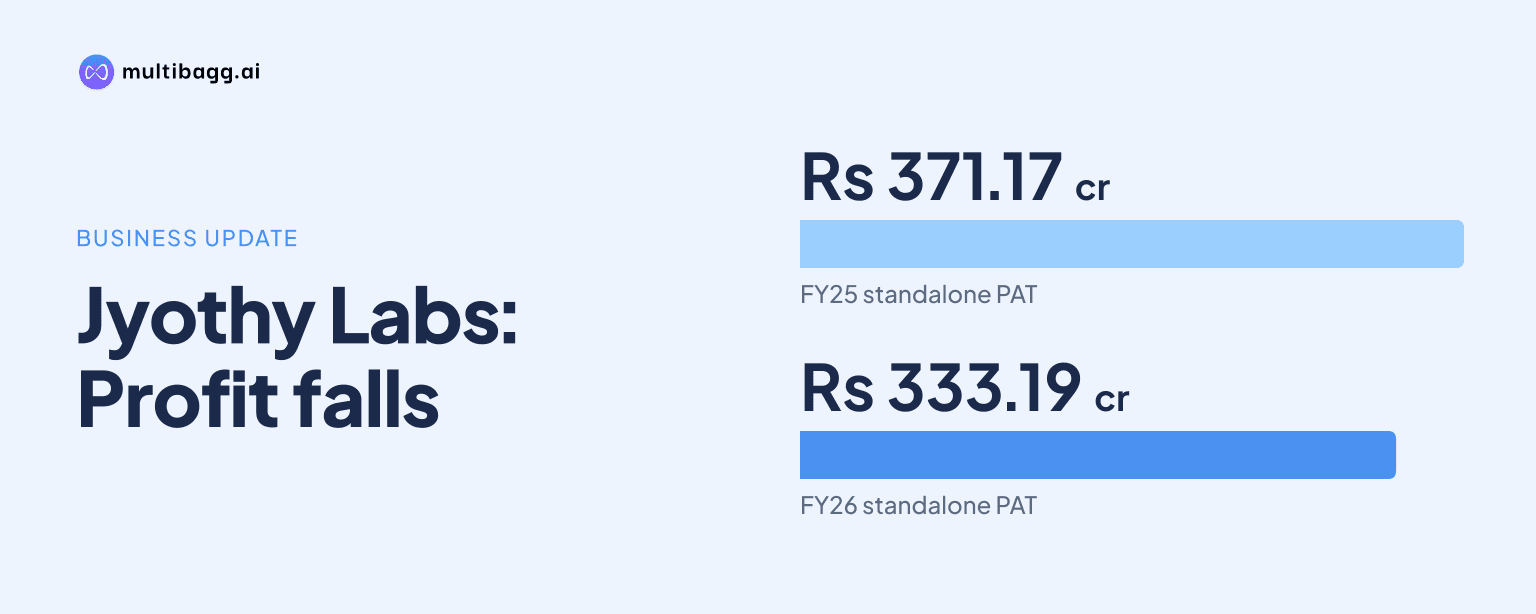
Jyothy Labs Limited reported FY26 standalone total income of Rs 3,011.85 crore, up from Rs 2,899.39 crore in FY25, but profit after tax fell Rs 37.98 crore to Rs 333.19 crore and return on net worth declined to 21% from 26.8%. The figures are from audited standalone financial statements for the year ended March 31, 2026.
Know Jyothy Labs inside out
Results, valuation, peers and who's buying, in one view.
How did Jyothy Labs perform in FY26?
Jyothy Labs increased revenue from operations by Rs 100.37 crore to Rs 2,944.29 crore in FY26 from Rs 2,843.92 crore in FY25. Other income rose to Rs 67.56 crore from Rs 55.47 crore, taking total income up Rs 112.46 crore to Rs 3,011.85 crore for the year ended March 31, 2026.
The FY26 top-line result extended the increase recorded from FY24, when revenue from operations was Rs 2,754.03 crore and total income was Rs 2,807.70 crore. Over the two financial years to FY26, revenue from operations increased Rs 190.26 crore and total income rose Rs 204.15 crore. These are standalone, rather than consolidated, results.
Jyothy Labs operates in fabric care, household insecticide, surface cleaning, personal care and home care in India. Its listed brands include Ujala, Maxo, Exo, Margo, Henko, More Light, Mr. White, Jovia, Maya and Fabric Spa, and it also provides laundry and dry-cleaning services. The offer document does not disclose FY26 revenue or profit by brand or operating segment.
Why did Jyothy Labs’ FY26 profit fall despite higher income?
Jyothy Labs’ profit after tax declined because total expenses increased more than total income in FY26. Total expenses rose Rs 154.52 crore to Rs 2,560.66 crore from Rs 2,406.14 crore in FY25, exceeding the Rs 112.46 crore increase in total income and reducing profit before tax by Rs 38.36 crore to Rs 451.19 crore.
Raw-material and component consumption, the largest disclosed cost line, increased Rs 112.80 crore to Rs 1,470.74 crore in FY26. Employee benefits expense rose Rs 15.90 crore to Rs 341.31 crore, purchases of stock in trade increased Rs 20.29 crore to Rs 97.53 crore, and depreciation and amortisation rose Rs 5.12 crore to Rs 61.24 crore.
Other expenses declined Rs 9.89 crore to Rs 591.27 crore in FY26, partly offsetting the increases in other costs. Inventory movement was a credit of Rs 6.42 crore in FY26, compared with a credit of Rs 17.66 crore in FY25, leaving Rs 11.24 crore less of an offset to expenses than in the preceding year.
Total tax expense was Rs 118.00 crore in FY26, close to Rs 118.38 crore in FY25 despite the lower profit before tax. FY26 included current tax of Rs 68.18 crore, Rs 10.64 crore of adjustment relating to earlier periods and Rs 39.18 crore recorded under deferred tax credits in the financial statement.
How did Jyothy Labs’ returns and per-share measures change?
Jyothy Labs’ return on net worth declined to 21% in FY26 from 26.8% in FY25 and 32.4% in FY24. The offer document defines return on net worth as profit after tax divided by net worth, and FY26 combined lower profit after tax of Rs 333.19 crore with higher net worth of Rs 1,588.61 crore.
Net worth increased Rs 206.00 crore from Rs 1,382.61 crore at March 31, 2025 to Rs 1,588.61 crore at March 31, 2026. Other equity was Rs 1,551.89 crore and equity share capital was Rs 36.72 crore at FY26-end, while total paid-up share capital and free reserves stood at Rs 1,515.90 crore.
Basic and diluted earnings per share were each Rs 9.07 in FY26, down from Rs 10.11 in FY25 and Rs 10.07 in FY24. Book value per share rose to Rs 43.26 from Rs 37.65 over FY26, corresponding with the increase in net worth at March 31, 2026.
Jyothy Labs reported no total debt in its standalone financial information for FY24, FY25 or FY26, and the debt-equity ratio was shown as a dash for each year. The filing defines debt-equity ratio as total debt divided by net worth, rather than providing a numerical result where total debt is nil.
Got a follow-up? Ask IRIS
What do Jyothy Labs’ September 2026 results show?
Jyothy Labs reported unaudited standalone total income of Rs 1,566.72 crore and profit after tax of Rs 58.24 crore for the six-month period ended September 30, 2026. The results were subject to a limited review by the statutory auditors, unlike the audited results for the year ended March 31, 2026.
Revenue from operations was Rs 1,533.44 crore during the six-month period, while other income was Rs 33.28 crore. Total expenses were Rs 1,485.36 crore, leaving profit before tax of Rs 81.36 crore and total tax expense of Rs 23.12 crore. The offer document does not provide a comparable prior-year six-month period.
Net worth was Rs 1,517.11 crore at September 30, 2026, down from Rs 1,588.61 crore at March 31, 2026, while other equity was Rs 1,480.39 crore. Basic and diluted earnings per share were Rs 1.59, book value per share was Rs 41.31, and the stated return on net worth of 7.7% was annualised.
How does the buyback relate to Jyothy Labs’ capital position?
Jyothy Labs set a maximum buyback amount of Rs 147 crore, excluding transaction costs, equal to 9.70% of its paid-up equity share capital and free reserves based on audited standalone financial statements at March 31, 2026. The company stated that borrowed funds from banks and financial institutions would not be used for the buyback.
The company had paid-up equity share capital of Rs 36.72 crore and free reserves of Rs 1,479.18 crore at March 31, 2026. It deposited Rs 29.70 crore in the escrow account as security for its buyback obligations, and a chartered accountant’s certificate dated November 11, 2026 stated that Jyothy Labs had adequate and firm financial arrangements.
Assuming full acceptance of 61.25 lakh equity shares, issued, subscribed and fully paid-up share capital would decrease from 36.72 crore shares to 36.11 crore shares. Under that assumption, promoter and promoter-group ownership would rise to 63.95% from 62.88%, although the document says the final post-buyback position will depend on the actual shares bought back.
Conclusion
Jyothy Labs’ FY26 standalone financials show a split outcome: income and revenue rose for a second consecutive year, but expenses increased faster than income. That reduced profit after tax to Rs 333.19 crore from Rs 371.17 crore and brought return on net worth down to 21% from 26.8%, while net worth increased to Rs 1,588.61 crore.
Next, investors can watch the completion of the proposed Rs 147 crore buyback and the actual number of shares accepted, since the document’s estimated post-buyback capital structure assumes acceptance of 61.25 lakh shares. Jyothy Labs must deposit the consideration payable to eligible shareholders in a special account immediately after the tendering period closes.