










Kansai Nerolac Q2 revenue rises 18.9%, profit growth lags
Key highlights
- Kansai Nerolac's standalone Q2 revenue rose 18.9% to Rs 2,268.77 crore.
- Kansai Nerolac reported Q2 EBITDA of Rs 223.23 crore, up 4.9% year on year.
- Kansai Nerolac's standalone Q2 profit after tax increased to Rs 148.64 crore from Rs 136.56 crore.
- Kansai Nerolac's consolidated H1 operating cash flow was an outflow of Rs 78.04 crore versus an inflow of Rs 201.71 crore.
powered by IRIS
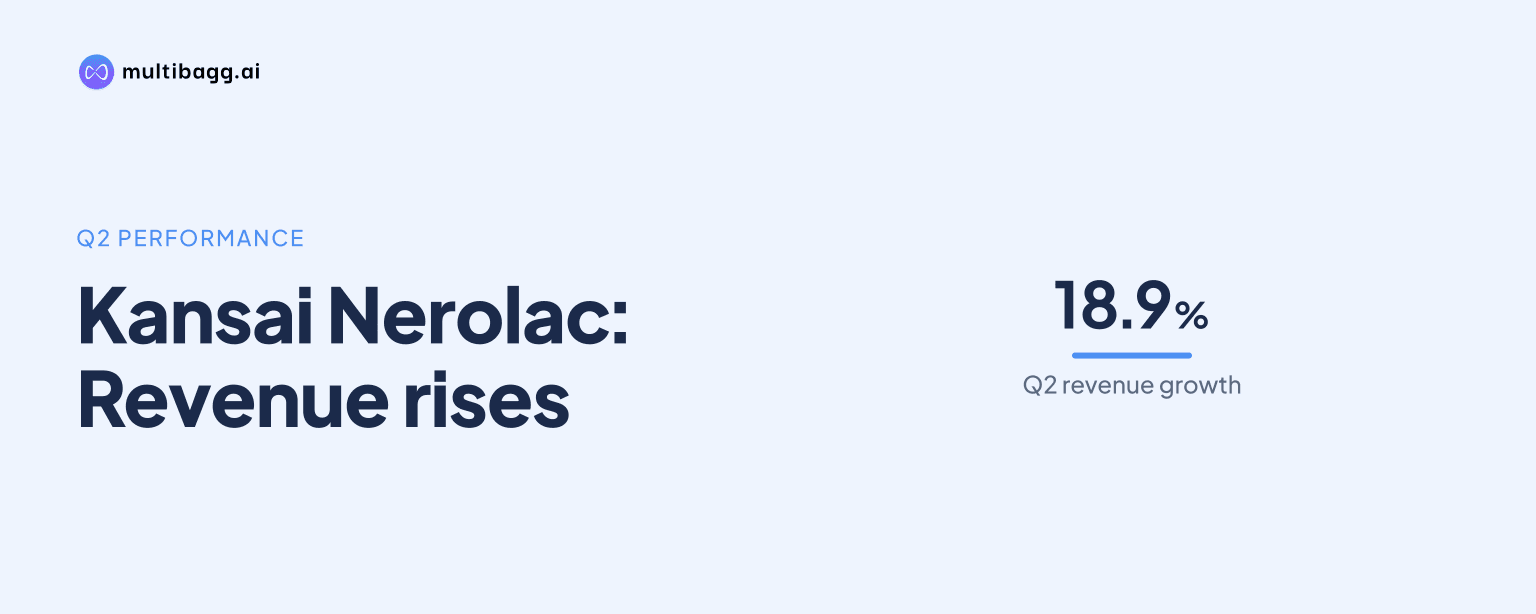
Kansai Nerolac Paints Limited reported standalone revenue from operations of Rs 2,268.77 crore for the quarter ended September 30, 2026, up 18.9% year on year, while EBITDA rose 4.9% and profit before tax increased 4.3% as raw-material and foreign-exchange volatility pressured input costs.
Know Kansai Nerolac Paints inside out
Results, valuation, peers and who's buying, in one view.
How did Kansai Nerolac perform in the September 2026 quarter?
Kansai Nerolac recorded standalone revenue from operations of Rs 2,268.77 crore in the quarter ended September 30, 2026, compared with Rs 1,907.46 crore a year earlier. Standalone profit before tax rose to Rs 191.98 crore from Rs 184.01 crore, while profit after tax increased to Rs 148.64 crore from Rs 136.56 crore. The company reported quarterly earnings before interest, tax, depreciation and amortisation, or EBITDA, of Rs 223.23 crore, up 4.9% year on year.
Revenue growth exceeded the rise in EBITDA and pre-tax profit during the quarter. Revenue was also below Rs 2,332.83 crore in the quarter ended June 30, 2026, while standalone profit before tax declined from Rs 318.43 crore, showing a lower sequential profit outcome in the September quarter despite higher sales than a year earlier.
What drove Kansai Nerolac's revenue growth?
Kansai Nerolac said both its Decorative and Industrial businesses contributed to momentum in the quarter ended September 30, 2026. Management said the Industrial business maintained strong momentum across key segments, supported by customer relationships, technology capabilities and a diversified portfolio, although the announcement did not provide revenue separately for Decorative and Industrial operations.
In Decorative, Kansai Nerolac said it continued to pursue growth with profitability and strengthen its position in construction chemicals, waterproofing, wood finishes and projects. Management linked its demand outlook to the festive season and activity in automotive, infrastructure, real estate and core industrial sectors, but did not set a quantified sales target for the second half of financial year 2026-27.
For the six months ended September 30, 2026, standalone revenue reached Rs 4,601.60 crore, compared with Rs 4,030.69 crore in the corresponding period a year earlier. The company reported six-month EBITDA of Rs 553.11 crore, up 5.8%, while standalone profit before tax rose 4.0% to Rs 510.41 crore, again below the 14.2% revenue growth rate.
Why did Kansai Nerolac's profit grow more slowly than sales?
Kansai Nerolac attributed slower profit growth to raw-material and foreign-exchange volatility that continued to pressure input costs in the September 2026 quarter. Its 18.9% revenue growth compared with EBITDA growth of 4.9% and pre-tax-profit growth of 4.3%, indicating that higher costs absorbed a substantial part of the sales increase.
Management said it had taken calibrated pricing actions to partly mitigate the impact, rather than saying that pricing had fully offset cost inflation. It also identified product mix, formulation optimisation, sourcing efficiencies and cost management as initiatives being intensified to improve the quality and sustainability of earnings.
Standalone earnings per share after exceptional items was Rs 1.84 for the September 2026 quarter, against Rs 1.69 a year earlier. For the first half, earnings per share was Rs 4.74 versus Rs 4.50, while annual standalone earnings per share after exceptional items was Rs 7.57 for the year ended March 31, 2026.
Got a follow-up? Ask IRIS
What do Kansai Nerolac's consolidated results and cash flows show?
Kansai Nerolac reported consolidated revenue from operations of Rs 2,317.38 crore for the quarter ended September 30, 2026, compared with Rs 1,954.18 crore a year earlier. Consolidated profit after tax was Rs 143.99 crore, up from Rs 133.31 crore, while consolidated earnings per share after exceptional items increased to Rs 1.81 from Rs 1.67.
For the six months ended September 30, 2026, consolidated revenue was Rs 4,690.97 crore and consolidated profit before tax was Rs 500.74 crore, compared with Rs 4,116.21 crore and Rs 477.13 crore respectively a year earlier. The consolidated accounts include KNP Japan Private Limited and Kansai Nerolac Paints (Bangladesh) Limited, as well as Kansai Paints Lanka (Private) Limited up to December 16, 2025.
Consolidated net cash flow from operating activities turned to an outflow of Rs 78.04 crore in the first half of 2026-27, from an inflow of Rs 201.71 crore a year earlier. Trade and other receivables increased by Rs 515.02 crore and inventories increased by Rs 392.34 crore, while cash generated from operations declined to Rs 9.21 crore from Rs 312.81 crore.
The unaudited standalone and consolidated results were reviewed by the Audit Committee and approved by the Board on November 4, 2026. The statutory auditors expressed an unqualified review conclusion on the financial results for the quarter and six months ended September 30, 2026.
What is Kansai Nerolac watching for the second half?
Kansai Nerolac expects demand conditions to remain supportive in Decorative and Industrial businesses, aided by the festive season and activity in automotive, infrastructure, real estate and core industrial sectors. Management also said it remains watchful of geopolitical uncertainty, commodity prices and currency movements, which may affect input costs.
The company’s stated priorities are to strengthen margins through disciplined execution, expand in identified attractive segments and continue investment in innovation, brand, distribution and customer service. Kansai Nerolac said the wider paint and coatings industry could benefit over the medium to long term from urbanisation, housing, real estate activity, infrastructure investment, automobile production and growth across core industries, while near-term demand remains competitive.
Conclusion
The September-quarter figures show that higher Decorative and Industrial demand lifted sales more quickly than operating profit. The difference between 18.9% revenue growth and the 4.9% increase in EBITDA reflects the input-cost and foreign-exchange pressure identified by management, while the first-half operating cash outflow points to increased working-capital use.
The next results will show whether calibrated pricing, product mix changes, formulation optimisation, sourcing efficiencies and cost management can narrow the gap between sales and profit growth. Investors can also watch receivables, inventories, commodity prices, currency movements and the festive-season demand conditions cited by management.