










Kaya Limited posts ₹7.1 crore standalone Q4 FY25 loss
Key highlights
- Kaya Limited reported a ₹7.1 crore standalone loss in Q4 FY25 despite 3% revenue growth.
- Kaya reported Q4 FY26 revenue of ₹55.8 crore and a net loss of ₹27.77 crore.
- Kaya’s reported FY26 consolidated net loss was ₹961.73 crore, versus a ₹836.75 crore profit in FY25.
- Kaya shares have been suspended from trading since October 1, 2026, pending financial-result disclosure.
powered by IRIS
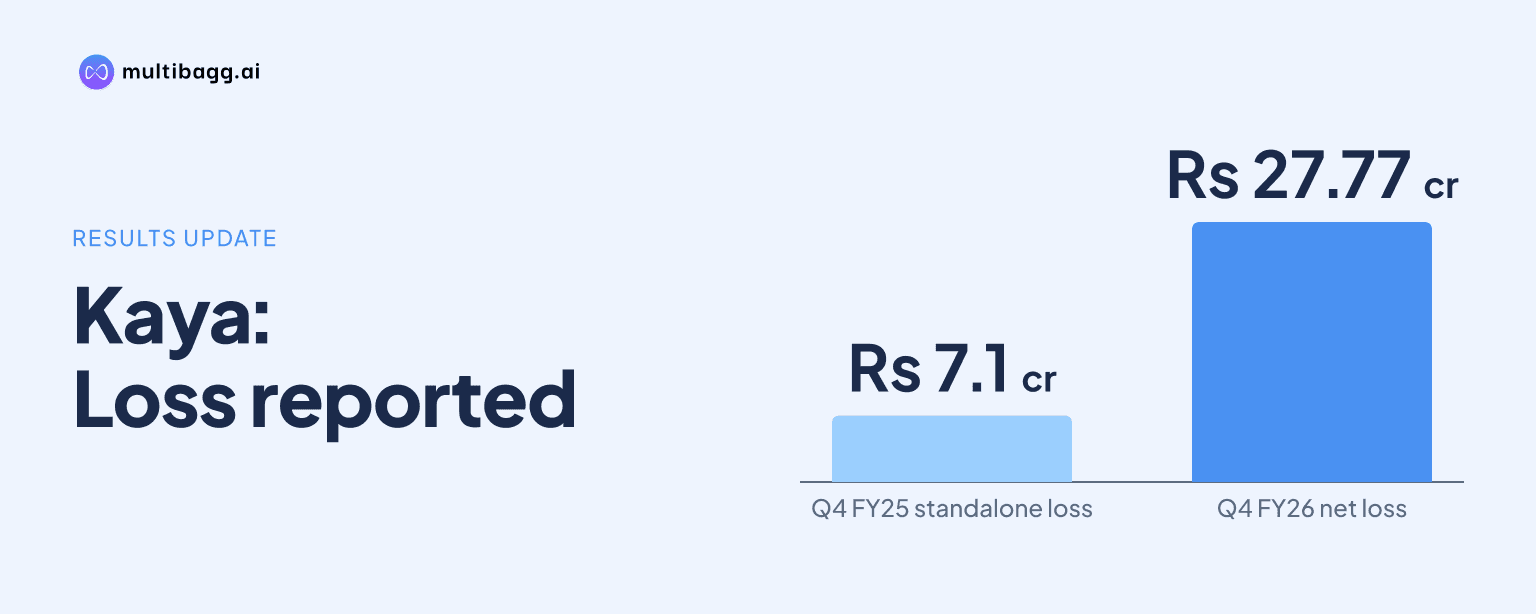
Kaya Limited reported a standalone loss of ₹7.1 crore in Q4 FY25 despite a 3% increase in revenue, underlining the company’s continuing profitability challenge in an aesthetics market stated to be growing at 17% annually. The disclosure comes alongside a later suspension of trading in Kaya shares pending financial-result announcements.
Know Kaya inside out
Results, valuation, peers and who's buying, in one view.
Why did Kaya Limited report a Q4 FY25 loss despite higher revenue?
Kaya Limited reported a standalone loss of ₹7.1 crore for Q4 FY25 even as revenue increased 3% from the corresponding period. The available information does not provide the absolute quarterly revenue figure, expense break-up, or management explanation for the loss. It therefore establishes revenue growth and the reported loss, but does not identify the specific cost or operating factors behind the outcome.
The result highlights the difference between top-line expansion and profitability for Kaya. A revenue increase does not automatically translate into earnings when operating costs, finance costs, clinic expenses, marketing spending, or other charges remain high. The source data does not quantify these items for Q4 FY25, so their relative contribution cannot be determined from the disclosed information.
Kaya operates in the aesthetics segment, where the market is described as growing at 17% annually. The reported Q4 FY25 loss indicates that market growth alone had not removed the company’s financial pressures. For investors, the central issue remains whether revenue growth can be converted into a sustained improvement in operating performance.
What do Kaya Limited’s FY26 results show about its financial position?
Kaya Limited’s reported FY26 figures show higher revenue but continued losses. For Q4 FY26, revenue from operations rose 2% to ₹55.8 crore from ₹54.7 crore in the corresponding quarter of the previous year, while net loss was ₹27.77 crore at both standalone and consolidated levels.
For the financial year ended March 31, 2026, Kaya reported consolidated revenue from operations of ₹2,224.76 crore, compared with ₹2,171.68 crore in the preceding year. It reported a consolidated net loss of ₹961.73 crore for FY26, compared with a consolidated net profit of ₹836.75 crore in the previous year. The source describes these as audited results approved by the board on May 20, 2026, with an unmodified auditor opinion.
A separate ICICI Direct financial table lists sales of ₹222.48 crore for March 2026, against ₹217.42 crore for March 2025, along with a loss after tax of ₹96.13 crore for March 2026. These figures are presented separately from the reported consolidated annual results. Investors should distinguish the reporting basis and scope of each financial disclosure rather than treating differently labelled figures as directly comparable.
Why are Kaya Limited shares suspended from trading?
Kaya Limited shares have been suspended from trading since October 1, 2026, and the suspension is set to continue until 48 hours after the company declares its financial results, according to the filing cited in the source material. No share-price movement can be assessed during the suspension period because trading is not taking place.
The company said it would hold a board meeting on November 6, 2026, to consider and approve unaudited standalone financial results for the quarter and half year ended September 30, 2026. The board was also to consider the limited review report issued by the statutory auditors. The article data separately refers to a board meeting scheduled for November 3, 2026, creating differing dates in the supplied updates.
The company’s investor-information material says quarterly and annual results are published on its website and in newspapers. It also confirms that audited results for the quarter and year ended March 31, 2026 were approved on May 20, 2026, while newspaper extracts for the quarter ended June 30, 2026 were published on August 5, 2026.
Got a follow-up? Ask IRIS
How do Kaya Limited’s longer-term financial trends compare?
Kaya’s longer-term data show modest sales expansion alongside weak profit trends. The ICICI Direct table reports a 10-year sales CAGR of 1.53%, while operating profit and profit after tax CAGRs are shown at negative 23.89% and negative 22.31%, respectively. These figures point to a long period in which earnings have not kept pace with sales.
The same table records sales rising from ₹178.31 crore in March 2023 to ₹222.48 crore in March 2026. But it shows operating profit of negative ₹23.17 crore in March 2026 and profit after tax of negative ₹96.13 crore. Operating profit was ₹26.49 crore in March 2025, while profit after tax was negative ₹26.51 crore in that year.
Finance costs are also material in the table, rising to ₹37.63 crore in March 2026 from ₹32.41 crore in March 2025. The supplied figures do not explain the drivers of this change. Still, the reported data show that sales growth has been accompanied by volatile operating results and recurring losses.
What does the suspension and loss mean for investors and operations?
The trading suspension limits investors’ ability to buy or sell Kaya shares until 48 hours after the relevant financial results are declared. The next disclosed financial review covers the quarter and half year ended September 30, 2026, making that result important for updated information on revenue, losses, and the company’s financial position.
For the business, the disclosed Q4 FY25 and FY26 outcomes show that revenue growth has not yet consistently delivered profitability. The 17% annual market-growth figure provides sector context, but Kaya’s reported losses show that company-level financial performance remains the more immediate consideration. No turnaround target, capital plan, clinic expansion plan, or earnings forecast is included in the supplied information.
Conclusion
Kaya Limited’s ₹7.1 crore standalone Q4 FY25 loss, despite 3% revenue growth, is consistent with the broader pattern in the supplied financial data: sales have grown, but profitability has remained under pressure. The FY26 disclosures, including a ₹27.77 crore Q4 loss and a ₹961.73 crore consolidated annual loss, reinforce the importance of examining margins and losses alongside revenue growth.
The next item to watch is the board’s consideration of unaudited standalone results for the quarter and half year ended September 30, 2026, along with the statutory auditors’ limited review report. Kaya has stated that trading will remain suspended until 48 hours after the financial results are declared.