










KIMS targets 10,000-plus beds after reaching 26 hospitals
Key highlights
- KIMS increased its hospital count from 12 in 2024 to 26 in 2026.
- KIMS lists a 10,033-bed roadmap across six states.
- Andhra Pradesh and Telangana account for 6,556 of KIMS’s listed beds.
- KIMS identifies a 700-plus-bed opportunity through greenfield, acquisition and O&M routes.
powered by IRIS
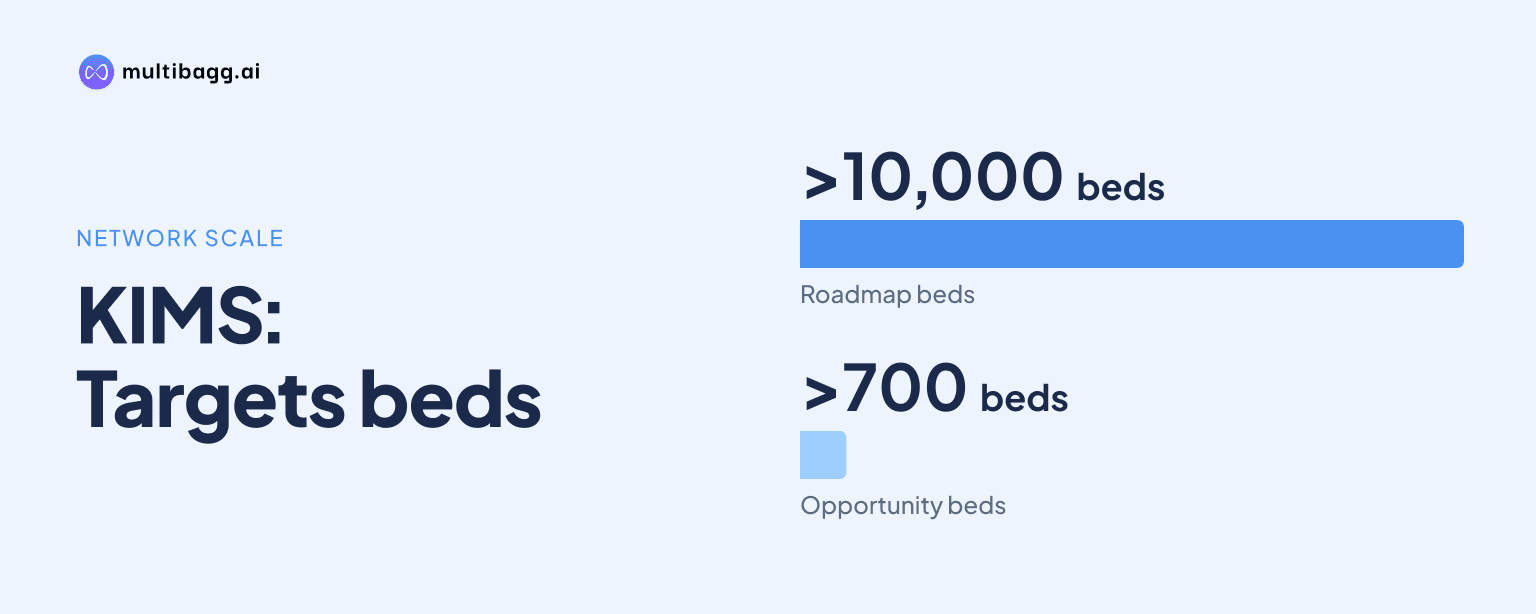
KIMS Hospitals lists a 10,033-bed network across six states after its hospital count increased from 12 in 2024 to 26 in 2026. The largest capacities are 3,447 beds in Andhra Pradesh and 3,109 in Telangana, while management identifies a further 700-plus-bed expansion opportunity through greenfield projects, acquisitions and operation-and-maintenance arrangements.
Know Krishna Institute of Medical Sciences inside out
Results, valuation, peers and who's buying, in one view.
How quickly has KIMS expanded its hospital network?
KIMS increased its hospital count from 12 in 2024 to 26 in 2026, adding 14 hospitals over the two-year period shown in its annual performance record. The network had remained at 12 hospitals in both 2022 and 2024, before rising to 18 in 2025 and then 26 in 2026.
The increase followed a longer expansion path from one hospital in 2005 to nine in 2020 and 12 in 2022. KIMS reported total revenue of Rs 26.3 crore in 2005, compared with Rs 3,930.8 crore in 2026, and states that revenue recorded a compound annual growth rate, or CAGR, of 26.9% between 2005 and 2026.
Revenue rose by Rs 1,416.5 crore between 2024 and 2026 while the hospital count more than doubled from 12 to 26. The presentation does not disclose whether every hospital in the count is owned, acquired or operated under an operation-and-maintenance, or O&M, arrangement, but its capacity roadmap identifies O&M sites separately for several locations.
What does KIMS mean by its 10,000-plus-bed roadmap?
KIMS’s roadmap totals 10,033 beds across Andhra Pradesh, Telangana, Maharashtra, Keralam, Karnataka and Tamil Nadu. Andhra Pradesh is the largest listed market at 3,447 beds, followed by Telangana at 3,109 beds; together, these two states account for 6,556 beds of the stated total.
The roadmap combines facilities dated from 2000 through 2026 with projects marked as planned. It also includes O&M facilities, such as the 200-bed Guntur Shikara site and 100-bed Guntur Chakra site in Andhra Pradesh, the 350-bed Sangli site in Maharashtra, and the 351-bed Thrissur site in Keralam.
KIMS’s largest individual listed facility is the 1,000-bed Secunderabad hospital, dated 2004. The 2026 entries include 787 beds at Kondapur II in Telangana, 250 beds at Anantapur II in Andhra Pradesh, 208 beds at Palakkad in Keralam and 250 beds at the Arete O&M site in Telangana.
Which states account for KIMS’s planned capacity?
KIMS’s listed capacity is concentrated in Andhra Pradesh and Telangana, which together represent about two-thirds of the 10,033-bed roadmap. Andhra Pradesh includes 434 beds at Vizag, 335 at Vizag II, 250 at Nellore and 183 at Kakinada, while Telangana includes 1,000 beds at Secunderabad, 369 at Begumpet and 787 at Kondapur II.
Maharashtra is the third-largest listed market with 1,309 beds, followed by Keralam with 1,068 beds and Karnataka with 800 beds. Maharashtra includes 334 beds at Nagpur, 325 at Nashik, 350 at Sangli O&M and 300 at Thane; Karnataka comprises 450 beds at Mahadevapura and 350 at Electronic City, both dated 2025.
Tamil Nadu represents 300 beds through a planned Chennai facility. Management describes its approach as a regional market leadership strategy focused on building presence in target geographies, and the capacity schedule shows that the expansion extends beyond its Andhra Pradesh and Telangana base into Maharashtra, Keralam, Karnataka and Tamil Nadu.
Got a follow-up? Ask IRIS
What expansion does KIMS still have planned?
KIMS identifies an opportunity to add more than 700 beds through greenfield development, acquisitions and O&M opportunities. Its rows explicitly marked planned comprise Rajahmundry II with 350 beds, Ongole with 50 beds and Chennai with 300 beds, which together total 700 beds.
The company does not provide capital expenditure, commissioning dates or acquisition targets for this 700-plus-bed opportunity. The wording indicates that management expects the next phase to use more than one route, rather than relying solely on greenfield hospital construction.
KIMS also cites strategic doctor partnerships involving equity participation as a future-growth lever. Management says a recent acquisition moved from a single-digit earnings before interest, tax, depreciation and amortisation, or EBITDA, percentage to a double-digit EBITDA percentage after integration, but the presentation neither identifies the asset nor discloses the underlying percentages.
How have KIMS revenue and EBITDA changed during expansion?
KIMS reported EBITDA of Rs 758.4 crore in 2026, compared with Rs 620 crore in 2024, while total revenue increased to Rs 3,930.8 crore from Rs 2,514.3 crore. The company reports a 28.1% EBITDA CAGR between 2005 and 2026, using EBITDA before Indian Accounting Standards, or Ind AS, adjustments and other income.
Revenue and EBITDA did not move in the same direction in the final two years listed. Revenue rose from Rs 3,067 crore in 2025 to Rs 3,930.8 crore in 2026, while EBITDA decreased marginally from Rs 759 crore to Rs 758.4 crore; the presentation does not provide segment profitability, occupancy, cost or margin data to explain that movement.
KIMS links its model to affordable healthcare, transplant programmes and medical technology. Its technology schedule says new four-arm high-definition da Vinci robotic surgical systems were procured for Secunderabad, Kondapur, Nagpur and Kannur, covering locations in Telangana, Maharashtra and Keralam that also appear in the multi-state capacity plan.
Conclusion
KIMS has outlined a shift from 12 hospitals in 2024 to 26 in 2026 alongside a 10,033-bed roadmap spanning six states. Andhra Pradesh and Telangana remain the central markets with 6,556 beds combined, while Maharashtra, Keralam and Karnataka broaden the network beyond its established base.
The next item to watch is execution of management’s stated 700-plus-bed opportunity through greenfield projects, acquisitions and O&M arrangements. The disclosed planned projects total 700 beds at Rajahmundry II, Ongole and Chennai, but KIMS has not provided project costs, opening dates or details of any potential acquisitions.