








Kiri Industries Limited Sets FY28 Downstream Copper Start

Find your next multibaggerBe a Pro Investor
Research stocks and track your picks on the go. Download the app.
Key highlights
- Kiri plans about 2.6 lakh tonnes of downstream copper capacity to operate in FY28.
- Kiri places its smelter, fertilizer and precious-metal refining units in FY29.
- Management indicated 5 lakh tonnes of copper and 11 lakh tonnes of fertilizer output once operations start.
- Kiri said it has visibility for almost 80% of copper concentrate and semi-finished input requirements.
powered by IRIS
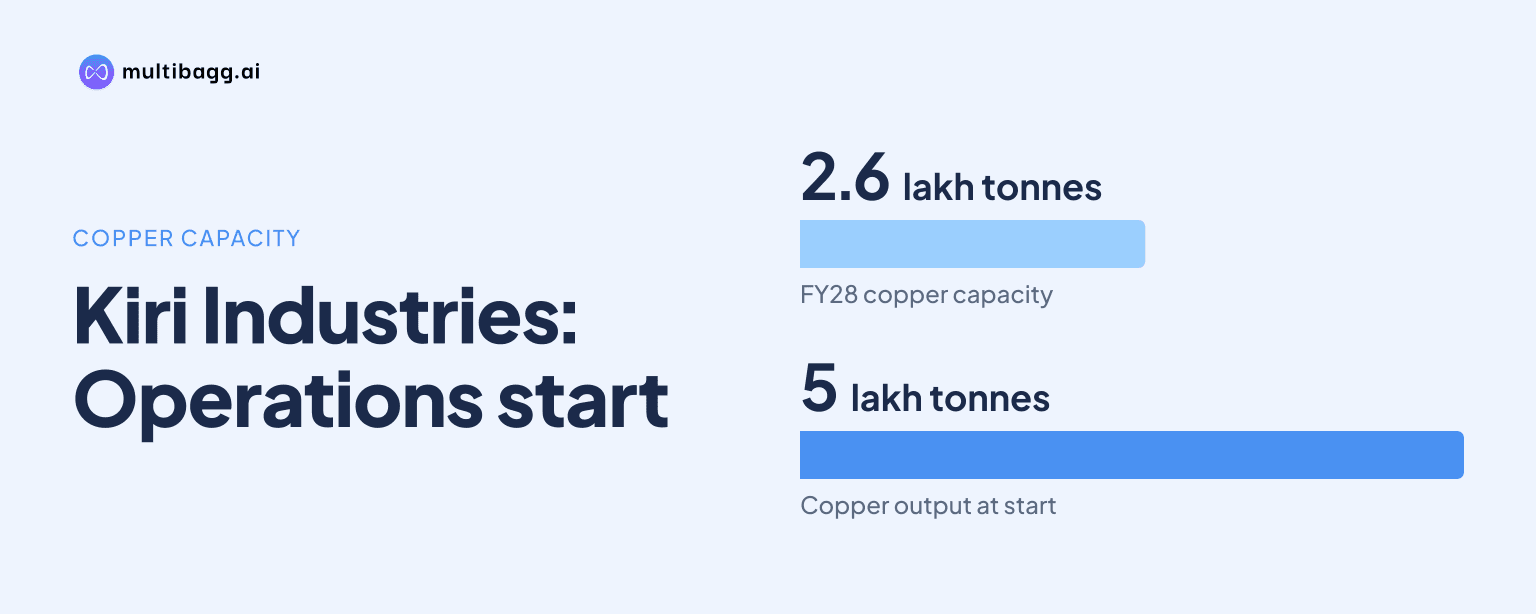
Kiri Industries Limited plans to bring almost all downstream copper products into operation in FY28 with about 2.6 lakh tonnes of downstream capacity, before the smelter, fertilizer, precious-metal refining and other units are scheduled for FY29. Management described a phased start-up rather than commissioning the full copper complex at once.
Know Kiri Industries inside out
Results, valuation, peers and who's buying, in one view.
When will Kiri’s copper operations begin?
Kiri said almost all downstream copper products are expected to be operational in 2027-28, identified during the call as the next financial year and referred to as FY28. Management placed the smelter, fertilizer, precious-metal refining and other units in 2028-29, or FY29, creating a one-financial-year separation between the downstream phase and later integrated operations.
The FY28 statement applies to “almost all” downstream products, rather than every asset in the broader copper project. Management separated the downstream facilities from the furnace-linked smelter and refining operations, which matter because Kiri said it expects to make copper cathodes itself when its furnaces become operational in FY29.
The schedule therefore does not indicate that all copper-related capacity will be available in FY28. It indicates that Kiri intends to begin with downstream processing capacity of 2.6 lakh tonnes, while the operations that can produce cathodes and process additional copper-bearing materials are planned for FY29.
How much downstream copper capacity will Kiri have in FY28?
Kiri said the combined downstream facilities would have around 2.6 lakh tonnes of copper capacity in FY28. Management explicitly corrected an analyst who described the figure as total capacity, saying that it represented downstream capacity instead.
That clarification distinguishes the FY28 capacity figure from the 5 lakh tonnes of copper management mentioned in response to a question about production once operations start. The call did not provide a year-by-year production forecast, first-year utilisation level or a split of the 5 lakh-tonne copper figure between the FY28 downstream assets and the FY29 units.
Management also cited 11 lakh tonnes of fertilizer output once operations start. However, it did not specify whether that output would be reached in FY29, identify a first-year fertilizer production target, or disclose the capacity utilisation assumed for either the copper or fertilizer operations.
The comparison is consequently between two different measures: 2.6 lakh tonnes is stated downstream copper capacity for the earlier phase, while 5 lakh tonnes of copper and 11 lakh tonnes of fertilizer were described as output levels after start-up. Kiri did not provide enough detail in the call to treat those output figures as annual guidance for the initial commissioning periods.
Which units are scheduled for Kiri’s FY29 phase?
Kiri said the smelter, fertilizer, precious-metal refining and other units are expected to be operational in FY29. These assets follow the FY28 launch of downstream products and form the later part of the integrated development management outlined during the call.
The smelter and furnace operations have a different role from the downstream phase because management said they would allow Kiri to make cathodes itself. Once furnaces are operating, Kiri said it could process blisters, anodes, scrap and other secondary materials, alongside cathodes, subject to managing the cost of the inputs.
Fertilizer is also included in the FY29 group, with management indicating 11 lakh tonnes of output once operations start. The transcript does not break out fertilizer capacity from copper facilities, give a separate commissioning date during FY29, or state whether precious-metal refining will begin at the same time as smelting.
The phased sequence means Kiri would initially depend more heavily on externally sourced copper inputs for its downstream operations. The later furnace operations are relevant because management expects them to broaden the material that can be processed, including secondary material available in the market.
Got a follow-up? Ask IRIS
How does Kiri plan to source copper before its furnaces operate?
Kiri said it had visibility for almost 80% of its total requirement for copper concentrate and other copper semi-finished products after its team attended London Metal Exchange Week about a month before the call. Management said suppliers had given further quantitative assurances and that its sourcing book was building towards the project’s needs.
Management did not disclose how the nearly 80% visibility was divided between copper concentrate, cathodes, scrap and other semi-finished materials. It also did not state whether that visibility consisted of contracts, supplier discussions, volume allocations or another form of supply arrangement.
For copper cathodes, Kiri said Japanese cathodes are duty-free in India under the India-Japan bilateral treaty and are therefore preferred. Management estimated that Japanese cathodes entering India total around 2 lakh tonnes, but said this is insufficient for India’s overall requirement and that cathodes from other origins carry duty.
Kiri identified the blended average cost of cathodes as the issue to manage before furnace operations begin, rather than describing availability as the main constraint. The company said it would need to combine duty-free Japanese material where available with dutiable imports from other origins until it can make cathodes and process blisters, anodes, scrap and other secondary material.
What remains unresolved in Kiri’s commissioning plan?
Kiri has disclosed an FY28 target for about 2.6 lakh tonnes of downstream capacity and an FY29 target for smelting, fertilizer and refining units, but it has not disclosed an annual operating ramp. The 5 lakh-tonne copper and 11 lakh-tonne fertilizer figures were stated as output once operations start, without a defined financial-year allocation.
Input economics also remain a disclosed variable for the period before furnaces operate. Japanese cathodes are duty-free but limited to around 2 lakh tonnes entering India, while other origins attract duty, meaning Kiri will need to manage a blended input cost as it starts the downstream phase.
Management’s almost 80% sourcing visibility provides an indication of progress in lining up copper concentrate and semi-finished inputs. Yet the call did not quantify the remaining requirement, identify the mix of raw materials, or explain how input availability and cost would vary between the FY28 downstream start and the FY29 furnace-linked operations.
The company also did not disclose capital expenditure milestones, commissioning dates within FY28 or FY29, or individual throughput targets for smelting and precious-metal refining. These omissions limit the ability to measure the speed at which the stated 2.6 lakh-tonne downstream capacity could translate into the eventual 5 lakh-tonne copper output mentioned by management.
Conclusion
Kiri’s stated plan separates the project into an earlier FY28 downstream phase and a later FY29 integrated phase. The first milestone is about 2.6 lakh tonnes of downstream copper capacity, while the second adds smelting, fertilizer, precious-metal refining and furnace operations that management associated with 5 lakh tonnes of copper and 11 lakh tonnes of fertilizer output once operations start.
The next points to watch are whether Kiri maintains its FY28 and FY29 timetable, converts nearly 80% sourcing visibility into supply arrangements, and discloses an operating ramp for the downstream facilities. Management will also need to balance the cost of limited duty-free Japanese cathodes, estimated at around 2 lakh tonnes entering India, against dutiable material from other origins before furnace operations begin.

