










Kirloskar Ferrous Industries Limited Revenue Rises 17% in Q2 FY27
Key highlights
- KFIL reported Q2 FY27 standalone revenue from operations of ₹2,046.7 crore, up 16.6% year on year.
- KFIL's Q2 FY27 profit after tax rose 10.3% to ₹97.6 crore, while profit before tax increased 15% to about ₹138 crore.
- KFIL's EBITDA margin declined to 10.9% from 12.2% as material costs rose to 57.7% of revenue.
- KFIL spent ₹274 crore on capital expenditure year to date in FY27.
powered by IRIS
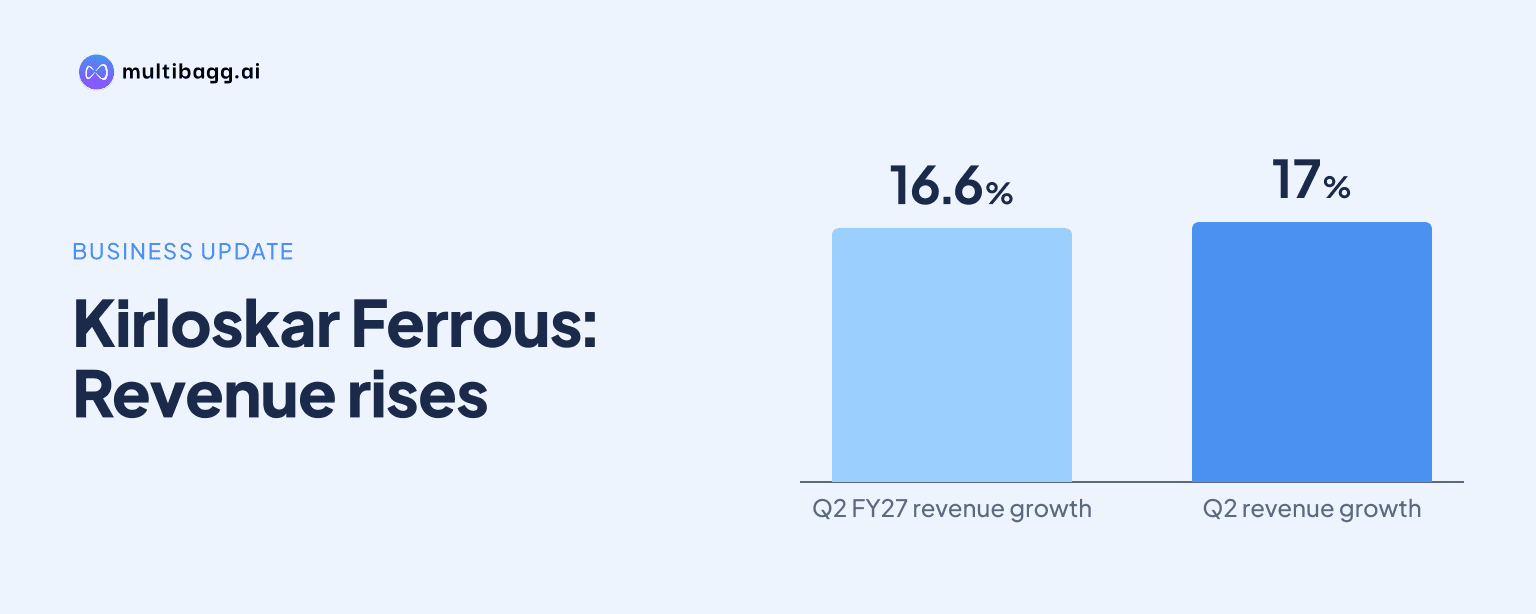
Kirloskar Ferrous Industries Limited reported standalone revenue from operations of ₹2,046.7 crore in Q2 FY27, up 16.6% year on year, supported by higher volumes across its castings and steel businesses. Profit after tax rose 10.3% to ₹97.6 crore, although EBITDA margin declined by 130 basis points to 10.9% as material costs increased.
Know Kirloskar Industries inside out
Results, valuation, peers and who's buying, in one view.
How did KFIL perform in Q2 FY27?
KFIL recorded broad-based volume growth during the quarter ended September 30, 2026, helping standalone revenue from operations rise from the corresponding period a year earlier. The company reported profit before tax of about ₹138 crore, a 15% year-on-year increase, while profit after tax increased from ₹88.5 crore in Q2 FY26 to ₹97.6 crore in Q2 FY27.
The revenue growth was ahead of profit growth because operating profitability was affected by a higher cost of materials. EBITDA margin was 10.9%, compared with 12.2% in the year-ago quarter. The financial update was filed by KFIL under the SEBI Listing Regulations and forwarded by parent Kirloskar Industries Limited as its material subsidiary's result disclosure.
What drove KFIL's revenue growth?
KFIL said volume growth in the castings and steel divisions supported the increase in revenue. Castings volumes rose 20% year on year to 47,888 metric tonnes, while steel volumes increased 34% to 26,606 metric tonnes. Pig iron volumes grew 3% to 134,940 metric tonnes.
Tubes volumes were broadly stable, with a 2% decline reported for the quarter. Realisations improved in several product categories. Pig iron realisations rose 16% year on year to ₹43,054 per metric tonne, castings realisations increased 8% to ₹132,192 per metric tonne, and steel realisations rose 11% to ₹77,523 per metric tonne.
The combination of higher realisations and higher dispatch volumes explains the top-line expansion across KFIL's principal product lines. The result also indicates that growth was not limited to one segment, although the extent of volume improvement differed across products.
Got a follow-up? Ask IRIS
Why did KFIL's EBITDA margin decline?
KFIL's EBITDA margin fell to 10.9% because material costs took a larger share of revenue in Q2 FY27. Material costs accounted for 57.7% of revenue during the quarter, compared with 55.2% in Q2 FY26, placing pressure on the operating margin despite higher sales.
The margin movement is relevant for investors because KFIL's profit after tax increased at a slower rate than revenue. Revenue grew 16.6%, while profit after tax rose 10.3%. The reported figures show that the company retained year-on-year earnings growth, but with a lower operating margin than in the corresponding quarter.
No share-price movement or market reaction was provided in the disclosure. The available financial information therefore establishes the operational trend in revenue, volumes and margins, without indicating how investors valued the update in trading.
What capital expenditure and operating initiatives is KFIL pursuing?
KFIL spent ₹274 crore on capital expenditure year to date in FY27. The company said its priorities include cost leadership and a higher-value product mix, alongside continued capacity-related investments.
Its disclosed initiatives include pulverised coal injection and oxygen enrichment at blast furnaces, intended to reduce coke consumption. KFIL is also expanding machining capacity and introducing new foundry lines at Solapur to address large-casting opportunities. These projects are part of the company's stated operating programme, while their financial contribution was not quantified in the quarterly update.
KFIL's listed status makes its results material to Kirloskar Industries Limited shareholders, as the parent company has identified KFIL as a material subsidiary. Kirloskar Industries also reported governance updates, including shareholder approval of Sandeep Gokhale's appointment as an independent director for a five-year term from September 1, 2026 to August 31, 2031.
Conclusion
KFIL delivered 16.6% revenue growth in Q2 FY27, backed by stronger castings and steel volumes and higher realisations across key categories. However, the increase in material costs reduced EBITDA margin to 10.9%, meaning earnings growth did not fully match the pace of revenue expansion.
Investors will watch KFIL's cost-control measures, the progress of its ₹274 crore year-to-date capital expenditure programme, and the rollout of blast-furnace and machining initiatives. The company has also outlined new foundry lines at Solapur for large castings, but has not disclosed a specific timeline or financial target for these projects.