










KMEW raises FY27 growth guidance to 80%, sees EBITDA above 45%
Key highlights
- KMEW raised FY27 revenue-growth guidance to 80% from 60%, after an initial 30% to 40% range.
- Management said EBITDA margin should stabilise above 45%, compared with its earlier 35% to 40% projection.
- KMEW expects its new dredging vessel to generate more than Rs 150 crore of annual revenue.
- KMEW disclosed an order book of Rs 1,700 crore and a bid pipeline of Rs 2,500 crore to Rs 3,000 crore.
powered by IRIS
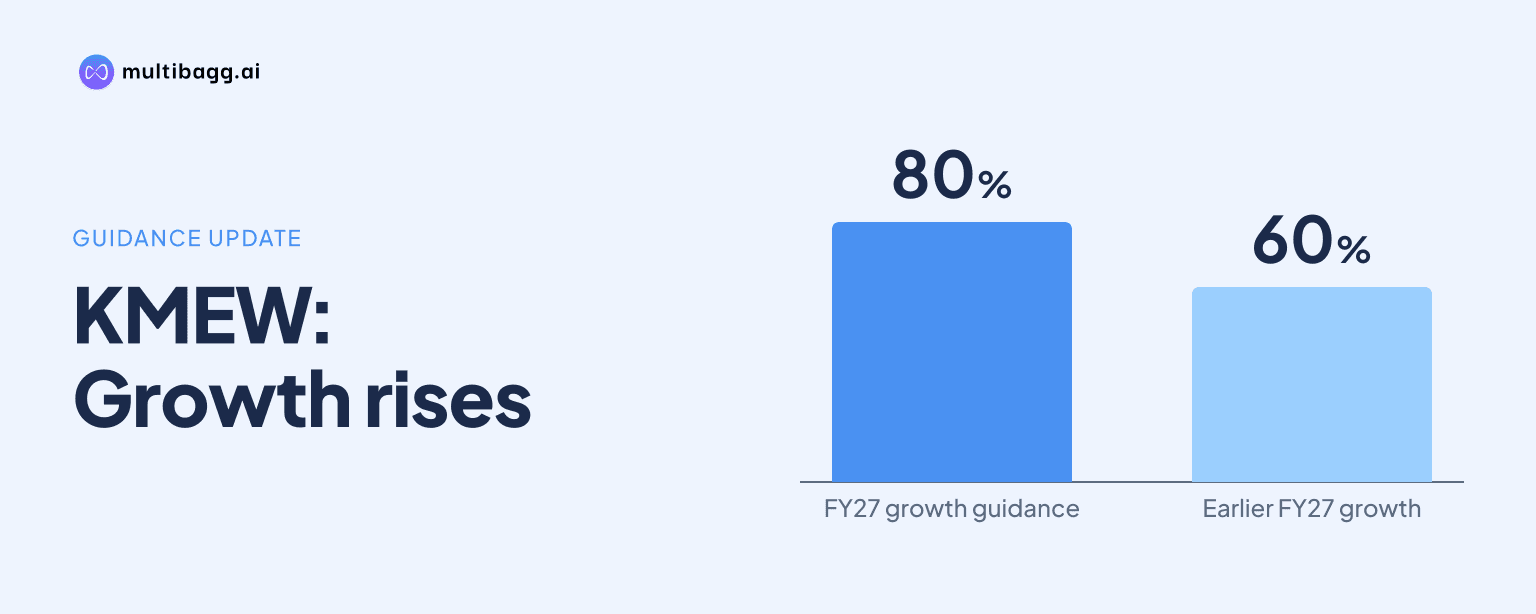
KMEW has raised its FY27 revenue-growth guidance to 80% from 60%, based on current and expected order inflows, while management said EBITDA margin should stabilise above 45%. The revised outlook follows a first-half EBITDA margin of about 50% to 55%, according to management, compared with its earlier margin projection of 35% to 40%.
Know Knowledge Marine & Engineering Works inside out
Results, valuation, peers and who's buying, in one view.
Why did KMEW raise its FY27 growth guidance?
KMEW raised its FY27 revenue-growth guidance to 80% because management cited current order inflow and expected further inflow. The company had initially projected FY27 growth of 30% to 40%, before increasing that range to 60%. Management confirmed on the call that the latest 80% figure applies to FY27 and is guidance rather than reported revenue.
The change from the initial 30% to 40% range to 80% represents a materially higher sales expectation, supported by activity in dredging, chartering and shipbuilding. Management said revenue, EBITDA and profit after tax had all expanded as volume business increased. It added that future revisions would depend on orders in hand, additions to the order book and bids that meet its stated operating criteria.
KMEW disclosed a current order book of Rs 1,700 crore and bids in the pipeline worth Rs 2,500 crore to Rs 3,000 crore. Management said the pipeline is dynamic and changes daily, but it expects the order book to remain above Rs 2,000 crore on a continuing basis in the following year. An analyst referred to management aiming for Rs 450 crore of revenue in the current year and Rs 650 crore to Rs 700 crore in the next year, but management did not independently restate those absolute targets.
What EBITDA margin does KMEW expect going forward?
KMEW expects EBITDA margin to be more than 45% once operations stabilise, above its earlier 35% to 40% projection. Management attributed the revised margin expectation to scalable volumes and said it was still assessing where a durable level of confidence should lie over the next two to three years.
Management said first-half EBITDA margin was close to 50% to 55%. During the same discussion, an analyst cited a second-quarter margin of around 40%, as well as earnings before interest and tax margins of about 35% to 38% for shipbuilding and repairs and about 50% for dredging. Management said margin could expand to 50% to 55% during the period before the business reaches a stable level.
The margin outlook is linked to the mix and execution of KMEW's contracts rather than to a fixed annual EBITDA target. Management said it did not see a challenge or contraction in margins on contracts currently in hand because they had been planned and execution was on track. It also acknowledged that all three operating segments face competitors in bids, while maintaining that execution capabilities have helped it secure orders.
Got a follow-up? Ask IRIS
How will dredging work support KMEW's revised outlook?
KMEW expects its recently purchased dredging vessel to generate more than Rs 150 crore of annual revenue and handle 8 million to 10 million cubic metres of maintenance dredging each year. Management estimated combined maintenance-dredging demand at major and minor ports at about 150 million cubic metres annually, placing the vessel's planned volume within that larger market.
The vessel was expected to begin work for New Mangalore Port before November 15, as required by the customer, and then move to another project. KMEW said it had already bid for several contracts at other major ports and at defence and naval establishments on India's west coast. Management expected bid outcomes during the current month and said it was confident of meeting the Rs 150 crore annual revenue target for the vessel.
Management said vessel transfers between contracts should take less than 15 days in a 365-day period. It described the asset as a self-propelled vessel capable of 13-knot speed, allowing coastal movement without the constraints associated with smaller vessels. A second dredger has been identified and is waiting for a potential contract; KMEW said it would undertake the capital expenditure and bring in that vessel after the contract is finalised.
Chartering vessels deployed with ports were at 100% utilisation on long-term contracts, according to management. Dredging vessels are generally fully utilised from October to May after the monsoon period, and KMEW said all vessels operating around ports and on NW-1 and NW-16 were at 100% utilisation in October. This utilisation profile is relevant to the volume-led explanation for the upgraded revenue and margin outlook.
What will shipbuilding contribute to KMEW's expansion?
KMEW expects shipbuilding revenue to rise by three to four times in the current year from the previous year, after generating about Rs 40 crore from shipbuilding in the present quarter. Management said revenue from the acquired shipyard had already started flowing while construction and infrastructure development continued at the site.
Management projects shipbuilding will provide 40% of total revenue in FY28 and FY29, while dredging and chartering will account for the other 60%. Complete commissioning of the Saphale shipyard is planned after Q4 FY27. Until then, KMEW said yard construction and infrastructure development would continue in parallel with vessel construction.
Shipbuilding contracts use staged payments tied to five to 10 construction milestones certified by class or flag authorities, management said. KMEW also has the option to draw 10% of a contract's value initially by providing advance bank guarantees or insurance surety bonds. Management said this structure means shipbuilding currently does not require substantial working capital.
KMEW is discussing export orders with three clients, whose assessments of the shipyard are under way. Management said the potential size and scale of those orders cannot be known until commercial negotiations close. It also said current shipbuilding contracts were progressing to schedule, with no delay penalties or complications disclosed during the call.
Conclusion
KMEW's revised FY27 growth outlook reflects management's expectation that order inflows, a higher-volume dredging asset and rising shipbuilding activity will support 80% revenue growth. Its margin outlook has also moved higher, from 35% to 40% previously to more than 45% after stabilisation, although management indicated that margins may vary during the next two to three years.
The next disclosed milestones are the start of the New Mangalore assignment before November 15, the outcome of other port and defence bids, and full commissioning of the Saphale shipyard after Q4 FY27. Management is also executing a Rs 1,000 crore capital-expenditure programme over two years, of which six to seven months had elapsed, including spending on a large trailing suction hopper dredger, three green tugs and one conventional tug.