










Knowledge Marine H1 FY27 Revenue Rises 89%, PAT Jumps 267%
Key highlights
- KMEW reported H1 FY27 revenue of ₹186.21 crore, up 89% year on year.
- H1 FY27 profit after tax rose 267% to ₹84.27 crore, with a 45% PAT margin.
- KMEW reported a 55% H1 EBITDA margin versus earlier guidance of 35% to 40%.
- The confirmed order book was about ₹1,732 crore, and FY27 revenue-growth guidance was raised to about 80%.
powered by IRIS
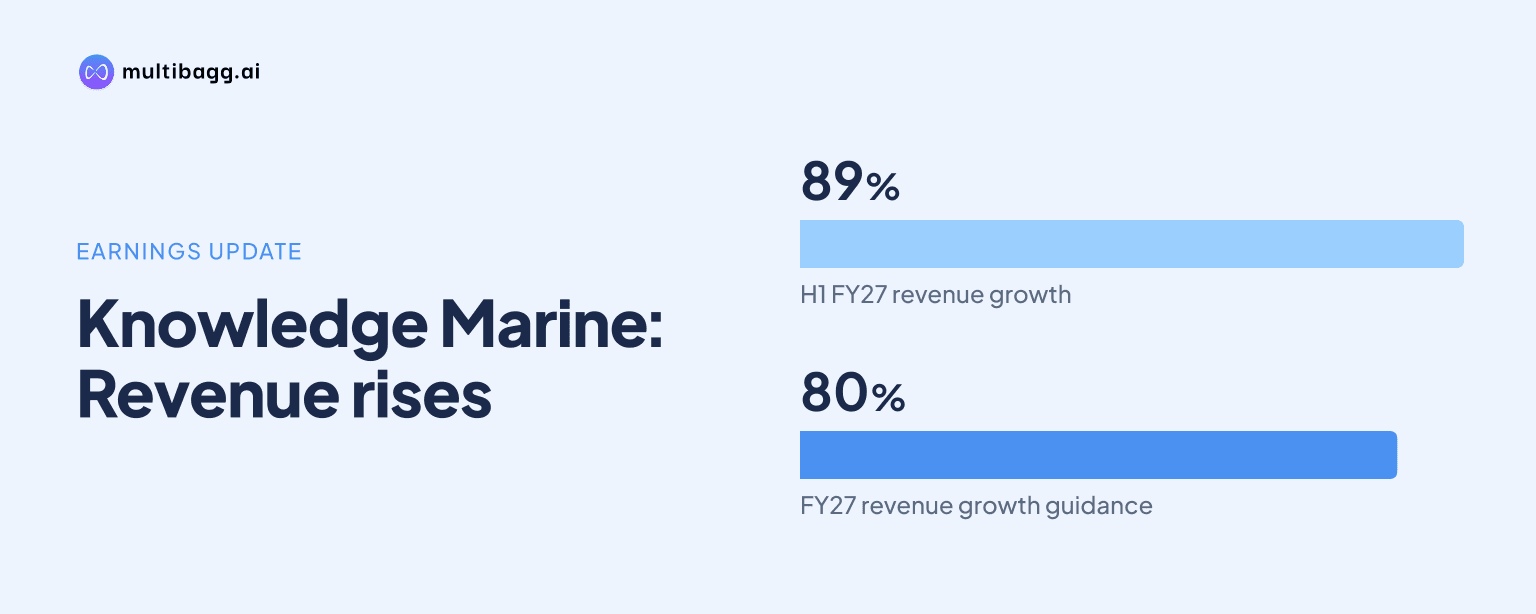
Knowledge Marine & Engineering Works Limited reported H1 FY27 revenue growth of 89% to ₹186.21 crore and profit after tax growth of 267% to ₹84.27 crore, supported by complex dredging projects and an expanded order book. The company also reported a 55% EBITDA margin and raised its FY27 revenue-growth guidance to about 80%.
Know Knowledge Marine & Engineering Works inside out
Results, valuation, peers and who's buying, in one view.
What did KMEW report for H1 FY27?
KMEW reported revenue from operations of ₹186.21 crore for H1 FY27, compared with ₹98.50 crore in H1 FY26, representing year-on-year growth of 89%. EBITDA rose 155% year on year to ₹101.71 crore, while profit after tax increased 267% to ₹84.27 crore. The reported PAT margin was 45%.
The results were discussed during the company's Q2 FY27 earnings call held on November 6, 2026. Management attributed the growth to execution of complex dredging projects, a significant dredging win and improved fleet utilisation. The H1 performance is particularly important because management described Q2 as seasonally soft, placing greater weight on execution in the second half.
Why did KMEW raise its FY27 growth guidance?
KMEW raised its FY27 revenue-growth guidance to about 80% from an earlier 60%, following the order book expansion and the stronger H1 performance. Management indicated that the revised outlook was supported by project execution, fleet efficiency and the scale of its existing confirmed work.
The company had earlier guided for an EBITDA margin of 35% to 40%, but reported a 55% margin in H1 FY27. Management said it expects EBITDA margin to remain above 45%. The margin outperformance was a major feature of the call because the achieved H1 level was above the upper end of the prior guidance range.
Management also referred to growth assumptions of 40% to 60% for later years, although the exact fiscal-year mapping was not fully clarified in the available call summary. Investors therefore have a stated FY27 growth outlook, but should distinguish it from longer-term references made during the discussion.
What is KMEW's order book and tender position?
KMEW said its confirmed order book stood at about ₹1,732 crore and reiterated a target to sustain it above ₹2,000 crore. The company also cited a demand pipeline of ₹3,500 crore at one stage of the call, while another reference placed the pipeline in the ₹2,500 crore to ₹3,000 crore range.
Pending tender outcomes remain important for the company's second-half delivery. Management had previously indicated that some tender results could arrive within 30 to 45 days, but they were still pending at the time of the November 6 call. As a result, the raised guidance is linked not only to the confirmed order book but also to the conversion and execution of available opportunities.
The company presented Indian dredging and inland-waterway activity as a substantial opportunity area. It also indicated that its operations have limited direct overlap with Dredging Corporation of India. This positioning reflects the company's focus on dredging and related marine operations, where equipment availability, project execution and tender awards affect revenue visibility.
Got a follow-up? Ask IRIS
What operational issues did KMEW identify?
KMEW said Bahrain operations remain paused and will not restart without acceptable safety and insurance conditions. This means the company is not treating a restart as a confirmed near-term contributor to its operating plan.
Management also said that assets from Myanmar remain deployed in India. Separately, the Safale commissioning could extend beyond Q4 FY27, according to the call summary. These points matter because deployment and commissioning schedules influence fleet availability and the pace at which awarded projects can be executed.
The company also revised the timing of some earlier plans. Its Phase I yard target was indicated as February 2027, compared with an earlier March 2027 expectation, while the ₹1,000 crore capital-expenditure plan was described over two years rather than the previously mentioned one-and-a-half years. These are execution milestones rather than reported financial results.
How does the H1 result affect KMEW investors and the dredging sector?
The H1 result gives investors measurable evidence of higher revenue, profitability and margin performance, with revenue at ₹186.21 crore and EBITDA margin at 55%. It also shows that KMEW's earnings in the first half were driven by operating project execution rather than only by a stated future pipeline.
At the same time, the company's second-half outcome depends on pending tenders, follow-on dredging work and project execution. Management's 80% FY27 revenue-growth guidance is an outlook, not a reported result. The paused Bahrain operations and possible Safale commissioning delay are additional operational factors disclosed during the call.
For the broader dredging and inland-waterway segment, KMEW's comments point to an active tender environment and a sizeable pipeline. But order pipelines are not equivalent to confirmed revenue. The confirmed order book of about ₹1,732 crore provides a clearer disclosed measure of work visibility than the wider pipeline figures.
Conclusion
KMEW's H1 FY27 performance was marked by 89% revenue growth, 267% PAT growth and a 55% EBITDA margin, with management linking the result to dredging-project execution and fleet utilisation. The company also raised FY27 revenue-growth guidance to about 80% and reported a confirmed order book of about ₹1,732 crore.
The next areas to watch are the outcome of pending tenders, delivery in H2 FY27, progress towards an order book above ₹2,000 crore, and the disclosed operational milestones for the Phase I yard and Safale commissioning. Bahrain's safety and insurance conditions will also determine whether operations there can resume.