










Knack Packaging Plans 70,000-Tonne Capacity, Pinch-Bottom Growth
Key highlights
- Knack Packaging plans to raise installed annual capacity from 42,000 tonnes to 69,000-72,000 tonnes.
- Knack Packaging targets 25,000-30,000 tonnes of pinch-bottom bags later in FY28, against 32,000 tonnes of planned installed capacity.
- Q2 FY27 sales volume was 11,252 tonnes, while overall plant utilisation was 90%-91%.
- Pinch-bottom bags accounted for 21% of revenue, compared with about 17%-18% in the prior year.
powered by IRIS
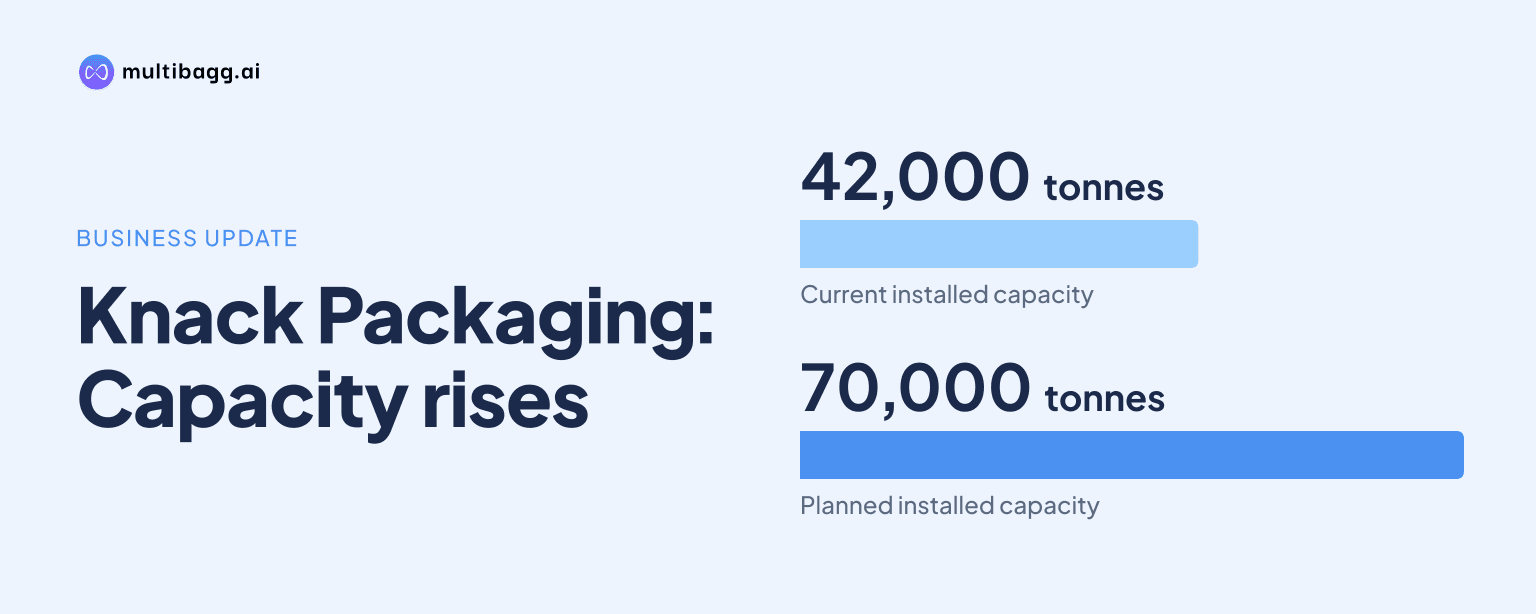
On October 28, 2026, Knack Packaging Limited said it plans to raise installed annual capacity from 42,000 tonnes to 69,000-72,000 tonnes and seek 25,000-30,000 tonnes of pinch-bottom bags later in FY28. Management’s plan follows overall plant utilisation of 90%-91% in Q2 FY27 and includes two additional pinch-bottom machines expected next October.
Know Knack Packaging inside out
Results, valuation, peers and who's buying, in one view.
How much capacity will Knack Packaging add?
Knack Packaging plans to lift installed annual capacity to 69,000-72,000 tonnes from 42,000 tonnes. That stated range implies an increase of 27,000-30,000 tonnes, although management separately described the new facility as adding about 30,000-32,000 tonnes annually. Management cited current production capacity utilisation equivalent to about 39,000-40,000 tonnes against the 42,000-tonne installed base.
The company added 5,040 tonnes of capacity in August and said the facility had begun ramping up. Management expected roughly 50% utilisation, or about 2,500 tonnes, from the addition in Q3 FY27. Q2 FY27 sales volume was 11,252 tonnes, up 3% from 10,940 tonnes in Q1 FY27 and 13%-14% from 9,927 tonnes in Q2 FY26, leaving the new capacity as a source of higher Q3 production and sales.
What is Knack Packaging’s pinch-bottom bag target?
Knack Packaging aims to produce 25,000-30,000 tonnes of pinch-bottom bags later in FY28, against planned installed pinch-bottom capacity of 32,000 tonnes within a potential 72,000-tonne total capacity base. Management said two additional pinch-bottom machines were expected next October, taking the machine count to seven from five already installed.
Pinch-bottom capacity is a conversion stage rather than a wholly separate upstream production line, according to management. Fabric first passes through tape-line, loom, gravure and laminated-fabric processes before it can be finished either as a regular bag or a pinch-bottom bag. With overall operations at 90%-91% utilisation in Q2 FY27, materially higher pinch-bottom output will require added upstream fabric capacity as well as a shift of some regular-bag production.
Why is Knack Packaging increasing its pinch-bottom mix?
Knack Packaging is increasing pinch-bottom output because management said the product offers better margins than regular PLWPP bags, which management described as printed laminated woven bags. Pinch-bottom bags supplied 21% of revenue at the time of the call, compared with about 17%-18% in the prior year. The increase indicates that the product-mix shift was already under way before the larger capacity expansion.
The newer pinch-bottom lines were operating at about 60%-70% utilisation after two machines were added, leaving scope for higher conversion on those lines. Management said shifting a customer from regular bags to pinch-bottom bags takes four to five months because designs must be finalised and customers may need to install filling machines. Machine availability alone, therefore, does not determine how quickly pinch-bottom revenue can grow.
Rice is the principal near-term application cited by management, which said Q3 is historically a better period for pinch-bottom demand as the rice season begins. Management said it had received orders for pinch-bottom bags and identified domestic rice sales as a major market. It also said PLWPP bags account for 71%-72% of its total business base, creating an existing customer pool for conversion to the pinch-bottom format.
Got a follow-up? Ask IRIS
Where does Knack Packaging expect demand for added capacity?
Knack Packaging expects demand from export markets, deeper sales to existing customers, new countries and customer conversion across 27 industries. Management named rice, grain, pulses, fertiliser, cement, seeds and pet food among the relevant end markets, and said the company exports to more than 72 countries. It also cited double-digit growth in India’s dog-food industry as an opportunity for its customer relationships.
Management described a progression from jute bags to polypropylene woven bags, then PLWPP bags and pinch-bottom bags for suitable customers. It said about 80% of the pinch-bottom opportunity is among users already buying PLWPP bags, rather than entirely new users. Management also said paper-bag users in Europe and the United States could migrate to its products, but did not quantify the potential sales or volumes from that opportunity.
An existing international customer extended a contract for three years with a minimum annual value of Rs 150 crore, management said during the call. Knack Packaging currently serves that customer in eight to nine countries, while management said the customer operates in more than 100 countries. Management said additional countries, product varieties and paper-bag conversions could expand the relationship, but these were expectations rather than disclosed contracted volumes.
How do utilisation and pricing affect Knack Packaging’s earnings?
Knack Packaging reported Q2 FY27 revenue of Rs 294.76 crore, up 52.5% from Rs 193.26 crore in Q2 FY26, while sales volume increased 13%-14% year on year to 11,252 tonnes. EBITDA, or earnings before interest, tax, depreciation and amortisation, rose 29.9% to Rs 49.77 crore. However, EBITDA margin declined to 16.35% from 19.25% as polymer and freight costs increased.
Management said raw-material prices rose about 26% between the beginning and end of Q2 FY27, while only 45%-50% of customers have contractual pass-through arrangements. It said monthly contractual revisions can take about three to three-and-a-half months to be reflected, while quarterly revisions can take about four to four-and-a-half months. Management expects pricing actions, Q3 seasonal demand and a larger pinch-bottom mix to improve performance, while noting that polymer prices remain a market variable.
For H1 FY27, revenue rose 47.2% to Rs 569.11 crore and EBITDA increased 41.5% to Rs 108.94 crore, although EBITDA margin eased to 19.14% from 19.91%. Profit after tax increased 34.5% to Rs 55.55 crore but included a Rs 6.06 crore loss from the Sayem Knack joint venture in Mexico. Management said the Mexico facility has 400 tonnes of monthly installed capacity and could approach break-even near 120 tonnes of monthly sales.
Conclusion
Knack Packaging’s expansion plan addresses a Q2 FY27 operating base that was already running at 90%-91% utilisation while directing more production towards pinch-bottom bags, which supplied 21% of revenue. The proposed 69,000-72,000-tonne annual capacity range and 25,000-30,000-tonne pinch-bottom target depend on completing upstream capacity additions and converting existing PLWPP customers.
The next disclosures to watch are Q3 FY27 utilisation of the 5,040 tonnes added in August, seasonal rice orders and the two pinch-bottom machines management expects next October. Management also expects price pass-through to be reflected after the Q2 FY27 cost increase, while the Mexico joint venture’s progress towards about 120 tonnes of monthly sales remains relevant to consolidated profitability.