










Kotyark targets 60-70% utilisation after 1,500-KLPD expansion
Key highlights
- Kotyark expanded Sirohi biodiesel capacity from 500 KLPD to 1,500 KLPD.
- Kotyark management targets utilisation of about 60-70%, compared with a current level of about 7-8%.
- Kotyark reports an order book of about Rs 233.45 crore, including Rs 173.45 crore from OMCs.
- Kotyark reported H1FY27 EBITDA of Rs 24.41 crore, up 30.19% year on year.
powered by IRIS
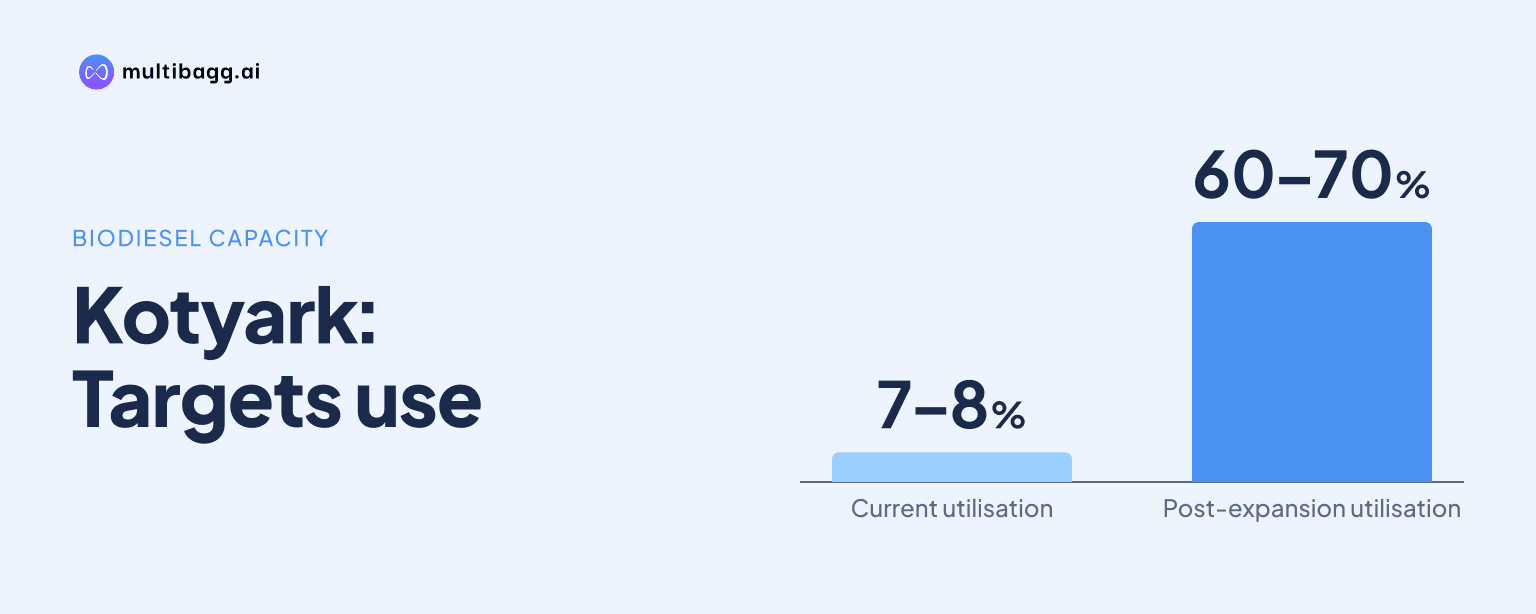
KOTYARK INDUSTRIES LIMITED targets biodiesel capacity utilisation of about 60-70% over the next two to three years, after expanding its Sirohi, Rajasthan plant threefold from 500 to 1,500 kilolitres per day (KLPD). Kotyark reported Sirohi utilisation of 5-6% on 31-03-2026 and describes overall utilisation at about 7-8%.
Know Kotyark Industries inside out
Results, valuation, peers and who's buying, in one view.
How much biodiesel capacity does Kotyark have?
Kotyark has installed biodiesel capacity of 4,80,000 kilolitres (KL) a year across two integrated facilities as of 31-03-2026. The Sirohi facility in Rajasthan has 1,500 KLPD of capacity, while the Anand facility in Gujarat has 100 KLPD. Kotyark also reports annual crude-glycerin capacity of about 63,000 KL.
The Rajasthan expansion increased Sirohi capacity from 500 KLPD to 1,500 KLPD, a threefold change. Kotyark’s presentation compares its post-expansion 1,500-KLPD capacity with a cited listed peer at about 100 KLPD and regional or emerging biodiesel players at typically below 50 KLPD. Installed capacity, however, does not represent actual output when plants are operating below their potential.
The site figures show that Anand operated at 30%, compared with 5-6% at Sirohi on 31-03-2026. Sirohi had 15 times Anand’s daily capacity, but a lower reported utilisation rate. Kotyark separately cites a current utilisation range of about 7-8%, without reconciling that group-level figure to the two disclosed site rates.
What is Kotyark’s utilisation target and timetable?
Kotyark management targets utilisation of about 60-70% over the next two to three years, against its stated current level of about 7-8%. Management links the intended increase to greater participation in oil marketing company (OMC) procurement, higher biodiesel-blending mandates and expanding industrial demand, rather than to another disclosed plant expansion.
FY27 is the first stage of Kotyark’s three-year roadmap. The plan calls for optimisation of existing annual biodiesel capacity of 4,80,000 KL and repeats the objective of lifting utilisation from 7-8% to 60-70%. This is a management target, not a reported production forecast or contracted operating rate.
FY28 priorities include expanding industrial and bulk-buyer presence, extending retail fuel-network reach and improving logistics integration. Kotyark also plans to improve glycerin-processing efficiency and increase supplies to pharmaceutical and personal-care sectors. For FY29, the roadmap proposes evaluating downstream biofuel opportunities, additional feedstock ecosystems and carbon-credit monetisation opportunities.
What could fill Kotyark’s expanded biodiesel capacity?
Kotyark identifies OMC tenders, bulk industrial sales and retail distribution as its routes to higher biodiesel volumes. Its customer presentation names IndianOil, Bharat Petroleum and Hindustan Petroleum as OMC customers, while its supply-chain presentation identifies direct deliveries to mining companies and transport contractors as industrial sales channels.
OMC supply is based on tenders rather than automatic offtake. OMCs assess registered suppliers on production capability, Bureau of Indian Standards (BIS) fuel compliance, documentation, pricing, depot proximity and logistics feasibility. Successful bidders receive allocation sheets, accept allocations, execute agreements and may subsequently receive letters of intent, purchase orders or supply indents.
Kotyark reports an order book of about Rs 173.45 crore from OMCs and about Rs 60 crore from other parties, totalling about Rs 233.45 crore. It also reports an estimated order pipeline of about Rs 15 crore under discussion, which is additional to the stated order book. OMC orders account for about 74% of the disclosed Rs 233.45 crore order book before the pipeline.
The presentation also cites a policy framework supporting biodiesel demand. India’s biodiesel blending was estimated at more than 1% in 2025, compared with below 0.1% before 2015, and the stated national target is 5% blending by 2030. Kotyark cites OMC procurement programmes, a 5% goods and services tax rate for biodiesel and permitted direct B100 sales to bulk consumers.
Got a follow-up? Ask IRIS
How do feedstocks and glycerin support Kotyark’s plan?
Kotyark says its plants can use about 10-15 feedstocks and processing inputs, including used cooking oil (UCO), acid oils and non-edible vegetable oils. The company says this enables sourcing changes based on seasonal availability and pricing. Its presentation assigns an approximate 84-86% share of major raw materials to UCO, 10-20% to alcohol and 0.2% to catalysts.
Higher utilisation requires feedstock availability as well as sales volumes. Kotyark cites a pan-India procurement network and promoter experience in vegetable-oil trading, while describing its plant architecture as suitable for multi-feedstock processing. The presentation does not disclose feedstock purchase commitments, procurement volumes or input-price data.
Crude glycerin is a by-product alongside biodiesel. Kotyark says every 100 litres of biodiesel produces about 14 litres of crude glycerin, and its Sirohi operation has annual crude-glycerin capacity of about 63,000 KL. The FY28 plan to improve processing efficiency and supply pharmaceutical and personal-care customers makes glycerin a stated part of by-product monetisation.
Kotyark also reports earning 57,874 carbon credits between September 2020 and March 2022 and describes its operations as zero effluent discharge. Its FY29 roadmap includes exploring carbon-credit monetisation from waste-to-energy and biodiesel operations. The presentation says credits require verified and certified emissions reductions before sale through exchanges, brokers or bilateral agreements, and does not report carbon-credit revenue.
What do recent financial results show about Kotyark’s plan?
Kotyark reported H1FY27 revenue of Rs 153.25 crore, up 4.03% from Rs 147.32 crore in H1FY26. Earnings before interest, tax, depreciation and amortisation (EBITDA) rose 30.19% to Rs 24.41 crore from Rs 18.75 crore, while EBITDA margin increased by 321 basis points to 15.93% from 12.72%.
The Q2FY27 comparison showed a different sales and margin pattern. Revenue declined 5.53% year on year to Rs 61.27 crore, while EBITDA increased 50.70% to Rs 12.70 crore from Rs 8.43 crore. EBITDA margin increased to 20.72% from 12.99%, and profit after tax rose 147.62% to Rs 6.24 crore.
Management’s three-year financial aspiration is EBITDA margin of about 18-22% and revenue compound annual growth of about 25-30%. It attributes the aspiration to improved utilisation, operating efficiency, integrated sourcing and value-added products. H1FY27 EBITDA margin of 15.93% was below that stated range, while Q2FY27 margin of 20.72% was within it; neither partial-period outcome establishes the three-year result.
Conclusion
Kotyark’s central execution task is to convert expanded Rajasthan capacity into sustained output. The Sirohi plant’s capacity rose from 500 KLPD to 1,500 KLPD, yet it reported utilisation of only 5-6% on 31-03-2026. The company’s 60-70% target would therefore depend on tender awards, delivery execution, industrial and retail channel development, and multi-feedstock procurement.
The next disclosed milestones are FY27 capacity optimisation, FY28 distribution and glycerin initiatives, and FY29 evaluation of carbon-credit and downstream biofuel opportunities. What to watch is whether Kotyark executes its Rs 233.45 crore order book, converts the additional Rs 15 crore pipeline into orders and reports utilisation progress toward management’s two-to-three-year target.