










Kotyark receivables more than doubled to Rs 67.85 crore
Key highlights
- Kotyark trade receivables increased Rs 39.41 crore to Rs 67.85 crore in H1FY27 from H1FY26.
- Kotyark’s calculated net current assets increased Rs 43.13 crore to Rs 144.52 crore in H1FY27.
- Kotyark short-term borrowings increased Rs 16.54 crore to Rs 64.71 crore in H1FY27.
- Kotyark H1FY27 profit after tax increased 62% to Rs 10.70 crore while total income increased 4% to Rs 153.28 crore.
powered by IRIS
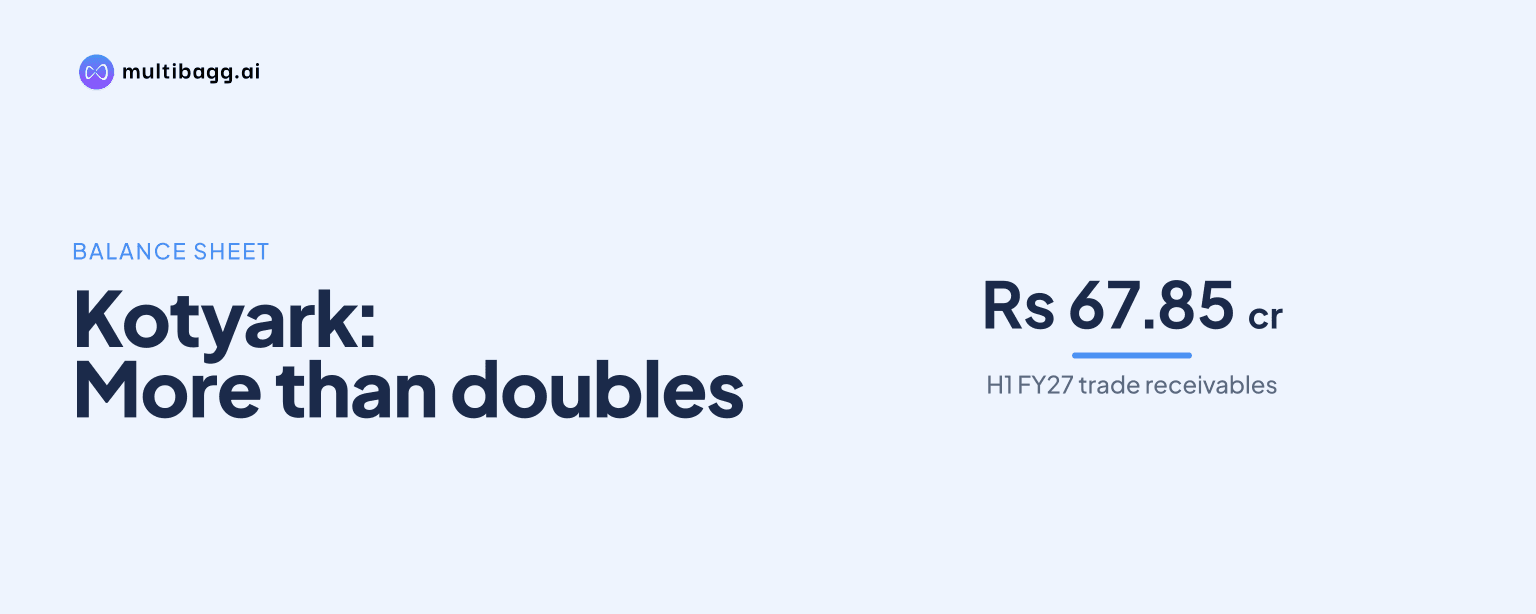
Kotyark Industries Limited reported trade receivables of Rs 67.85 crore in H1FY27, up Rs 39.41 crore from H1FY26, while total current assets increased Rs 63.38 crore to Rs 229.14 crore. The balance-sheet change occurred alongside H1FY27 total income of Rs 153.28 crore and profit after tax of Rs 10.70 crore.
Know Kotyark Industries inside out
Results, valuation, peers and who's buying, in one view.
Why did Kotyark working capital expand in H1FY27?
Kotyark’s net current assets expanded because the Rs 63.38 crore increase in current assets exceeded the Rs 20.25 crore increase in current liabilities. Current assets reached Rs 229.14 crore in H1FY27 from Rs 165.76 crore in H1FY26, while current liabilities rose to Rs 84.62 crore from Rs 64.37 crore. On this calculated basis, net current assets increased Rs 43.13 crore to Rs 144.52 crore.
Trade receivables were the largest contributor to the current-asset increase, rising Rs 39.41 crore, while inventories increased Rs 15.71 crore and cash and cash equivalents increased Rs 15.52 crore. These movements were partly offset by the removal of Rs 7.96 crore of short-term loans and advances recorded in H1FY26. The H1FY27 balance sheet therefore carried higher receivables, inventory and cash balances.
How much did Kotyark trade receivables increase?
Kotyark’s trade receivables increased by Rs 39.41 crore to Rs 67.85 crore in H1FY27 from Rs 28.44 crore in H1FY26, an increase of about 139%. The movement was larger than the Rs 5.93 crore increase in revenue, which rose to Rs 153.25 crore from Rs 147.32 crore over the same half-year comparison.
The presentation lists the aggregate trade-receivables balance but does not provide an ageing schedule, customer concentration data, credit terms or collections after the H1FY27 balance-sheet date. Those items would be needed to establish the composition of the Rs 67.85 crore balance and the timing of collections.
The receivables increase also exceeded the Rs 15.71 crore rise in inventories. Inventory remained the largest current-asset category at Rs 133.75 crore in H1FY27, but its year-on-year increase was less than half the increase in trade receivables. Other current assets rose Rs 0.69 crore to Rs 10.44 crore.
How did Kotyark inventory, cash and current liabilities change?
Kotyark’s inventory increased Rs 15.71 crore to Rs 133.75 crore in H1FY27 from Rs 118.04 crore in H1FY26, while cash and cash equivalents increased Rs 15.52 crore to Rs 17.09 crore. Together, these two increases totalled Rs 31.23 crore, below the Rs 39.41 crore addition to trade receivables.
On the liabilities side, short-term borrowings rose Rs 16.54 crore to Rs 64.71 crore from Rs 48.17 crore. Trade payables also increased Rs 1.91 crore to Rs 6.19 crore. These items accounted for most of the Rs 20.25 crore increase in total current liabilities, although other current liabilities fell Rs 4.38 crore to Rs 0.58 crore.
Current tax liabilities were Rs 12.24 crore in H1FY27, compared with nil in H1FY26, while provisions fell to nil from Rs 6.96 crore. Kotyark also reported other financial liabilities of Rs 0.91 crore in H1FY27, compared with nil a year earlier. The mix of current liabilities therefore changed alongside the increase in short-term borrowings.
Got a follow-up? Ask IRIS
Did Kotyark profit growth accompany the balance-sheet increase?
Kotyark’s H1FY27 profit after tax increased 62% to Rs 10.70 crore from Rs 6.61 crore in H1FY26, while total income increased 4% to Rs 153.28 crore. Earnings before interest, tax, depreciation and amortisation, or EBITDA, increased 30% to Rs 24.41 crore, and the EBITDA margin rose 321 basis points to 15.93%.
The increase in profit was faster than the increase in revenue. Profit after tax margin rose to 6.98% in H1FY27 from 4.48% in H1FY26, while total expenditure was nearly unchanged at Rs 128.87 crore versus Rs 128.65 crore. Raw-material expense increased Rs 0.35 crore to Rs 120.39 crore despite the Rs 5.93 crore revenue increase.
The quarterly comparison within the half year showed a different revenue trend. Q2FY27 total income declined 5.6% to Rs 61.29 crore from Rs 64.91 crore in Q2FY26, but EBITDA increased 51% to Rs 12.70 crore and profit after tax increased 148% to Rs 6.24 crore. The presentation does not include a cash-flow statement, so it does not quantify how H1FY27 profit translated into operating cash after working-capital movements.
How did Kotyark’s broader funding position change?
Kotyark’s total assets increased Rs 52.55 crore to Rs 299.92 crore in H1FY27 from Rs 247.37 crore in H1FY26. Current assets contributed more than the full increase because non-current assets declined Rs 10.83 crore to Rs 70.78 crore. Property, plant and equipment fell Rs 10.04 crore to Rs 50.91 crore, while capital work in progress fell Rs 2.64 crore to Rs 10.62 crore.
Net worth increased Rs 37.29 crore to Rs 186.48 crore, including Rs 1.77 crore of non-controlling interest in H1FY27. Long-term borrowings decreased Rs 4.61 crore to Rs 27.92 crore, contrasting with the Rs 16.54 crore increase in short-term borrowings. Kotyark also reported net debt-to-equity of 0.41 times in H1FY27, compared with 0.54 times in H1FY26.
The H1FY27 asset increase was concentrated in current balances rather than non-current operating assets. Total non-current assets were Rs 70.78 crore, down from Rs 81.61 crore, whereas current assets were Rs 229.14 crore, up from Rs 165.76 crore. Subsequent movements in receivables, inventory, cash and short-term borrowings will therefore be relevant to the balance-sheet trend.
Conclusion
Kotyark’s H1FY27 balance sheet combined a more-than-doubling of trade receivables with higher inventory, cash and short-term borrowings. Calculated net current assets increased Rs 43.13 crore to Rs 144.52 crore, while profit after tax increased Rs 4.09 crore to Rs 10.70 crore and total income increased Rs 5.88 crore to Rs 153.28 crore. The presentation establishes the scale of the balance-sheet movement but not the receivables ageing or collection pattern behind it.
Management’s FY27 roadmap calls for utilisation of its existing 4,80,000 kilolitre capacity to increase from 7-8% to 60-70%. Its FY28 priorities include distribution expansion, logistics integration and glycerin-processing efficiency. The disclosed plan makes the relationship between reported revenue, capacity utilisation, receivables, inventory and short-term borrowings the next area to watch.