










KP Energy pursues full EPC with Rs 1,940 crore order book
Key highlights
- KP Energy’s order book was approximately 1.64 GW and worth about Rs 1,940 crore at September 30, 2026.
- KP Energy said it was bidding for nearly 1 GW of available tenders on November 13, 2026.
- Q2 FY27 consolidated total income rose 78% year on year to Rs 540 crore.
- H1 FY27 PAT was Rs 53.18 crore, compared with Rs 61.37 crore in H1 FY26.
powered by IRIS
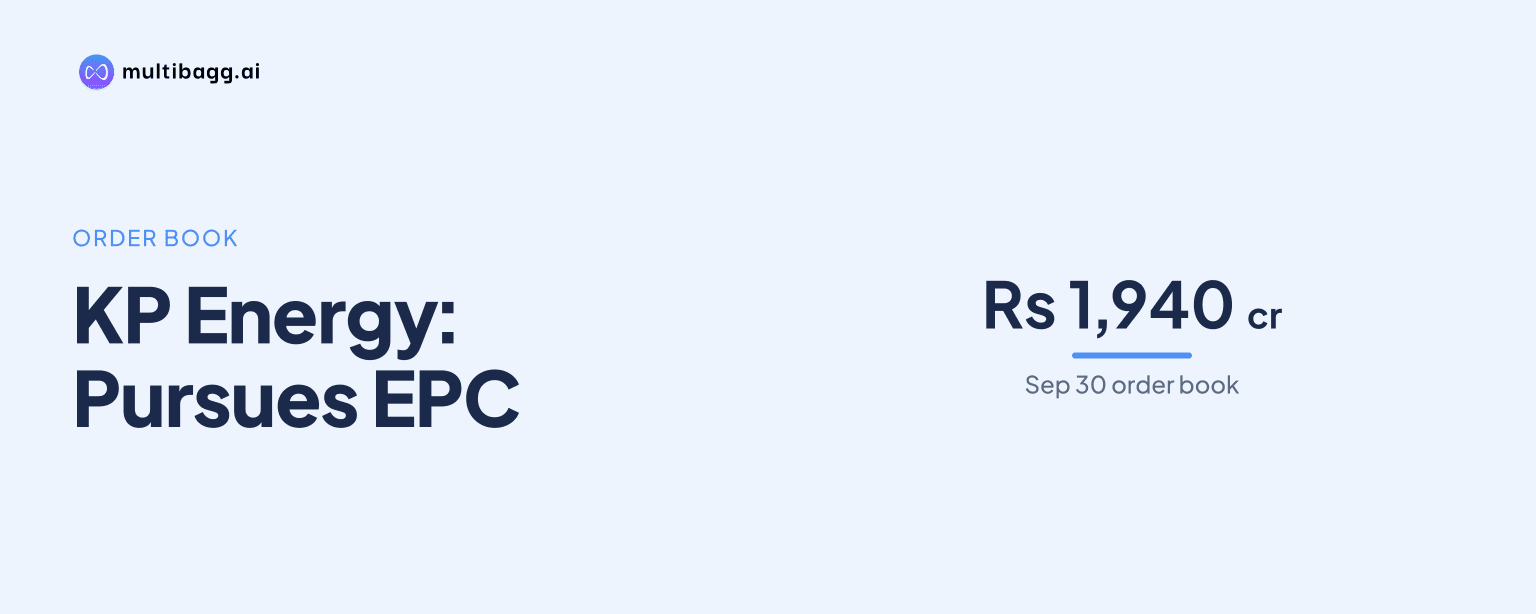
K.P. Energy Limited is pursuing a phased move into full wind engineering, procurement and construction, or EPC, supported by a 1.64-gigawatt order book valued at Rs 1,940 crore as of September 30, 2026. Management also said on November 13, 2026 that KP Energy was bidding for nearly 1 GW of available tenders.
Know K.P. Energy inside out
Results, valuation, peers and who's buying, in one view.
What is KP Energy’s current order book and tender pipeline?
KP Energy’s reported order book was approximately 1.64 GW, worth an estimated Rs 1,940 crore, at September 30, 2026. Management said the contracted backlog offers revenue visibility for coming quarters as the company expands both the volume and scope of its project delivery. The backlog followed H1 FY27 consolidated total income of Rs 1,062 crore, equivalent to about 71% of the total income reported for full-year FY26.
The nearly 1-GW tender pipeline is separate from the 1.64-GW reported order book. During the November 13, 2026 call, management said KP Energy was bidding for almost 1 GW of available tenders, while the moderator noted that a hypothetical 70% strike rate would represent 700 MW. That calculation was not management guidance or a disclosed award, so the tender pipeline cannot be treated as secured work.
Management linked the opportunity to India adding 6.05 GW of wind capacity in FY26, up about 46% from the preceding year, followed by 3 GW in H1 FY27. It also cited the Ministry of New and Renewable Energy’s indication of about 7.5 GW to 8 GW of wind additions in FY27, compared with a national target of 100 GW by 2030.
How is KP Energy changing from BOP work to full EPC?
KP Energy is making a phased transition from a balance-of-plant, or BOP, contractor to a full wind EPC partner. On the November 13, 2026 call, management said the wider model is intended to increase the scope and value delivered per megawatt and deepen customer relationships. Its stated capabilities include site identification, development, land, right-of-way, electrical works, evacuation and transmission infrastructure.
The strategy is based on greater project volume and wider EPC scopes rather than a stated plan to lift margins. Management said stable margins on a larger revenue base should increase absolute profit, while it continues to focus on project-level profitability and delivery consistency. Q2 FY27 gross margin was about 19%, broadly in line with Q1 FY27 despite the monsoon period, when site activity is traditionally slower.
The wider EPC model will not make every contract identical. Management said in Q2 FY27 discussions that some contracts include turbine supply, some cover BOP only and others cover infrastructure only; turbine supply carries a small markup when included. This mix means revenue, project scope and margins can differ between contracts rather than follow a standard EPC template.
Got a follow-up? Ask IRIS
How did KP Energy’s revenue and profit change in Q2 and H1 FY27?
KP Energy’s Q2 FY27 consolidated total income rose 78% year on year to Rs 540 crore, while H1 FY27 income increased 103% to Rs 1,062 crore. Infrastructure development drove the quarterly increase, generating Rs 527 crore of revenue compared with Rs 289 crore in Q2 FY26. Operations and maintenance, or O&M, revenue rose to about Rs 3.2 crore from Rs 1.72 crore, while sale-of-power revenue fell to about Rs 8.41 crore from Rs 10.01 crore.
Profit did not increase at the same pace as income in H1 FY27. Profit before tax, or PBT, declined to Rs 76.3 crore from Rs 88.72 crore in H1 FY26, while profit after tax, or PAT, fell to Rs 53.18 crore from Rs 61.37 crore. In contrast, Q2 FY27 PBT of Rs 38.86 crore exceeded Rs 37.44 crore in Q1 FY27, and Q2 PAT of Rs 26.92 crore exceeded Rs 26.08 crore sequentially.
Management said current margins should, for now, be assumed to remain at this level as KP Energy operates at a larger EPC scale. It attributed cost pressure during the November 13 call to raw materials, labour, right-of-way arrangements, access roads and possible labour or crane idling when site work is delayed. Revenue from group entities represented approximately 50% of Q2 FY27 revenue, down from about 80% to 85% in the preceding quarter.
What does KP Energy’s IPP plan mean for capital spending?
KP Energy had 48.5 MW of independent power producer, or IPP, capacity operational and another 202 MW under development at the Q2 FY27 call. Management said the additional capacity should add recurring revenue once commissioned alongside the EPC business, while associated depreciation would support cash profits. Q2 FY27 sale-of-power revenue was about Rs 8.41 crore.
Management said there were no large additional IPP plans beyond the 202 MW under development, indicating limited further capital expenditure after that programme. Under its KP 3.0 plan, management said debt-to-equity would not exceed 2 even after the IPP development. This is a management commitment rather than a reported future outcome.
Working capital remains relevant to project execution. Inventory was Rs 1,067 crore at the time of the November 13 call, down from Rs 1,330 crore previously. Management said the earlier inventory build helped protect delivery timelines amid geopolitical conditions and volatile steel prices, and it did not expect massive inventory growth while EPC projects remain lined up.
Conclusion
KP Energy’s stated strategy combines a Rs 1,940 crore, 1.64-GW order book with a move toward broader wind EPC responsibility. Q2 FY27 demonstrated the increase in scale, with total income rising to Rs 540 crore from Rs 303 crore a year earlier, but H1 PBT and PAT declined year on year. Management’s position is that future earnings growth should come from volume and broader EPC scope rather than a return to earlier margin levels.
The next developments to watch are whether nearly 1 GW of tenders converts into awards, execution progress on the 1.64-GW order book and commissioning of the 202-MW IPP portfolio under development. Investors can also track whether inventory continues to decline from Rs 1,067 crore and whether KP Energy remains within management’s stated debt-to-equity ceiling of 2 as the IPP programme advances.