










KP Energy resets EPC margin outlook to 12% for 2-4 quarters
Key highlights
- KP Energy expects EPC margins of about 12% for the next two to four quarters.
- Management said FY26 average EBITDA margin was about 21%, compared with about 12% currently.
- KP Energy reported about Rs 521 crore of total income in the first quarter of FY27, versus about Rs 221 crore a year earlier.
- KP Energy is bidding for nearly 1 gigawatt of projects worth about Rs 7,000 crore to Rs 8,000 crore.
powered by IRIS
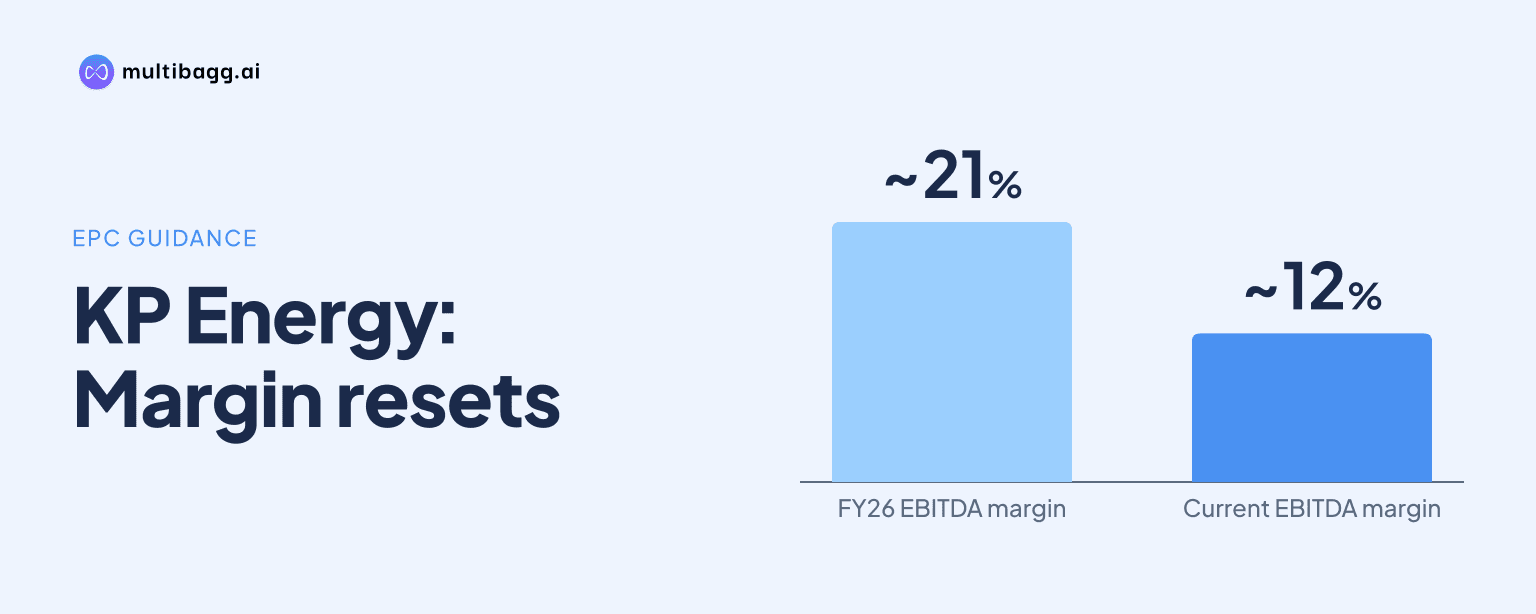
In the second quarter of financial year 2027, KP Energy said engineering, procurement and construction (EPC) margins should remain about 12% for the next two to four quarters, versus about 21% in financial year 2026 (FY26), as right-of-way, labour and raw-material costs disrupted wind-project execution.
Know K.P. Energy inside out
Results, valuation, peers and who's buying, in one view.
Why did KP Energy reset its EPC margin outlook?
KP Energy reset its outlook because management said wind EPC economics and execution conditions had changed as project volumes increased. Kapil Kriplani said investors could safely assume margins would remain at the current level, and later said the company would have to operate with that condition for at least the next two to four quarters.
The change is material against management's FY26 comparison. Management said average earnings before interest, tax, depreciation and amortisation (EBITDA) margin was about 21% in FY26, compared with about 12% currently. It said the impact of geopolitical conditions, including what it called the Hormuz effect, had not been sufficiently clear when FY26 results were published in May.
An investor referred to KP Energy's earlier expectation of 18% to 20% margins and asked why it had changed. Management did not repeat that range as achievable under present conditions. Instead, it said it would focus on expanding volumes and generating higher absolute profitability as revenue grows.
How are right-of-way and labour affecting KP Energy margins?
KP Energy said right-of-way (ROW) costs, labour volatility and raw-material expenses are the main contributors to the present 12% margin level. Management said changes in ROW rates had increased compensation payable to farmers and landowners, while steel pricing remained volatile for transmission, power infrastructure and other wind-project requirements.
Wind EPC work also creates site-specific execution risks, according to management. A wind project requires access roads and equipment installation at multiple locations selected for wind availability, unlike a more concentrated solar site. If a ROW issue stops activity at one location, labour and equipment can remain idle while the matter is resolved.
KP Energy identified crane availability as another execution dependency that can add idling costs. It did not disclose labour cost as a share of revenue when asked by an analyst. Management said the margin pressure cannot be assigned to one cost line because ROW delays, labour, raw materials and equipment availability can affect a project at the same time.
How does KP Energy's revenue growth compare with its margin change?
KP Energy reported a sharp increase in revenue scale despite the lower margin outlook. Management compared total income of about Rs 221 crore in the first quarter of FY26 with about Rs 521 crore in the first quarter of FY27, an increase of about Rs 300 crore. It also said second-quarter FY27 turnover was above Rs 540 crore.
Across the first two quarters of FY27, KP Energy said turnover exceeded Rs 1,060 crore, nearly 70% of the turnover it delivered during the preceding full year. Management's position was that a larger revenue base can produce higher absolute profit even if the percentage margin is lower than the FY26 average.
This is not a forecast of a near-term return to the previous 18% to 20% range. Kriplani said KP Energy could deliver about 25% growth and lift profits as revenue rises, but also said EPC pricing must reflect current industry conditions. Management did not provide a target date for margin recovery beyond the stated two-to-four-quarter outlook.
Got a follow-up? Ask IRIS
Does contract mix explain KP Energy's lower EPC margin?
KP Energy said its contract mix can affect period margins because each EPC assignment has a different scope. Some contracts include turbine supply, some cover balance of plant (BOP) work, and others involve infrastructure only. The company said it earns a small markup on turbines it supplies, while reported margins reflect the combination of work delivered during the period.
Management rejected the suggestion that group-related contracts carry lower margins. It said contracts with group entities are conducted at arm's length and at prevailing prices. Group entities accounted for about half of second-quarter revenue, compared with roughly 80% to 85% in the prior quarter.
KP Energy did not give a forward target for the share of group-related revenue. Management also compared earlier turnover of about Rs 200 crore to Rs 300 crore with more than Rs 1,000 crore delivered over two quarters of FY27. That comparison supports its view that scale has changed, although management separately attributed the margin reset to ROW, labour, materials and geopolitical conditions.
What could affect KP Energy after the margin reset?
KP Energy said it is bidding for nearly 1 gigawatt of projects with an aggregate approximate value of Rs 7,000 crore to Rs 8,000 crore. Management said results from these bid-based opportunities could emerge within three to six months. It expressed a positive view on a 70% strike rate, while noting that market economics and rival bidders' capacity will determine outcomes.
The company also said it has no large further independent power producer (IPP) expansion plan beyond the capacity already under development. KP Energy had 48.5 megawatts of operational IPP capacity and 202 megawatts under development. Management said its KP 3.0 plan sets a debt-to-equity ceiling of 2 even after the IPP programme.
The IPP portfolio remains a separate source of recurring revenue beside EPC work. KP Energy reported generation of 2.75 crore units in the second quarter and 5.92 crore units in the first half of FY27. Management said operational IPP assets would add recurring revenue and depreciation benefits to cash profits, but did not quantify the potential contribution against lower EPC margins.
Conclusion
KP Energy has replaced its earlier higher-margin expectation with an outlook of about 12% for the next two to four quarters. The reset follows a change from about 21% average EBITDA margin in FY26, with management attributing the difference to higher ROW payments, labour volatility, raw-material pricing and the logistical demands of dispersed wind installations.
The next disclosed markers are results from nearly 1 gigawatt of bids, which management expects within three to six months, and execution of the 202 megawatts of IPP capacity under development. The next two to four quarterly reports will show whether revenue growth above Rs 1,060 crore in the first half of FY27 translates into greater absolute profit while margins remain near management's stated level.