










KPI Green Energy Limited Energises 630 MW DC in Q2FY27
Key highlights
- KPI Green Energy energised more than 630 MW DC in Q2FY27, its highest quarterly capacity addition since inception.
- The Bharuch hybrid project has reached 269.7 MW AC and 389.7 MW DC of energised capacity.
- KPI Green Energy's IPP portfolio stands at 2.57 GWp, including about 1.16 GWp already energised.
- KPI Green Energy reported a 300 MW ISTS-connected wind power PPA with SJVN.
powered by IRIS
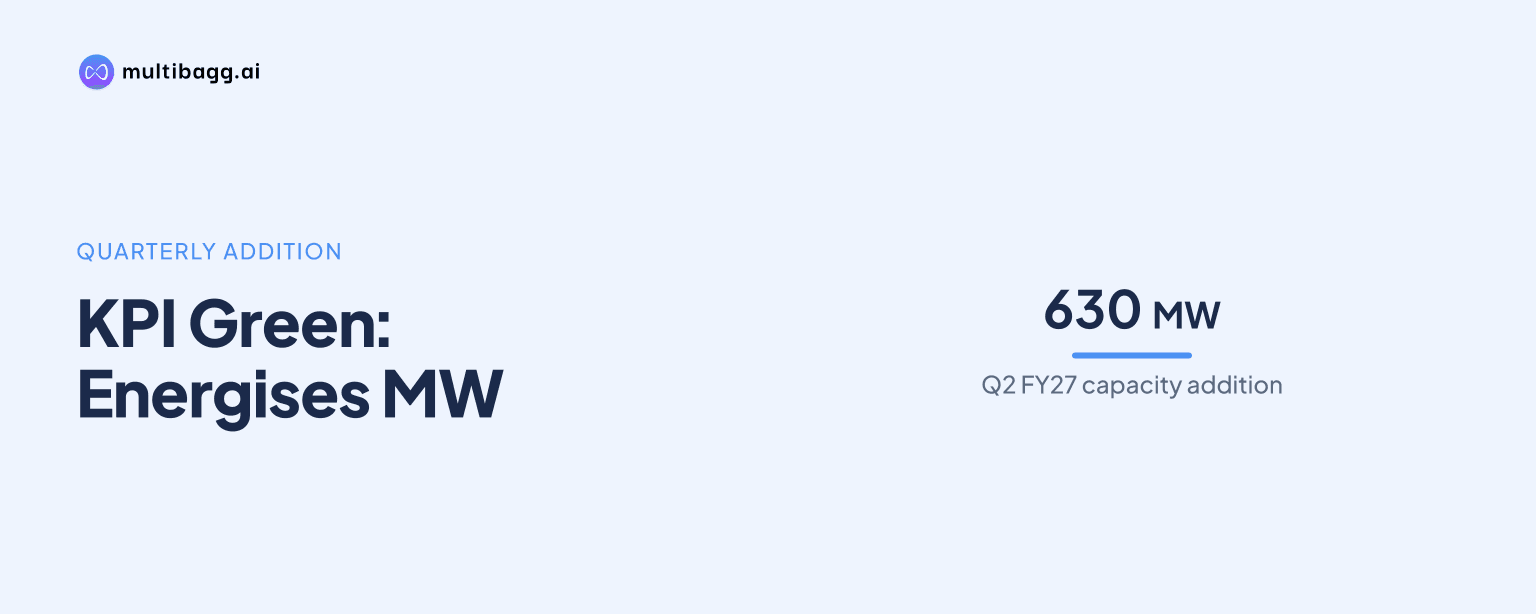
KPI Green Energy Limited energised more than 630 MW DC of renewable capacity during Q2FY27, its highest capacity energisation in a single quarter since inception, across its independent power producer and engineering, procurement and construction businesses. The company has also reported a 300 MW wind power purchase agreement with SJVN.
Know KPI Green Energy inside out
Results, valuation, peers and who's buying, in one view.
What did KPI Green Energy Limited energise in Q2FY27?
KPI Green Energy Limited said it energised more than 630 MW DC of capacity during the June-August period of Q2FY27. The capacity was added across the company's IPP and EPC operations, marking its highest quarterly energisation since it was incorporated in 2008.
Energisation is an important operational milestone because it indicates that a project has been connected and made ready for power injection or operation. For KPI Green Energy, the update shows continued execution across solar and hybrid assets in Gujarat, while its broader renewable portfolio also includes wind projects.
The company develops, owns and operates renewable plants under the Solarism brand. It is the renewable-energy vertical of KP Group and is based in Gujarat. Its operating model includes building assets for its own IPP portfolio as well as executing projects through EPC activities.
How has the Bharuch hybrid project progressed?
KPI Green Energy energised an additional 130 MW AC, or 195 MW DC, of solar capacity at its 370 MW AC and 677 MW DC wind-solar hybrid IPP project in Bharuch, Gujarat. Following this addition, cumulative energised capacity at the project reached 269.7 MW AC and 389.7 MW DC.
The Bharuch project is being developed under a long-term power purchase agreement with Gujarat Urja Vikas Nigam Limited. It combines solar and wind generation, allowing the project to use more than one renewable source within the same development.
Earlier additions at the project included solar and wind capacity under the same GUVNL-linked hybrid programme. The balance capacity of the 370 MW AC and 677 MW DC project remains under execution, according to the company updates provided.
What is the status of KPI Green Energy's IPP portfolio?
KPI Green Energy's total IPP portfolio has reached 2.57 GWp, of which about 1.16 GWp has already been energised. Around 1.41 GWp remains under active execution, showing that a substantial part of the company's planned generation portfolio is still moving through construction and commissioning stages.
The portfolio includes a 200 MW, or 240 MWp, solar IPP project at Khavda Solar Park in the South Block. The company said the project has been commissioned and has started injecting power. It also reported grid synchronisation and power injection from a 50 MW, or 92.15 MWp, hybrid project ahead of its scheduled July 2026 commercial operation date.
A separate 250 MW and 350 MWp solar project has also progressed in phases. Earlier disclosures cited 181 MW and 251 MWp as energised, with full completion targeted by October 2026. The company subsequently reported an additional 24.2 MW of operational capacity at this project.
Got a follow-up? Ask IRIS
What does the SJVN wind power agreement mean?
KPI Green Energy has reported the successful execution of a power purchase agreement with SJVN for a 300 MW ISTS-connected wind power project. An ISTS-connected project is linked to the inter-state transmission system, which can enable power evacuation through the national transmission network rather than limiting supply to a single state grid.
The supplied company information does not state the tariff, project location, commissioning schedule or capital cost for the 300 MW SJVN project. It does, however, indicate that the agreement would add to KPI Green Energy's wind portfolio alongside its solar and hybrid development pipeline.
KPI Green Energy has separately signed a PPA with GUVNL for a 150 MW wind IPP project in November 2025. That project achieved financial closure and is under execution, with commissioning expected by October 2027. Green-bond proceeds supported by a partial credit guarantee were intended to help expand the company's solar, wind and hybrid capacity in Gujarat, including a 150 MW wind project.
How do the project additions affect KPI Green Energy's operations?
The latest energisation increases the volume of capacity that KPI Green Energy has moved from development into operational or grid-connected status. For an IPP, this progression is central to converting a project pipeline into long-term generation assets supported by power purchase agreements.
Long-term PPAs with counterparties such as GUVNL, SJVN and Coal India-related projects provide the contractual framework for projects cited in the company's updates. Actual financial contribution will depend on generation, tariff terms, commercial operation milestones and project costs, none of which were detailed for every asset in the supplied material.
The company has also outlined a 2,022 MWp Khavda project spanning IPP and captive power producer segments. It said 240 MWp for GUVNL was completed, while 405 MWp for Coal India and 246 MWp for SJVN were at advanced execution stages. Installation, testing and commissioning work for 1,131 MWp of solar projects for Adani Group entities was also reported.
Why does the record quarterly energisation matter for the renewable sector?
The 630 MW DC quarterly figure is significant because it demonstrates execution across several project structures - solar, wind-solar hybrid, IPP and EPC. Large renewable developments require land, equipment delivery, grid connectivity, commissioning and contracted offtake to progress in sequence, making energisation a useful indicator of implementation activity.
KPI Green Energy is pursuing KP Group's stated target of 10 GW each in IPP, captive power producer and battery energy storage system capacity by 2032. Separately, the company has cited a 10 GW target by 2030 in its broader expansion plans. These targets reflect a sizable pipeline, but the supplied updates do not provide a reconciliation between the two target timelines.
For investors and industry participants, the key operating markers remain the rate at which the 1.41 GWp under execution is energised, the completion of the Bharuch hybrid project, and the commissioning of contracted wind and solar assets. The company has not provided a share-price reaction or project-level revenue impact in the information available.
Conclusion
KPI Green Energy's record energisation of more than 630 MW DC in Q2FY27 adds operational momentum to a portfolio that stands at 2.57 GWp, with around 1.16 GWp already energised. The additional 130 MW AC at Bharuch and progress at Khavda demonstrate continued movement from project development into connected renewable capacity.
The next disclosed milestones include completing the remaining capacity under the Bharuch hybrid project, advancing the 300 MW SJVN wind project, and commissioning the 150 MW GUVNL wind project expected by October 2027. Progress on the 1.41 GWp under active execution will determine the pace at which the wider IPP pipeline becomes operational.