










KPIL order book rises to Rs 71,846 crore on FY27 inflows
Key highlights
- KPIL reported FY27-to-date order inflows of Rs 23,934 crore, including Rs 17,940 crore in H1 FY27.
- KPIL's consolidated order book stood at Rs 71,846 crore on 30 September 2026, with T&D contributing Rs 29,389 crore.
- Domestic projects represented 62% of KPIL's order book and international projects represented 38%.
- KPIL disclosed about Rs 5,000 crore of additional L1 or favourably placed projects.
powered by IRIS
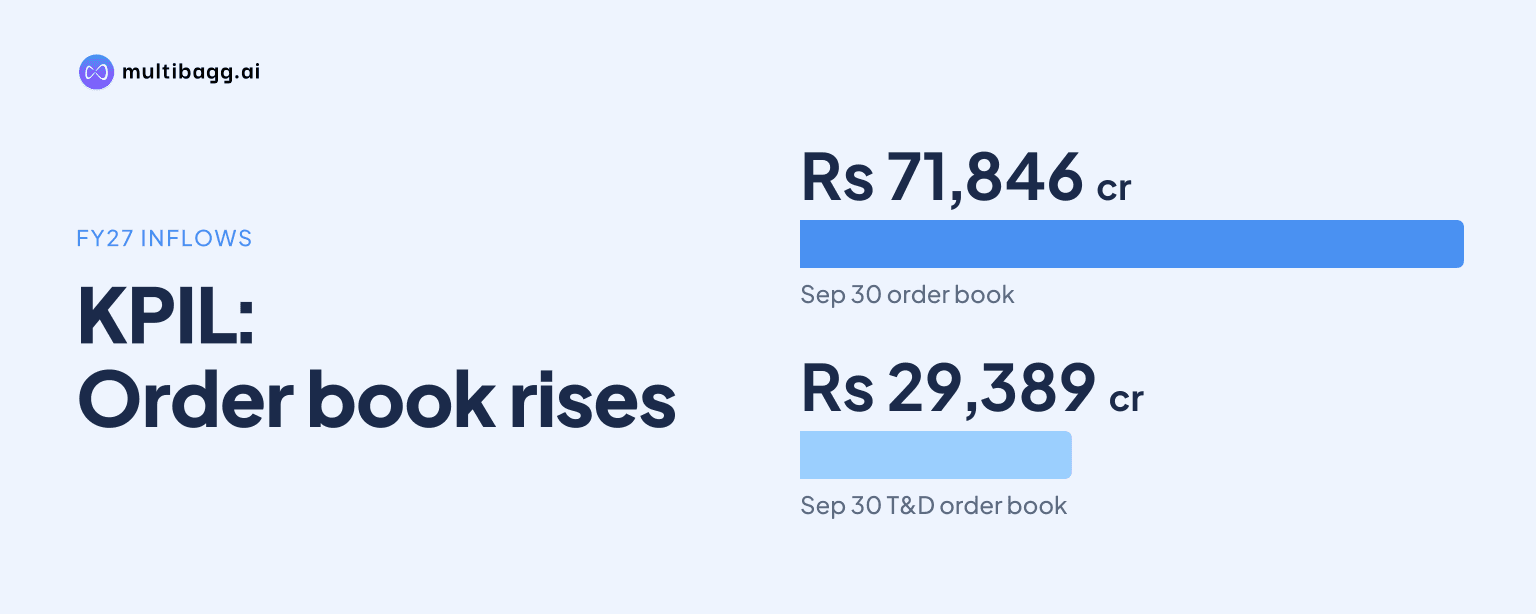
Kalpataru Projects International Limited (KPIL) reported a consolidated order book of Rs 71,846 crore on 30 September 2026 after securing Rs 23,934 crore of orders in financial year 2027 (FY27) to date. Transmission and distribution (T&D) accounted for 42% of new orders and 41% of the order book, making it the largest disclosed business in both measures.
Know Kalpataru Projects International inside out
Results, valuation, peers and who's buying, in one view.
How did KPIL build FY27 order inflows?
KPIL built Rs 23,934 crore of order inflows in FY27 to date, with Rs 17,940 crore secured in the first half of FY27 (H1 FY27) and Rs 5,994 crore received in the third quarter of FY27 to date (Q3 FY27). By calculation, H1 FY27 contributed about three-fourths of the reported FY27-to-date inflow, while Q3 FY27 to date supplied the balance.
T&D was the largest contributor to new orders at Rs 10,122 crore, or 42% of the total. Buildings and Factories (B&F) followed with Rs 8,000 crore, representing 33%, while Oil & Gas contributed Rs 5,279 crore, or 22%. The remaining inflows came from Water at Rs 344 crore and Infrastructure, including Railways, at Rs 189 crore.
The inflow mix was concentrated in T&D, B&F and Oil & Gas, which together accounted for Rs 23,401 crore based on the displayed segment values. The stated segment percentages total 99% because of rounding, while the individual sector values add to KPIL's reported total of Rs 23,934 crore.
Which sectors make up KPIL's order book?
KPIL's Rs 71,846 crore order book at 30 September 2026 was led by T&D at Rs 29,389 crore, followed by B&F at Rs 21,659 crore. These two businesses together represented 71% of the reported backlog, giving them the largest stated share of work available for execution among KPIL's operating segments.
Oil & Gas held Rs 8,196 crore, or 12%, of the order book, while Water accounted for Rs 6,702 crore, or 9%. Infrastructure, which includes Railways in KPIL's presentation, represented Rs 5,900 crore and 8%. The backlog distribution differed from the new-order mix because Water and Infrastructure had larger shares of the existing book than of FY27-to-date inflows.
The comparison shows Oil & Gas supplied 22% of FY27-to-date order inflows against 12% of the 30 September backlog, whereas Water supplied 1% of inflows against 9% of the backlog. B&F also had a higher share of current inflows, at 33%, than of the order book, at 30%, according to KPIL's sectoral disclosure.
Got a follow-up? Ask IRIS
How is KPIL's order book split between domestic and international markets?
KPIL reported that 62% of its Rs 71,846 crore order book was domestic and 38% was international on 30 September 2026. On the same order-book base, KPIL's geography table identified India as 59%, the Middle East as 14%, Africa as 10%, the Americas as 9%, Europe as 6% and Others as 2%.
India was the largest single geography in the 30 September 2026 backlog at 59%, while the Middle East was the largest overseas regional category at 14%. The domestic-international classification and geographic classification are presented separately by KPIL, so the presentation does not provide a reconciliation between India's 59% geographic share and the 62% domestic share.
The international component spans the Middle East, Africa, the Americas and Europe, which together represented 39% of the geographic table before the 2% Others category. This geographic spread sits alongside sector-specific activity: KPIL said Oil & Gas revenue growth in H1 FY27 was led by Middle East projects, and it secured its first major United Arab Emirates gas-pipeline infrastructure project.
What is the additional Rs 5,000 crore of favorably placed projects?
KPIL disclosed about Rs 5,000 crore of additional L1 or favorably placed projects beyond the Rs 23,934 crore of orders already received in FY27 to date. The presentation identifies this amount as additional and does not include it in the stated order-inflow total or the Rs 71,846 crore order book at 30 September 2026.
The disclosed figure indicates projects in which KPIL was favourably placed rather than reported order awards. The presentation does not provide a sector, geography, award date or conversion timetable for the approximately Rs 5,000 crore amount, leaving those details unresolved in the update.
KPIL's reported revenue gives context on execution across businesses supplying the backlog. Total core-business revenue, excluding the Brazil subsidiary, rose 11% year on year to Rs 13,242 crore in H1 FY27. Oil & Gas revenue grew 38% to Rs 1,577 crore, B&F rose 17% to Rs 3,619 crore and T&D increased 8% to Rs 5,993 crore.
Not every segment recorded revenue growth in H1 FY27. Water revenue declined 5% year on year to Rs 1,124 crore, while Infrastructure revenue decreased 7% to Rs 929 crore. KPIL attributed Water's performance to execution in line with planned project progress and said Infrastructure reflected its focus on closing conventional railway projects while metro-rail execution continued.
Conclusion
KPIL's Rs 23,934 crore of FY27-to-date inflows were led by T&D, B&F and Oil & Gas, while its Rs 71,846 crore order book remained weighted towards T&D and B&F at 30 September 2026. The disclosed backlog also combined 62% domestic work with a 38% international component, including a 14% Middle East geographic share.
The next point to watch is whether the approximately Rs 5,000 crore of L1 or favourably placed projects converts into awarded orders, since KPIL did not disclose timing, segment allocation or conversion outcomes. Subsequent revenue updates will also show execution trends after H1 FY27 Oil & Gas revenue rose 38%, while Water and Infrastructure revenue declined 5% and 7%, respectively.