










Krishna Defence prioritises consumables for earlier revenue
Key highlights
- Krishna Defence said specialised weld consumables and additional components can use much of its existing infrastructure.
- Management said the current product range could support Rs 400 crore to Rs 450 crore of revenue with incremental capital expenditure.
- Krishna Defence has annual Bulb Bar capacity of about 4,000 to 4,500 tonnes and weld-consumable capacity of close to 500 tonnes.
- The company disclosed a Rs 305 crore bid pipeline and said its usual win ratio is about 50%.
powered by IRIS
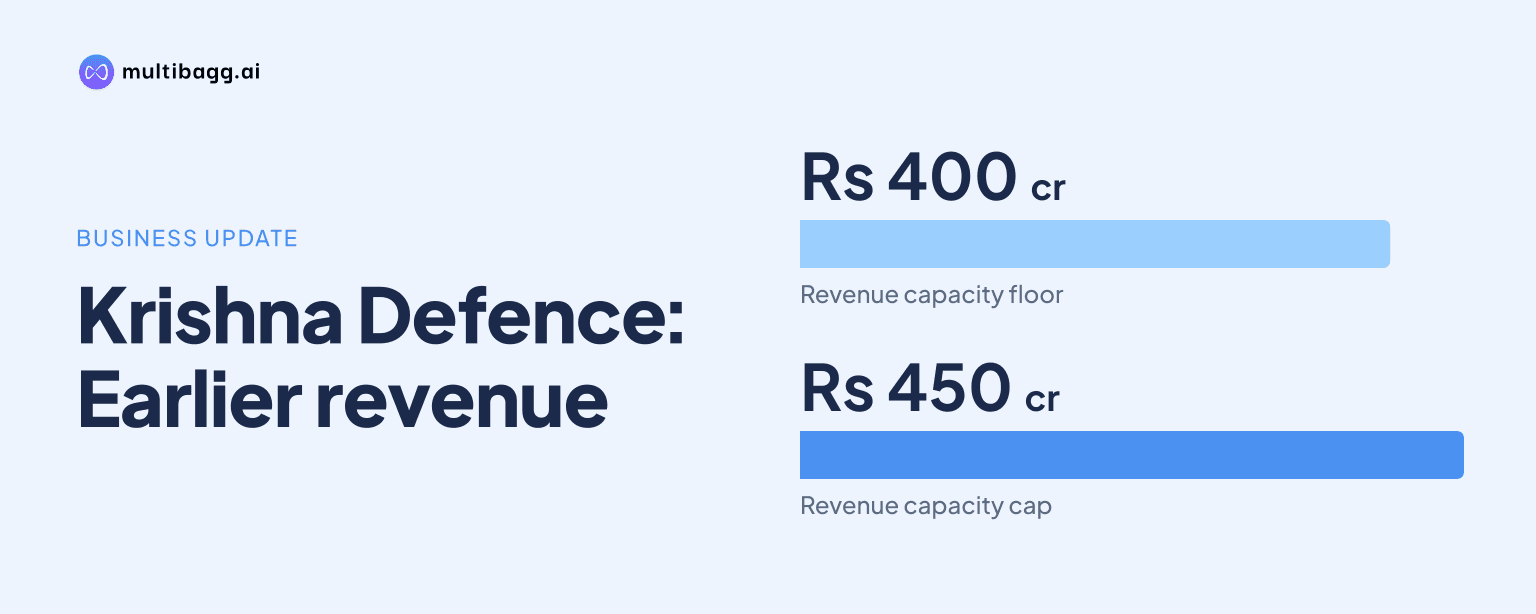
On the conference call, Krishna Defence said specialised weld consumables, additional components and imported steel products offer earlier revenue potential, while smart ammunition and underwater platforms remain development-led opportunities. Management said its current product range could support Rs 400 crore to Rs 450 crore of revenue with incremental capital expenditure rather than a new plant.
Know Krishna Defence & Allied Industries inside out
Results, valuation, peers and who's buying, in one view.
Which Krishna Defence businesses can generate revenue first?
Krishna Defence said specialised weld consumables, additional components and imported steel products are its nearer-term new-business opportunities. Management described these activities as the lower-hanging fruits because most of the existing infrastructure can support them, with additions made as the businesses progress.
The distinction rests on commercial readiness rather than on stated market size. Management said smart ammunition and underwater platforms would take more time before revenue begins because both remain developmental activities, whereas consumables and components can use the existing operating base. It also said the current product range could reach Rs 400 crore to Rs 450 crore of revenue through incremental capital expenditure.
Krishna Defence’s existing manufacturing approach combines in-house specialised work with outsourcing of non-critical processes. Management said it keeps critical operations involving tailor-made machinery, furnaces and certain special processes within its facilities, while outsourcing cutting, painting and shot blasting. This arrangement was cited when an analyst asked about the company’s asset base and turnover.
Why are underwater platforms and smart ammunition longer-term opportunities?
Krishna Defence said underwater platforms and smart ammunition represent its largest opportunity areas by addressable market, but they are not yet near-term revenue contributors. Management said it seeks to establish a small place in these large domains, while making clear that both businesses require further development before commercial revenue can emerge.
Smart ammunition for naval guns is under development with another company, according to management. Krishna Defence said the product could have export potential because it is NATO-approved, but it did not provide a revenue timeline, addressable-market value or order estimate for the programme.
Management also addressed a separate ammunition-component opportunity, saying it is currently intended for the domestic market. It declined to quantify that market because the details are classified. This means the call disclosed an export possibility for the naval-gun smart-ammunition programme, but not a disclosed export plan for the domestic ammunition-component work.
How could Krishna Defence benefit from naval shipbuilding programmes?
Krishna Defence said its naval opportunity depends on shipyards first receiving platform orders and then placing supplier orders. Management stressed that it does not build destroyers or submarines itself, so it could not state when shipyards would receive orders for future platforms or when resulting orders would reach Krishna Defence.
For destroyers and corvettes, management said Krishna Defence would have some contribution but could not put a value on it because functional designs had only recently been signed. The company also said shipyard-side design finalisation prevents it from estimating the tonnage requirement for prospective programmes.
Bulb Bars remain a defined part of the naval-supply proposition. Management said Bulb Bars typically account for about 10% to 15% of a ship’s weight, a proportion it expects to remain unchanged. Krishna Defence has annual Bulb Bar capacity of about 4,000 to 4,500 tonnes and said it hopes to receive at least a 50% share of relevant future work, although this was an expectation rather than a contracted allocation.
Krishna Defence also identified composite doors and hatches as a potential supply and retrofit category. Management said the Navy currently uses steel doors and hatches, while European navies have moved to composite alternatives that are lighter and easier to use and repair. It said its approvals were at the final stage, after which it could pursue both new-ship and retrofit opportunities.
Got a follow-up? Ask IRIS
What capital expenditure and capacity plans has Krishna Defence disclosed?
Krishna Defence said it does not need a new plant to reach more than Rs 400 crore of revenue from its existing product range. Management instead plans continuing incremental capital expenditure for infrastructure improvements, process improvement and automation, and put the revenue capacity range at Rs 400 crore to Rs 450 crore.
The company has acquired an additional 50,000 square feet of land for future expansion. Management said the current expansion would be used for other work and not for a new Bulb Bar line. It may consider Bulb Bar expansion after a couple of years, while current work is focused on incremental changes and automation rather than a new facility.
Krishna Defence gave broad annual capacity of close to 500 tonnes for weld consumables, while noting that electrodes and wires cover different grades and are not directly interchangeable. Management also corrected an analyst’s figure on fixed assets, saying property, plant and equipment stood at about Rs 38 crore as of 30 September, compared with the Rs 20 crore plant-and-machinery figure cited from an earlier period.
What other order channels could support Krishna Defence’s growth?
Krishna Defence said it has begun supplying commercial ships, though order sizes have been small so far. Management said margins on Bulb Bars and other profiles supplied for commercial vessels are almost the same as naval margins, but it could not provide a timetable for commercial shipbuilding demand to become material revenue.
Management attributed the uncertain timing to the heavy capital expenditure needed to build large vessels and to the need for a wider ecosystem of accessories and ancillary suppliers. It said action had started in commercial shipbuilding but that the sector would mature over time rather than immediately.
Krishna Defence said it is currently an approved source for domestic commercial shipbuilding because it has licensing with ABS and other ship-classification societies. Management said Bulb Bar imports are not permitted for domestic commercial vessels, although imports may be allowed for export-specific orders under an advance licence. It also said exports had started in Belgium barriers and VABO, but volumes were too low to estimate an export-revenue mix.
The company disclosed a Rs 305 crore bid pipeline and said its usual win ratio is about 50%. Management hoped that all of those orders could be received within three to six months if Krishna Defence is declared the winner. Separately, it said most current orders should be executed in the third quarter, with some spilling into the fourth quarter.
Conclusion
Krishna Defence has set out a two-track growth approach: specialised weld consumables, additional components and imported steel products can be pursued using much of the present infrastructure, while underwater platforms and smart ammunition offer larger stated opportunity areas but remain subject to development and commercialisation timing. The Rs 400 crore to Rs 450 crore capacity range gives the nearer-term businesses an operating framework without requiring a new plant.
The next items to watch are management’s expected three-to-six-month outcome for the Rs 305 crore bid pipeline, final approvals for composite doors and hatches, and the pace at which shipyards receive naval-platform orders and place supplier orders. Management also plans process and automation improvements, while indicating that a dedicated Bulb Bar expansion may be considered only after a couple of years.