










Krishna Defence product mix lifts EBITDA margin to 27%.
Key highlights
- Krishna Defence reported a current-quarter EBITDA margin of 27%, supported by higher-margin welding consumables and Army products.
- Bulb Bars contribute about 55%-60% of Krishna Defence revenue, versus roughly 15%-20% each from armoured steel and welding consumables.
- Krishna Defence said defence products account for 92%-93% of revenue, while dairy products contribute nearly 7%-8%.
- Krishna Defence reported an order book of about Rs 109 crore and a tender pipeline of about Rs 305 crore.
powered by IRIS
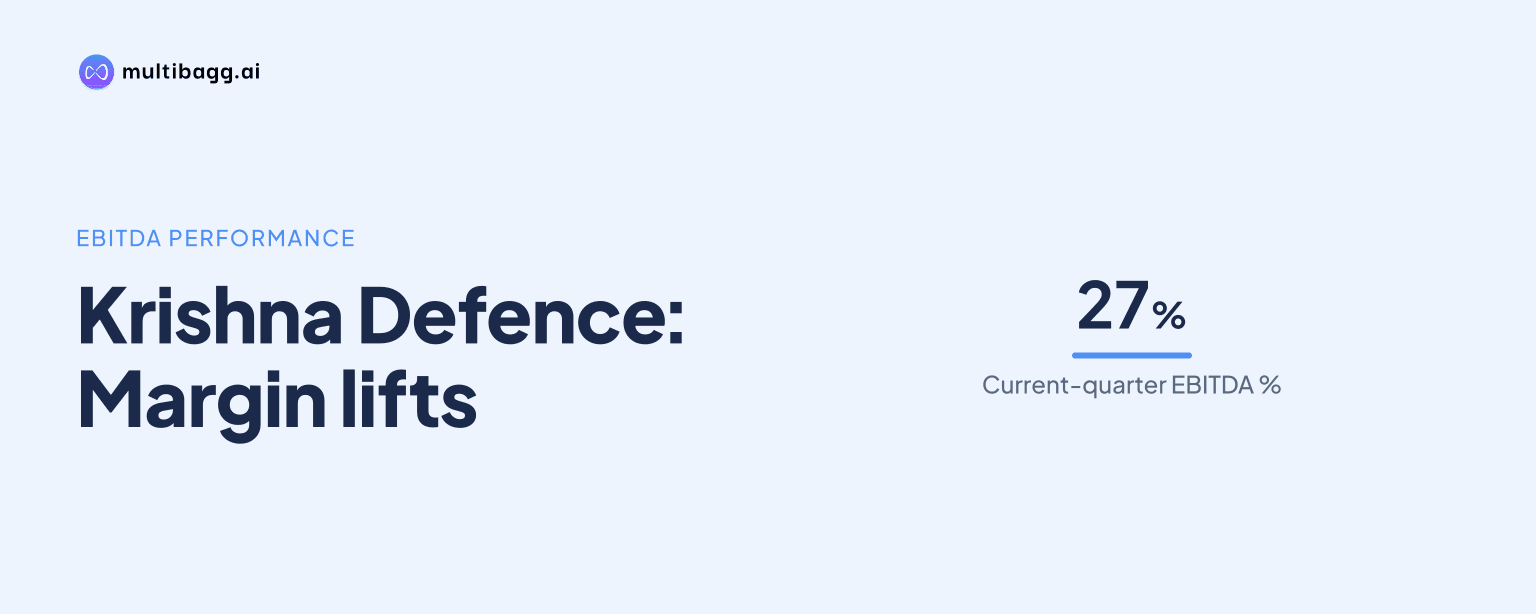
Krishna Defence said its current-quarter EBITDA margin reached 27%, as higher-margin welding consumables and Army products increased their contribution while Bulb Bars remained its largest product at about 55%-60% of revenue. Management said additions at its factory could support margins around current levels, while cautioning that this was not an affirmation.
Know Krishna Defence & Allied Industries inside out
Results, valuation, peers and who's buying, in one view.
What drove Krishna Defence’s 27% EBITDA margin?
Krishna Defence attributed its 27% earnings before interest, tax, depreciation and amortisation (EBITDA) margin in the current quarter to product mix, specifically higher-margin welding wire products and certain products supplied for the Army. Management said that when revenue from these categories is higher in a quarter, EBITDA margins rise, even though Bulb Bars remain the company’s largest individual product category.
Management distinguished between the current 27% outcome and a fixed margin commitment. It said some products carry higher margins while others have somewhat lower margins, and maintaining the intended mix is therefore central to sustaining profitability. In response to a question on whether EBITDA margins of 25%-26% could hold for the full year, management said it was making efforts to maintain that range given the mix then in place.
Krishna Defence also pointed to factory additions as a possible support for maintaining margins around current levels. However, management explicitly described this as an objective rather than an affirmation. It further said that quarter-to-quarter comparison is difficult because the revenue share of welding consumables, Army products and Bulb Bars changes with order execution, while its broader expectation is for EBITDA to improve year on year from the previous year.
How dependent is Krishna Defence on Bulb Bars?
Krishna Defence said Bulb Bars account for about 55%-60% of revenue, making them the core of its disclosed product mix. Armoured steel supplied to the Indian Army contributes roughly 15%-20%, and welding consumables contribute another 15%-20%, according to management’s percentage breakdown during the call.
The concentration in Bulb Bars means that shipbuilding demand remains important to Krishna Defence, but the 15%-20% ranges for armoured steel and welding consumables show why management does not describe the company as a one-product business. It said the wider product basket is intended to keep factories operating if one product area slows, including through work with the Army, Navy and commercial shipbuilding customers.
At the broader segment level, Krishna Defence said defence products represent 92%-93% of revenue, while dairy products account for nearly 7%-8%. That split places Bulb Bars, armoured steel and welding consumables inside a defence-led revenue base. It also means changes in defence procurement timing can affect the quarterly mix, even though management said commercial shipbuilding orders have begun to come through in smaller sizes.
Got a follow-up? Ask IRIS
Can Krishna Defence export its special alloy welding wires?
Krishna Defence cannot currently export the special steel alloy welding-wire grades it developed with the Defence Research and Development Organisation (DRDO), management said. The restriction limits the immediate export opportunity for those specific higher-margin consumables, despite the company already supplying them and recognising them as part of revenue.
Management did not provide a total addressable market figure for these welding wires because demand depends on the number of naval platforms being built and on evolving platform designs. It said the products are not a standard cut-copy-paste offering, as designs can change by platform. Krishna Defence said it is an approved source, meaning it will be considered when a relevant requirement arises.
The export constraint applies to the specially developed DRDO grades rather than to all Krishna Defence export activity. Separately, management said its Belgium memorandum of understanding is intended to enable manufacturing in India and exports to Belgium, with selling in India described as a later Phase 2 possibility. The welding-wire restriction therefore places a boundary on how quickly the product that helped the current-quarter margin can become an export-led growth line.
How is Krishna Defence reducing exposure to naval order timing?
Krishna Defence said it is seeking to reduce dependence on any one naval programme through Army products, other Navy projects, commercial shipbuilding and developmental product lines. Management noted that approvals and ordering at naval dockyards are outside its control, while saying it sees activity beginning to move again and that commercial shipbuilding enquiries and order flows are increasing.
Krishna Defence reported an order book of about Rs 109 crore, compared with about Rs 110 crore in the preceding quarter, and said the near-flat number reflected faster execution rather than a material decline. It reported Rs 75 crore of quarterly revenue and said most of the current order book was expected to be executed in the second half, with most in Q3 and some spillover into Q4.
Krishna Defence also cited a tender pipeline of about Rs 305 crore and said its usual win ratio is around 50%. Management expected, subject to being declared the winner, that bids in this pipeline could be resolved in about three to six months. It reiterated an objective of continuing approximately 30% growth, while noting that orders are increasingly arriving in smaller, on-demand pieces rather than as single Rs 80 crore or Rs 100 crore contracts.
Conclusion
Krishna Defence’s 27% current-quarter EBITDA margin was linked to a mix in which welding consumables and Army products contributed more heavily alongside Bulb Bars, which still provide about 55%-60% of revenue. The reported mix shows both the source of the margin increase and the continuing importance of shipbuilding-linked Bulb Bar demand within a business where defence supplies make up 92%-93% of revenue.
The next points to watch are execution of the roughly Rs 109 crore order book through Q3 and Q4, outcomes from the Rs 305 crore bid pipeline over the stated three-to-six-month period, and whether the mix can remain near the 25%-27% EBITDA range management discussed. Longer term, management said incentives under its awarded production-linked incentive scheme should begin to fructify from FY28, while autonomous systems and smart ammunition remain developmental verticals expected to bear fruit in a couple of years.