










Zota Health Care Limited sees Davaindia EBITDA positive in Q4 FY27
Key highlights
- Zota Health Care reported consolidated EBITDA of Rs 7.92 crore in Q2 FY27, compared with a Rs 9.55 crore loss in Q1 FY27.
- Davaindia's operating EBITDA loss narrowed to Rs 11.6 crore in Q2 FY27 from about Rs 28 crore in Q1 FY27.
- Davaindia GMV rose to Rs 187.91 crore in Q2 FY27 from Rs 105.98 crore in Q2 FY26.
- Zota Health Care plans 400-450 store openings in H2 FY27 and retains a full-year target of 600-650 openings.
powered by IRIS
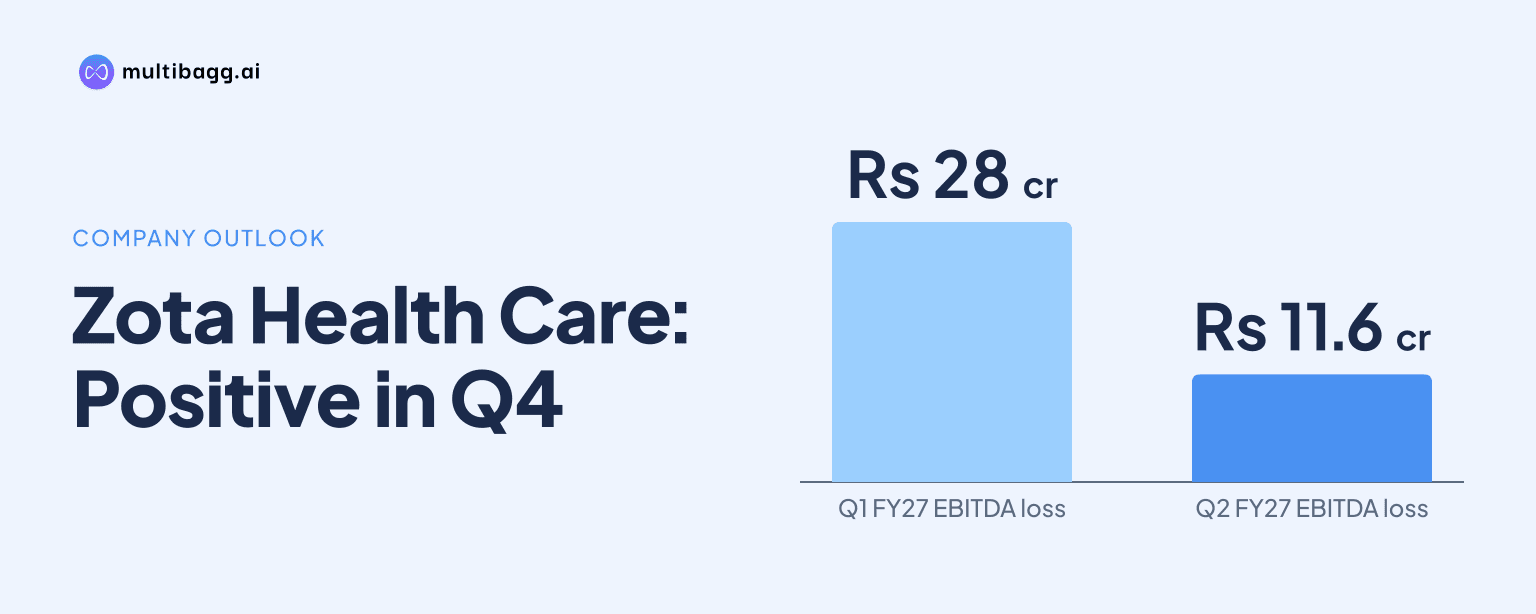
Zota Health Care Limited said Davaindia should become EBITDA-positive in Q4 FY27 after its operating EBITDA loss narrowed to Rs 11.6 crore in Q2 FY27 from about Rs 28 crore in Q1 FY27. Consolidated EBITDA also turned positive at Rs 7.92 crore, supported by restrained store additions and higher sales from the existing network.
Know Zota Health Care inside out
Results, valuation, peers and who's buying, in one view.
What drove Zota Health Care's Q2 FY27 EBITDA turnaround?
Zota Health Care reported consolidated EBITDA, or earnings before interest, tax, depreciation and amortisation, of Rs 7.92 crore in Q2 FY27, against a loss of Rs 9.55 crore in Q1 FY27. Management attributed the turnaround to fewer new stores, higher revenue from existing stores and operating-efficiency measures.
Revenue from operations rose 54.6% year on year to Rs 199.33 crore in Q2 FY27 from Rs 128.95 crore in Q2 FY26, and increased about 14.8% sequentially. Davaindia sales grew 76.3% year on year to Rs 168.47 crore and represented about 82% of consolidated revenue, with the remaining businesses contributing 18%.
Gross profit was Rs 119.94 crore and gross margin rose to 60.17% from 59.33% in Q2 FY26. The EBITDA improvement did not yet translate to net profit, as consolidated loss after tax narrowed to Rs 25.96 crore in Q2 FY27 from Rs 43.94 crore in Q1 FY27 after depreciation, finance costs and taxes.
How far did Davaindia's operating loss fall in Q2 FY27?
Davaindia's operating EBITDA loss fell to Rs 11.6 crore in Q2 FY27 from about Rs 28 crore in Q1 FY27, according to management. Management said the underlying Q1 loss was about Rs 20 crore after excluding the effect of higher advertising expenditure, implying a roughly Rs 8-9 crore improvement beyond lower marketing spending.
Advertising expenditure was around Rs 8-9 crore in Q2 FY27, compared with Rs 17-18 crore in Q1 FY27. Zota Health Care added 20 stores during Q2, comprising four company-owned, company-operated stores and 16 franchise-owned, franchise-operated stores, while closing five franchise outlets and ending September 30, 2026 with 2,840 stores.
Davaindia's quarterly gross merchandise value, or GMV, rose to Rs 187.91 crore from Rs 105.98 crore in Q2 FY26, while customer footfalls increased to 66.17 lakh from 43.53 lakh. Management said GMV increased by roughly Rs 20-22 crore sequentially despite limited new-store additions, linking that increase to the reduction in division-level losses.
Are Davaindia's older store cohorts profitable?
Yes, Zota Health Care said its oldest 29 Davaindia stores produced store-level EBITDA margins of roughly 35%-38% in Q2 FY27. Their average monthly GMV rose to around Rs 8 lakh per store from Rs 7.38 lakh in Q1 FY27, a roughly 10% sequential increase.
The cohort of about 234 stores opened between FY21 and FY24 generated average monthly GMV of Rs 4.60 lakh per store in Q2 FY27, compared with Rs 4.13 lakh in Q1 FY27. Management said this cohort generated store-level EBITDA of roughly 15%-17%, though it had earlier described profitability for the group as 12%-15% in another response.
A cohort of around 617 stores generated monthly GMV of Rs 2.59 lakh per store in Q2 FY27, against Rs 2.28 lakh in the preceding quarter. The approximately 804 stores opened in the last financial year generated about Rs 2 lakh monthly GMV per store and had store-level EBITDA losses of roughly 5%-7%, which management expects to move progressively positive over the next two quarters.
Got a follow-up? Ask IRIS
Why does Zota Health Care expect Davaindia EBITDA to turn positive?
Zota Health Care expects Davaindia to become EBITDA-positive in Q4 FY27, management said in response to an analyst question. Management qualified that outlook by saying losses should continue narrowing if the company does not undertake significant new-store additions.
The target relies on store productivity as well as cost control. Company-owned, company-operated store GMV rose to Rs 137.87 crore in Q2 FY27 from Rs 115.69 crore in Q1 FY27, while average customer wallet spend reached Rs 283, compared with Rs 229 in Q2 FY26.
Management said below-the-line neighbourhood activity and social-media campaigns helped increase average wallet spend by about Rs 50. It also said more than 80%-85% of customers were repeat customers, although it did not give a comparative repeat-customer percentage for an earlier quarter.
What expansion and margin factors could affect the Q4 FY27 target?
Zota Health Care plans to open roughly 400-450 additional stores in H2 FY27 after opening around 200 in Q1 FY27, retaining its full-year target of 600-650 new stores. Management also targets around 800 new openings in the following financial year, creating a balance to manage between expansion and the Q4 profitability objective.
Average monthly operating cost is around Rs 1.40-1.45 lakh per store, management said. New stores cost about Rs 1.30-1.40 lakh monthly, while mature stores can cost Rs 1.50-1.60 lakh because of rent escalation; management also expects annual price revisions of around 5%-10% to support gross margins over the next two to four quarters as products become eligible.
Conclusion
Zota Health Care's Q2 FY27 result showed two different stages of profitability: consolidated EBITDA turned positive at Rs 7.92 crore, while Davaindia's operating loss narrowed to Rs 11.6 crore. Store data underpin management's view, with the oldest 29 stores generating 35%-38% store-level EBITDA while the newest 804-store cohort remained at a 5%-7% loss.
The next test is whether Davaindia reaches EBITDA positivity in Q4 FY27 as management plans 400-450 additional H2 stores. Investors will also watch the pace of monthly GMV gains, the effect of annual price revisions over the next two to four quarters and whether new cohorts reach positive store-level EBITDA within management's expected two-quarter timeframe.