










Vivid Electromech says its product shift sets margin floor
Key highlights
- Management says Vivid Electromech will target a 50% to 60% revenue contribution from data centres.
- Vivid Electromech reported Rs 91 crore of H1 revenue, and management said H2 revenue is generally double H1 revenue.
- An analyst cited Rs 46 crore of H1 proprietary-product sales, including V-Set and PDUs, versus Rs 30 crore in the prior year.
- Management reiterated annual revenue guidance of around Rs 300 crore and 35% to 40% year-on-year growth.
powered by IRIS
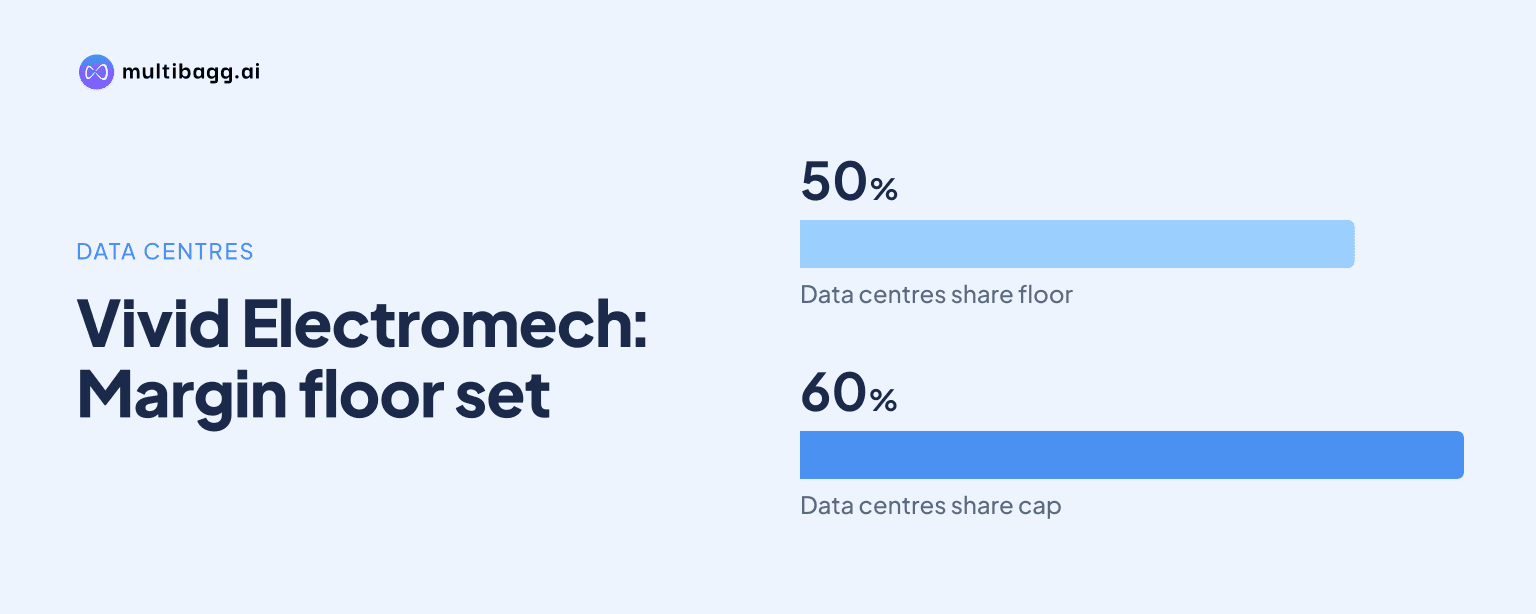
Vivid Electromech Limited says its current margin level should be a floor after shifting from residential and commercial projects to infrastructure and data centres, and expanding own-designed products. Management linked the benchmark to lower repeat-engineering costs, bulk vendor discounts and multi-OEM switchgear sourcing, while targeting 50% to 60% of revenue from data centres.
Know Vivid Electromech inside out
Results, valuation, peers and who's buying, in one view.
Why does Vivid Electromech call its current margin a floor?
Vivid Electromech says the recent margin level should be a floor because management has made it a benchmark in selecting and negotiating new orders. The comment came after an investor referred to margins rising from about 9% to 21% over two to three years, figures that management did not independently confirm or quantify as a target.
Management said first-half margins should not be compared directly with the full year because fixed costs in the first half, or H1, were spread over Rs 91 crore of revenue. It said second-half, or H2, revenue is generally double H1 revenue, which spreads fixed costs over a larger base, and management expects H2 margins to be in line with the previous year's H2.
The stated floor is therefore management's assessment of the changed project and product mix, rather than a published margin guidance range. Vivid Electromech said it is mindful of margins in order negotiations, but did not disclose segment-level profitability for infrastructure, data centres, V-Set panels or power distribution units, or PDUs.
How has Vivid Electromech changed its project mix?
Vivid Electromech says it has gradually exited most residential and commercial work, retaining only a few niche clients, and transferred its focus to infrastructure and data centres. Management described the earlier markets as highly competitive and affected by bad debts, while the newer focus areas carry larger project values.
The company said data-centre work reduces engineering effort because a design created for one floor can be repeated across eight or nine floors. That repeatability lowers engineering cost, according to management, while larger orders allow Vivid Electromech to negotiate bulk discounts from vendors. Management cited these two mechanisms as contributors to margin improvement over the past one to one-and-a-half years.
Management expects the mix to continue, saying data centres should contribute 50% to 60% of revenue, with the remainder coming from infrastructure, industries and solar. It also identified solar-cell ingot-wafer plants as a focus segment with large ticket sizes and said it had already disclosed some related orders to the National Stock Exchange of India.
How do Vivid Electromech's own-designed panels affect margins?
Vivid Electromech says its V-Set panels and PDUs are designed by the company, allowing it to choose switchgear from multiple original equipment manufacturers, or OEMs. Management said V-Set has been type-tested with three OEM switchgear options, giving the company more flexibility in sourcing and negotiating purchase terms.
This differs from ArTu K, which management described as an ABB-branded product. Vivid Electromech said it must use ABB products in ArTu K panels, whereas its own designs can use brands including ABB, Siemens and Schneider. Management said the wider supplier choice in own-designed products increases negotiating power and margins.
An analyst cited Rs 46 crore of H1 sales for proprietary panels and related products, compared with Rs 30 crore in the prior year. Management confirmed that the cited V-Set total included PDUs, but did not provide the requested split among V-Set panels, regular switch-distribution panels and PDUs. That leaves the product-level source of the sales increase undisclosed.
Got a follow-up? Ask IRIS
Is Vivid Electromech reducing its reliance on ArTu K?
Vivid Electromech says ArTu K's revenue share has declined as own-designed products have been added for the same data-centre customers. An investor said ArTu K represented 65% of FY26 revenue, and management responded that its share had come down in the current year, without giving the revised percentage.
Management does not expect ArTu K to disappear. It said customers such as STT can buy both ArTu K-format low-voltage panels and company-designed PDUs. The mix shift therefore reflects expansion of proprietary products within existing customer relationships, rather than a complete replacement of ABB-branded panels.
ArTu K also has a licence and royalty structure. Management said the original licence cost about Rs 40 lakh to Rs 50 lakh around seven to 10 years ago, while annual royalty payments are about Rs 7 lakh to Rs 10 lakh. It did not calculate the effect of those payments on ArTu K margins or compare them with the cost structure of V-Set.
What could affect Vivid Electromech's margin delivery?
Vivid Electromech is avoiding data-centre orders that require transformer skid solutions with one- or two-year delivery periods. Management cited price volatility as the reason for avoiding those contracts. Its current data-centre focus is on supply, installation, testing and commissioning of low-voltage panels and PDUs, where final deliveries generally do not exceed six months.
Management said executing the existing order book is its immediate priority and that it may begin booking orders for a further two or three quarters from January. It reiterated a target of around Rs 300 crore in annual revenue and 35% to 40% year-on-year growth, saying secured orders had begun execution and drawing stages were full. These are management targets rather than reported results.
Payment conditions may also create a margin and cash-conversion trade-off. For a Chennai data-centre order, management said it negotiated letter-of-credit-backed payments covering up to 90% of the contract value. It said that could make cash flow two to three times faster than a regular data-centre project, although it may require a margin concession of about 0.25%.
Conclusion
Vivid Electromech's margin-floor position rests on a combined change in markets, order size and product design. Management attributes the change to exiting much of the residential and commercial business, reducing engineering effort through repeatable data-centre designs, obtaining bulk purchasing terms and increasing the use of V-Set panels and PDUs that can source from more than one OEM.
The next test is whether the planned mix and execution support that benchmark. Management expects data centres to provide 50% to 60% of revenue, says H2 revenue is generally double H1 revenue of Rs 91 crore, and is targeting about Rs 300 crore of annual revenue with 35% to 40% growth. It also said segment-wise break-ups would begin a couple of quarters after facility-wise reporting started, which could clarify the contribution of proprietary products and end markets.