










Vivid avoids long-delivery skids, prioritises execution
Key highlights
- Vivid will avoid data-centre skid contracts with one- to two-year delivery periods because of price volatility.
- Vivid’s Rs 307 crore executable order book includes Rs 115 crore of data-centre work.
- Vivid reported Rs 119.75 crore of trade receivables on September 30, 2026, versus Rs 116.50 crore on March 31, 2026.
- The Ambernath project is designed to lift annual capacity from 7,500 to 22,500 verticals.
powered by IRIS
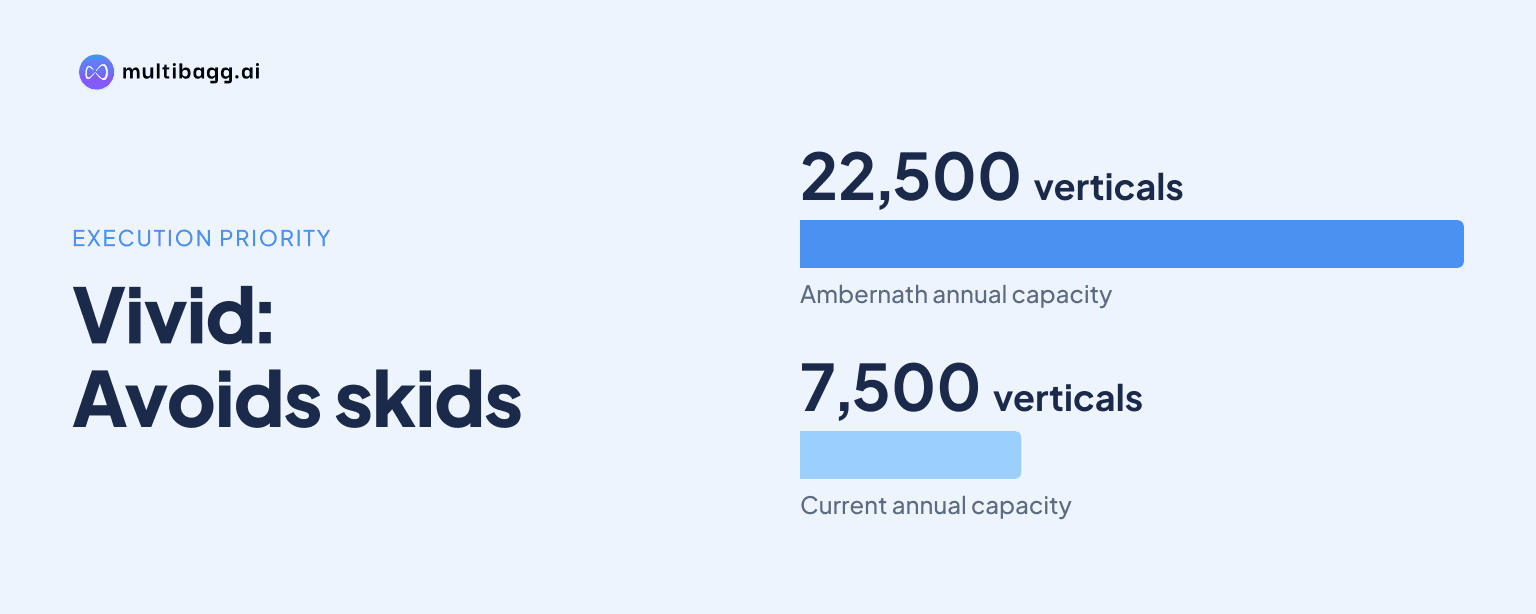
Vivid Electromech said in H1 FY2027 that it will avoid data-centre transformer skid contracts carrying one- to two-year delivery commitments, prioritise execution of its Rs 307 crore executable order book, and may begin booking new orders from January for the following two or three quarters.
Know Vivid Electromech inside out
Results, valuation, peers and who's buying, in one view.
Why is Vivid avoiding data-centre skid orders?
Vivid is avoiding complete data-centre solutions involving transformer supply on a skid because management is not comfortable with price volatility over delivery timelines of one to two years. Management said other Indian suppliers have accepted such long-duration contracts, but described its decision not to pursue them as a management call rather than a capacity constraint.
Vivid’s current data-centre work is focused on supply, installation, testing and commissioning, or SITC, of low-voltage panels and power distribution units, or PDUs. Management said final delivery for these orders does not extend beyond six months, giving Vivid a shorter period between order acceptance and completion than the one- to two-year skid commitments it is declining.
The distinction matters because data centres represented about 52% of Vivid’s H1 FY2027 revenue and accounted for Rs 115 crore of its Rs 307 crore executable order book. Vivid is retaining exposure to data-centre demand through panels and PDUs rather than withdrawing from the segment.
What will Vivid do before taking fresh orders?
Vivid’s immediate priority is to execute its existing Rs 307 crore order book, and management said it may start booking new orders from January for delivery over the subsequent two or three quarters. The approach follows H1 FY2027 revenue of Rs 91.53 crore, up 29.7% from Rs 70.57 crore in H1 FY2026.
The order book is split between Rs 115 crore in data centres, Rs 46 crore in metro rail and Rs 146 crore in other industries. Existing customers account for about 89% of its value, compared with 11% from new customers, meaning most work awaiting execution comes from established customer relationships.
Vivid linked this sequencing decision to execution rather than a stated reduction in its growth plans. Management said drawings were full and orders had begun execution, while reaffirming earlier FY2027 guidance of 35% to 40% year-on-year growth and a revenue target of around Rs 300 crore.
How is Vivid changing payment terms and collections?
Vivid is negotiating more collection-focused payment terms, including a Chennai data-centre order with letters of credit, or LCs, backing up to 90% of payments. Management said Vivid may sacrifice 0.25% of margin under such terms, but expects cash flow to be two to three times faster than on a regular data-centre project.
The change addresses payment structures in which 10% may be retained, another 10% can be due after commissioning, and a further 10% after the integrated system test, or IST, before the end user. Management said site-related factors can delay final commissioning by three to six months after Vivid has supplied equipment, extending the collection period.
Vivid has obtained enhanced non-fund-based limits from ICICI and Kotak and has started processing performance bank guarantees to substitute for retained payments. Management expects this step to bring into the collection pipeline amounts otherwise held under performance-bank-guarantee and defect-liability clauses.
Trade receivables stood at Rs 119.75 crore on September 30, 2026, compared with Rs 116.50 crore on March 31, 2026. Management said the similar closing balances did not mean collections had stopped: Vivid dispatched more than Rs 91 crore plus goods and services tax during the six months and collected about Rs 120 crore in that period.
Got a follow-up? Ask IRIS
What does Vivid’s working-capital position show?
Vivid reported negative operating cash flow of Rs 55.49 crore in H1 FY2027, driven by higher inventory, short-term advances, lower trade payables, increased other bank balances and income-tax payments. Inventory rose to Rs 17.29 crore on September 30, 2026, from Rs 6.66 crore on March 31, 2026, as Vivid procured materials ahead of project execution and dispatches.
Total borrowings fell to Rs 24.27 crore on September 30 from Rs 33.30 crore at the end of March, despite short-term borrowings rising to Rs 22.51 crore for working-capital needs. Long-term borrowings declined to Rs 1.76 crore from Rs 19.66 crore after repayments of about Rs 23.02 crore during H1 FY2027.
Vivid spent about Rs 34 crore on capital expenditure in H1 FY2027, primarily on manufacturing expansion and related investments, while investing cash outflow was Rs 28.23 crore. Of Rs 104.56 crore in initial public offering proceeds, Rs 81.64 crore had been used by September 30, leaving Rs 22.92 crore unutilised; shareholders approved a Rs 9 crore reallocation from factory capital expenditure to working capital on August 25, 2026.
How does added capacity fit Vivid’s order strategy?
Vivid had spent Rs 34 crore on the Ambernath facility by the call date, with phase one expected to add roughly 5,000 verticals of annual capacity. Management said machine installation was under way and first dispatches from the new facility were expected by November-end.
The full Ambernath project is designed to add 15,000 verticals annually, lifting total installed capacity from 7,500 to 22,500 verticals a year. Management said the remaining phase-two work, excluding the office and experience-centre block, was expected by December-end, while full utilisation could take one to one-and-a-half years.
The existing Navi Mumbai and Pune facilities were each operating at 95% capacity utilisation in H1 FY2027. Vivid said automation, robotic fabrication and in-house testing at Ambernath are intended to improve manufacturing efficiency and enable execution of larger and more complex orders, providing capacity for selective future order intake.
Conclusion
Vivid’s stated strategy is to favour shorter-cycle panel and PDU data-centre work over one- to two-year skid contracts exposed to price volatility. The plan combines execution of a Rs 307 crore backlog with revised payment structures, performance bank guarantees and higher bank limits, against H1 FY2027 operating cash outflow of Rs 55.49 crore and receivables of Rs 119.75 crore.
The next disclosed milestones are expected first dispatches from Ambernath by November-end, phase-two completion targeted for December-end, and potential resumption of fresh order bookings from January. Management also said improved receivables should be visible in the next balance sheet as LC-backed terms of up to 90%, bank guarantees and revised payment negotiations enter the pipeline.