










Kriti Industries reports losses for September quarter, half year
Key highlights
- Kriti Industries reported standalone and consolidated losses for the quarter and six months ended 30 September 2026.
- The group recognised a Rs 9.32 lakh share of net loss after tax from its associate in the September 2026 quarter.
- Kriti Industries reported one operating segment, plastics, under Ind AS 108.
- The audit committee reviewed the results on 4 November 2026 and the board took them on record on 5 November 2026.
powered by IRIS
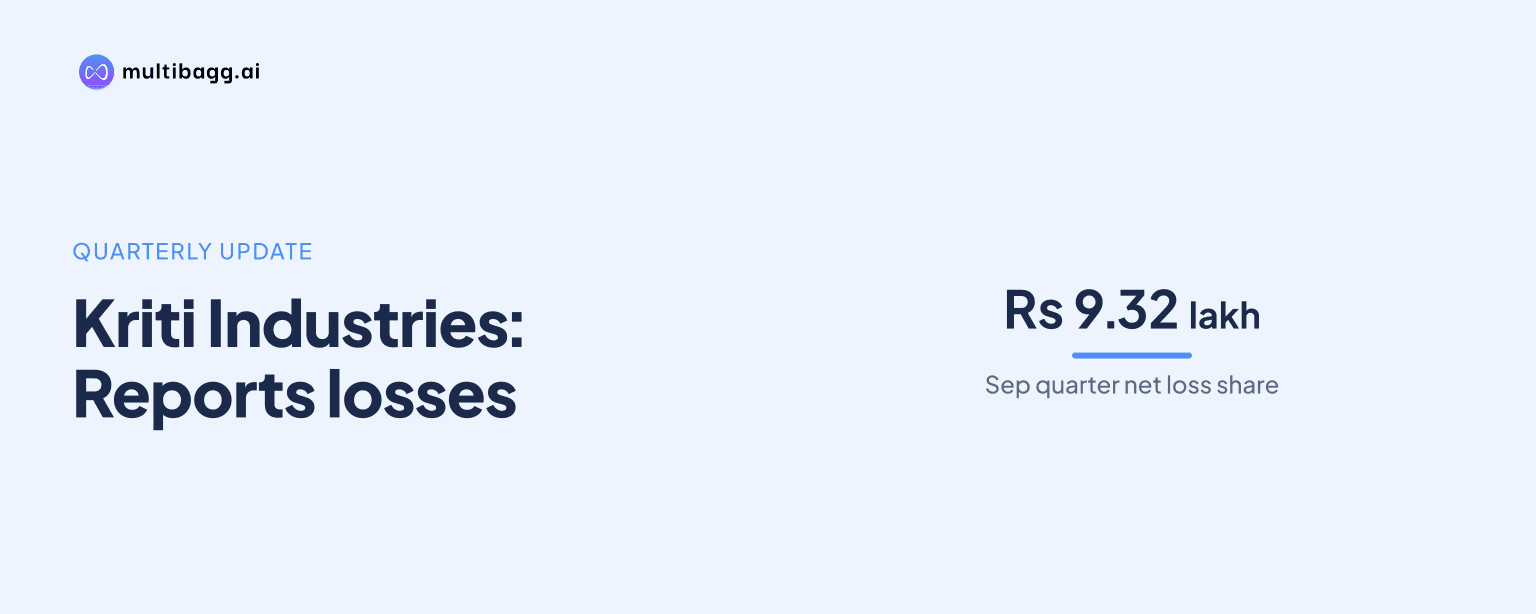
Kriti Industries (India) Limited reported unaudited standalone and consolidated losses for the quarter and six months ended 30 September 2026, with the group also recognising a Rs 9.32 lakh share of net loss after tax from its associate during the quarter. The board took the results on record on 5 November 2026.
Know Kriti Industries (India) inside out
Results, valuation, peers and who's buying, in one view.
Did Kriti Industries report losses in the September 2026 period?
Yes, Kriti Industries reported losses on both a standalone and consolidated basis for the quarter and six months ended 30 September 2026. The unaudited financial-results statement presents losses from continuing operations in both sets of accounts, while showing no profit or loss from discontinued operations for the reported periods.
The statement covers the quarter ended 30 September 2026, the quarter ended 30 June 2026 and the quarter ended 30 September 2025. It also compares the six months ended 30 September 2026 with the six months ended 30 September 2025, and includes the audited year ended 31 March 2026. This structure allows readers to distinguish the September quarter result from the first-half outcome.
Kriti Industries reported revenue from operations and other income alongside expenses for material consumption, changes in inventories, employee benefits, finance costs, depreciation and amortisation, and other expenses. The filing does not provide a management explanation for why the parent company and group recorded losses in the September 2026 quarter or first half.
The company reported paid-up equity share capital of Rs 5.27 crore, with a face value of Re 1 per equity share. Its statement also includes basic and diluted earnings per share for each reporting period, meaning the loss is presented both in the profit or loss account and on a per-share basis.
What does the comparison between standalone and consolidated results show?
The comparison shows that Kriti Industries recorded losses under both reporting bases for the quarter and six months ended 30 September 2026, rather than only at the parent-company level. The consolidated result includes entities beyond Kriti Industries itself, while the standalone result covers the listed parent company.
The scope changed between the two measures because the consolidated accounts include the wholly owned subsidiary Kriti Auto and Engineering Plastics Pvt. Ltd. and the associate FP Elite Energy Private Limited. The consolidated review report describes Kriti Industries as the holding company for the quarter and six months ended 30 September 2026.
The group’s share of net loss after tax from one associate was Rs 9.32 lakh for the quarter ended 30 September 2026. The associate recorded nil total comprehensive income for that quarter, according to the consolidated auditor’s report. That associate contribution affects the consolidated result but is not part of the standalone result.
Kriti Industries identified plastics as the group’s sole business segment under Indian Accounting Standard 108, or Ind AS 108, on operating segments. As a result, the filing does not provide a segment-by-segment revenue or profit comparison between plastics and another operating business for the September 2026 period.
How should readers compare the September quarter with other periods?
Readers should treat the September 2026 quarter as a balancing figure within the six-month result, rather than as a separately accumulated nine-month or annual number. Kriti Industries said the quarter ended 30 September 2026 was calculated as the difference between the reviewed six months ended 30 September 2026 and the reviewed quarter ended 30 June 2026.
The same method applies to the comparative quarter ended 30 September 2025. This means the filing provides a like-for-like quarterly comparison against both 30 June 2026 and 30 September 2025, while the half-year columns compare the first six months of the current and prior financial years.
The disclosed exceptional items relate to the audited year ended 31 March 2026, not to the September 2026 interim period. Kriti Industries reported an exceptional loss of Rs 3.78 crore for the estimated settlement of a fire-insurance claim and Rs 77.01 lakh related to the New Labour Code 2025 in that annual result.
What changed between the annual disclosure and the September 2026 interim disclosure is that the supplied September notes do not identify a comparable exceptional item. The annual fire-insurance and labour-code charges therefore provide context for the prior full-year result, but the filing does not state that they caused the losses reported for the quarter or six months ended 30 September 2026.
Got a follow-up? Ask IRIS
What do the balance sheet and cash flow disclosures add?
Kriti Industries included standalone and consolidated balance-sheet information and a cash-flow statement as on 30 September 2026 alongside the income statement. These statements provide financial-position and cash-movement context for the losses reported in the quarter and first half.
The cash-flow statement is presented in lakh rupees and accompanies the 30 September 2026 results. The filing includes operating, investing and financing cash-flow categories, which separate cash movements linked to operations from movements linked to investments and financing activities.
The income statement separately identifies finance costs, depreciation and amortisation, inventory changes and other expenses for the 30 September 2026 period. These are distinct accounting lines, and the cash-flow disclosure is relevant because depreciation and amortisation are not cash expenses in the same period in which they are recognised in profit or loss.
Kriti Industries did not disclose a liquidity target, borrowing programme, capital-expenditure plan or funding target in the supplied notes dated 5 November 2026. The filing therefore supports reporting on the balance-sheet and cash-flow statements, but not a conclusion about future financing requirements or future cash generation.
Were Kriti Industries' September 2026 results audited?
No, Kriti Industries' September 2026 results were reviewed rather than fully audited. M Mehta & Company issued separate standalone and consolidated independent review reports dated 5 November 2026 for the quarter and six months ended 30 September 2026.
For the standalone statement, the reviewer said nothing had come to its attention to indicate that the interim financial statements were not prepared, in all material respects, under Ind AS 34, Interim Financial Reporting, and other generally accepted accounting principles in India. The report also states that a review provides moderate assurance and does not express an audit opinion.
For the consolidated statement, the reviewer said the results gave a true and fair view of the consolidated net loss, including other comprehensive income, subject to the associate results being unreviewed or unaudited. The associate information was certified by that associate's management rather than reviewed by its auditor.
According to Kriti Industries' management, the unreviewed associate results were not material to the group. The audit committee reviewed the results on 4 November 2026, and the board took them on record on 5 November 2026 under the Companies (Indian Accounting Standards) Rules, 2015.
Conclusion
Kriti Industries' September 2026 filing shows that losses were recorded at both the standalone parent and consolidated group levels for the quarter and first half. The consolidated result has a broader scope than the parent result because it includes the wholly owned subsidiary and the group’s associate share, including a Rs 9.32 lakh quarterly associate loss.
The next disclosed matter to watch is the treatment of the associate in later results, because its September 2026 interim information was unreviewed and certified by its management. Readers can also track subsequent quarterly statements against the 30 September 2026 balance-sheet and cash-flow disclosures, while noting that Kriti Industries disclosed no liquidity, financing or operating target in this filing.