










Laser Power government revenue mix reached 65.2% in FY26
Key highlights
- Laser Power received Rs 1,515.7 crore, or 65.2%, of FY26 revenue from government customers.
- Laser Power’s FY26 EPC awards reached Rs 1,293.3 crore across eight projects, including GST.
- Laser Power’s FY26 total order book was Rs 3,243.4 crore, up from Rs 2,172.7 crore in FY24.
- Laser Power reports completing more than 43 EPC projects across India under government schemes.
powered by IRIS
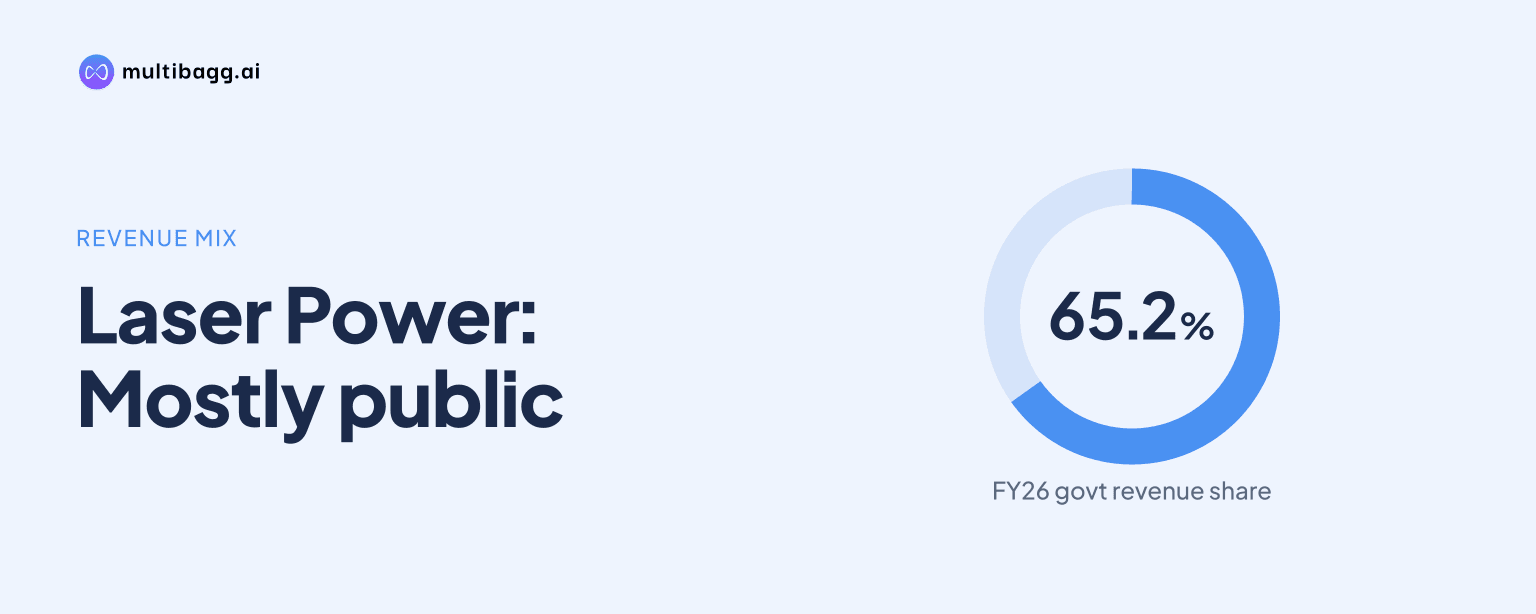
Laser Power & Infra Ltd received 65.2% of FY26 revenue from government-sector customers, contributing Rs 1,515.7 crore, while engineering, procurement and construction (EPC) awards rose to Rs 1,293.3 crore, including Goods and Services Tax (GST). Government revenue increased even as total revenue declined from the FY25 level.
Know Laser Power & Infra inside out
Results, valuation, peers and who's buying, in one view.
How dependent was Laser Power on government customers in FY26?
Laser Power generated Rs 1,515.7 crore from government customers in FY26, or 65.2% of total revenue of Rs 2,326.1 crore. Private-sector customers contributed Rs 810.4 crore, or 34.8%, leaving government-sector revenue Rs 705.3 crore higher than private-sector revenue during the year.
Government-sector revenue increased from Rs 937.7 crore in FY24 to Rs 1,437 crore in FY25 and Rs 1,515.7 crore in FY26. Its revenue share rose by 7.2 percentage points from 58.0% in FY24 to 65.2% in FY26, while the private-sector share fell from 42.0% to 34.8%.
Total revenue rose by Rs 820.6 crore between FY24 and FY25, before declining by Rs 112.4 crore in FY26. Government-sector revenue nevertheless increased by Rs 78.7 crore in FY26, whereas private-sector revenue fell by Rs 191.1 crore, increasing the government weighting in Laser Power’s customer mix.
How much did Laser Power’s EPC awards increase in FY26?
Laser Power secured EPC projects worth Rs 1,293.3 crore in FY26, compared with Rs 1,012.1 crore in FY25 and Rs 854.2 crore in FY24. The FY26 award value was the highest across the three reported years, although the number of projects awarded declined to eight from nine in FY25.
The value of awarded EPC projects increased by Rs 281.2 crore from FY25 to FY26. The award count moved from three projects in FY24 to nine in FY25 and eight in FY26, indicating a higher average award value in FY26 than FY25 based on the reported aggregate values and project counts.
Across FY24 to FY26, Laser Power secured 20 EPC projects with an aggregate awarded value of Rs 3,159.5 crore. Management attributes the rise in award value to increased tender participation and qualification capabilities; the presentation does not provide a forecast for future EPC awards.
What supports Laser Power’s government EPC participation?
Laser Power says government-agency supply requires pre-qualification based on prior supply experience, technical requirements, financial strength and price competitiveness. Its pre-qualified status with utilities and government agencies is presented as a factor supporting participation in government-linked tenders.
Laser Power reports completing more than 43 EPC projects across India under government schemes including the Revamped Distribution Sector Scheme (RDSS), Deendayal Upadhyaya Gram Jyoti Yojana (DDUGJY), Integrated Power Development Scheme (IPDS) and Saubhagya. Listed project locations include Saran, Bhagalpur and Patna in Bihar; Gorakhpur in Uttar Pradesh; Bongaigaon in Assam; Nadia in West Bengal; and Kalahandi in Odisha.
Laser Power describes its model as integrated, with backward integration, project-management capabilities and technology-led monitoring. Its three West Bengal manufacturing units had aggregate installed capacity of 85,448 metric tonnes as of March 31, 2026, producing power and control cables, specialty cables and conductors for its manufacturing and project activities.
Installed capacity increased by approximately 37.8% between FY24 and FY26, while actual production declined from 55,724 metric tonnes in FY25 to 52,629 metric tonnes in FY26. Capacity utilisation consequently fell from 76.2% in FY25 to 61.6% in FY26, following 85.8% in FY24.
Got a follow-up? Ask IRIS
What does Laser Power’s order book show about pending work?
Laser Power reported a total order book of Rs 3,243.4 crore at the end of FY26, up from Rs 2,172.7 crore at FY24-end and Rs 2,317.2 crore at FY25-end. The company states that the FY24-to-FY26 increase was 49.3%, with manufacturing orders pending execution accounting for most of the increase.
The manufacturing order book rose from Rs 543.8 crore at FY24-end to Rs 849.3 crore at FY25-end and Rs 1,668.9 crore at FY26-end. In contrast, the EPC order book was Rs 1,574.5 crore at FY26-end, above Rs 1,468 crore in FY25 but below the Rs 1,628.9 crore reported in FY24.
Manufacturing-business order inflow was Rs 2,123.2 crore in FY26, comprising Rs 1,005.3 crore from government customers, Rs 1,067.3 crore from private customers and Rs 50.6 crore from customers outside India. The manufacturing order book covers third-party customer orders only, while the EPC order book includes cables internally sourced from the manufacturing division.
The disclosed project scope includes high-voltage distribution systems in semi-urban and rural areas, 33/11 kilovolt substations, underground cabling and last-mile connectivity. The presentation does not provide a government-private split of the FY26 outstanding order book, despite government customers contributing 65.2% of FY26 revenue.
Conclusion
Laser Power’s FY26 mix shifted further toward government customers, whose revenue rose to Rs 1,515.7 crore and 65.2% of total revenue as private-sector revenue declined to Rs 810.4 crore. EPC award value also increased to Rs 1,293.3 crore despite the number of projects falling from nine in FY25 to eight in FY26, while the total order book reached Rs 3,243.4 crore.
The next disclosed indicators to watch are execution of the Rs 1,668.9 crore manufacturing order book and the Rs 1,574.5 crore EPC order book at FY26-end. Management’s reported tender-participation and qualification efforts, together with the unresolved government-private composition of outstanding orders, will determine how the higher government share of revenue develops beyond FY26.