










Laser Power & Infra Ltd capacity rose 37.8% as utilisation fell
Key highlights
- Laser Power's installed cable and conductor capacity rose approximately 37.8% from FY24 to 85,448 MT in FY26.
- Laser Power's capacity utilisation declined to 61.6% in FY26 from 85.8% in FY24.
- Laser Power produced 52,629 MT in FY26, compared with 55,724 MT in FY25.
- Laser Power operates three integrated West Bengal units spanning 40.39 acres.
powered by IRIS
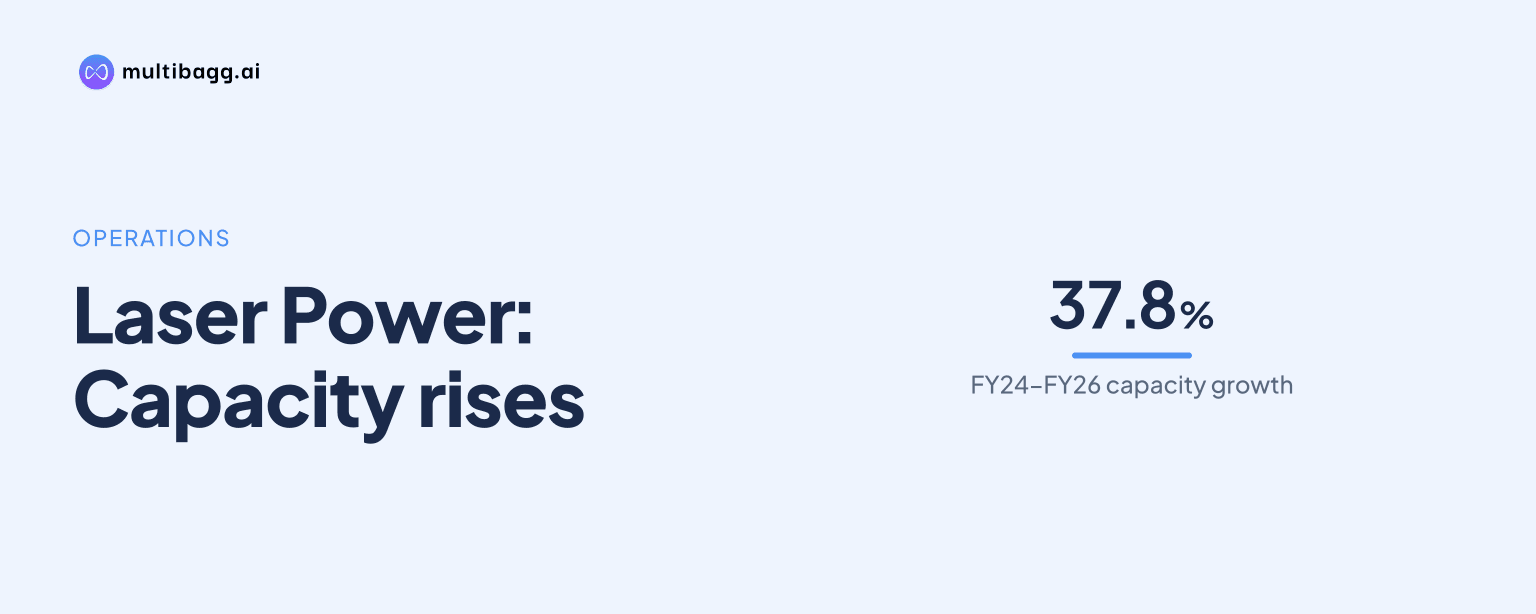
Laser Power & Infra Ltd expanded cable and conductor installed capacity by approximately 37.8% between FY24 and FY26 to 85,448 metric tonnes (MT), while capacity utilisation declined to 61.6% from 85.8%. Laser Power produced 52,629 MT in FY26, below both FY25 production of 55,724 MT and FY24 production of 53,191 MT.
Know Laser Power & Infra inside out
Results, valuation, peers and who's buying, in one view.
Why did Laser Power's capacity utilisation fall in FY26?
Laser Power's utilisation fell in FY26 because installed capacity increased while actual production declined. Capacity rose by 12,348 MT to 85,448 MT from 73,100 MT in FY25, while production decreased by 3,095 MT to 52,629 MT from 55,724 MT. The resulting utilisation rate was 61.6%, down 14.6 percentage points from 76.2% in FY25.
The FY26 result extended the gap between capacity expansion and output over the three reported years. Installed capacity increased by 23,448 MT, or approximately 37.8%, from 62,000 MT in FY24 to 85,448 MT in FY26. Actual production, however, declined by 562 MT over the same period, taking utilisation 24.2 percentage points below the FY24 rate of 85.8%.
How did Laser Power's capacity and production change from FY24 to FY26?
Laser Power added capacity in both FY25 and FY26, while production rose in FY25 before declining in FY26. Installed capacity increased by 11,100 MT in FY25, from 62,000 MT to 73,100 MT, and by a further 12,348 MT in FY26. Production increased by 2,533 MT in FY25, then fell by 3,095 MT in FY26.
The table shows that FY25 was the high point for production in the three-year series, at 55,724 MT, but its utilisation was lower than FY24 because capacity had risen to 73,100 MT. In FY26, the 12,348-MT capacity addition was larger than the FY25 addition, while production fell below both prior years. The presentation describes the FY24-to-FY26 installed-capacity increase as approximately 37.8%.
What manufacturing assets support Laser Power's expanded capacity?
Laser Power operates three integrated manufacturing units in West Bengal, covering a combined 40.39 acres and holding aggregate installed capacity of approximately 85,448 MT as of March 31, 2026. The facilities manufacture power and control cables, specialty cables and conductors. The presentation identifies Laser Power as among the leading East India players by manufacturing capacity in these product categories.
The manufacturing model includes in-house aluminium wire rods and cross-linked polyethylene (XLPE) and polyvinyl chloride (PVC) compounds. Laser Power says this backward integration supports cost efficiency, product consistency and operational flexibility. Its units are located near Kolkata and Haldia ports and close to raw-material hubs in Odisha and Jharkhand, which the presentation says can reduce transportation costs and lead times for domestic and export orders.
Laser Power also lists compounding, wire-rod rolling, and the recycling and reprocessing of PVC and XLPE scrap as elements of its production infrastructure. It reports in-house laboratories accredited by the National Accreditation Board for Testing and Calibration Laboratories (NABL), alongside ISO 9001 quality, ISO 14001 environment, and ISO 45001 occupational health and safety certifications.
Got a follow-up? Ask IRIS
Which products and markets can use Laser Power's capacity?
Laser Power's 85,448-MT capacity covers power and control cables, specialty cables and conductors, including aluminium alloy wire rods, aluminium conductor steel reinforced (ACSR) conductors, and insulated conductors. Its specialty portfolio includes AL-59 all-alloy aluminium conductors, Eco Conductors, and high-temperature low-sag (HTLS) products, including aluminium conductor steel supported conductors and gap-type conductors.
The presentation identifies government utilities, power transmission and distribution companies, and private infrastructure players as customer groups in domestic and international markets. Named domestic customers and channels include Indian Railways, distribution companies in West Bengal, Bihar, Kerala, Uttar Pradesh and Odisha, and engineering, procurement and construction (EPC) companies such as Tata Power and CESC. International clients are listed in Ethiopia, Rwanda, Uganda, Mauritius, Bhutan and Togo.
Government-sector revenue increased to Rs 151.57 crore in FY26 from Rs 93.77 crore in FY24, while its share of total revenue rose to 65.2% from 58.0%. Private-sector revenue increased to Rs 81.04 crore from Rs 68.02 crore over the same period, but its revenue share declined to 34.8% from 42.0%. Total revenue reached Rs 232.61 crore in FY26, after Rs 243.85 crore in FY25 and Rs 161.79 crore in FY24.
Laser Power also reports a strategic manufacturing agreement with TS Conductor Corp of the United States, under which it is a licensed stranding partner. The company says the arrangement enables local manufacture of advanced transmission conductors that are lighter, stronger and capable of carrying more power than conventional ACSR or carbon-fibre composite core conductors. The presentation says the collaboration can reduce import dependency and production lead times.
How does EPC activity relate to Laser Power's manufacturing base?
Laser Power reported Rs 129.33 crore of EPC projects awarded in FY26, compared with Rs 101.21 crore in FY25 and Rs 85.42 crore in FY24. The number of projects awarded was eight in FY26, after nine in FY25 and three in FY24. Across FY24 to FY26, the presentation reports Rs 315.95 crore of EPC projects awarded across 20 projects.
Laser Power says it has completed more than 43 EPC projects across India under government schemes including the Revamped Distribution Sector Scheme, Deendayal Upadhyaya Gram Jyoti Yojana, Integrated Power Development Scheme and Saubhagya Scheme. The presentation lists projects in Bihar, Uttar Pradesh, Assam, West Bengal and Odisha, including Saran, Gorakhpur, Bongaigaon, Nadia and Kalahandi.
The presentation also cites a CRISIL report dated June 2026 that expects the Indian wires and cables market to grow at an 11% to 13% compound annual growth rate through FY30, reaching Rs 2,350 to Rs 2,550 crore. It states that the conductor market grew from Rs 102 crore in FY20 to Rs 185 crore in FY25 at a 12.6% compound annual growth rate, with expected growth of 5% to 6% from FY25 to FY30.
Conclusion
Laser Power's FY24-to-FY26 figures show capacity growth exceeding production growth. Installed capacity increased approximately 37.8% to 85,448 MT, but FY26 production was 52,629 MT, below the 53,191 MT reported in FY24. That divergence reduced utilisation from 85.8% to 61.6% over the period, even as government-sector revenue rose to Rs 151.57 crore in FY26.
The next point to watch is whether EPC awards, which reached Rs 129.33 crore in FY26, and the TS Conductor Corp manufacturing agreement translate into higher output from the 85,448-MT base. Laser Power does not disclose a future capacity-utilisation target or a further installed-capacity schedule in the presentation, leaving the pace of production recovery unresolved.