










Laurus Labs posts record Rs 2,206 crore quarterly revenue
Key highlights
- Laurus Labs reported Q2 FY27 income from operations of Rs 2,206 crore, its highest quarterly level since inception.
- Small-molecule CDMO sales rose 86% year on year to Rs 875 crore in Q2 FY27.
- Laurus Labs reported Q2 FY27 EBITDA of Rs 762 crore and an EBITDA margin of 34.5%.
- Affordable-medicines revenue grew 15% year on year to Rs 1,302 crore in Q2 FY27.
powered by IRIS
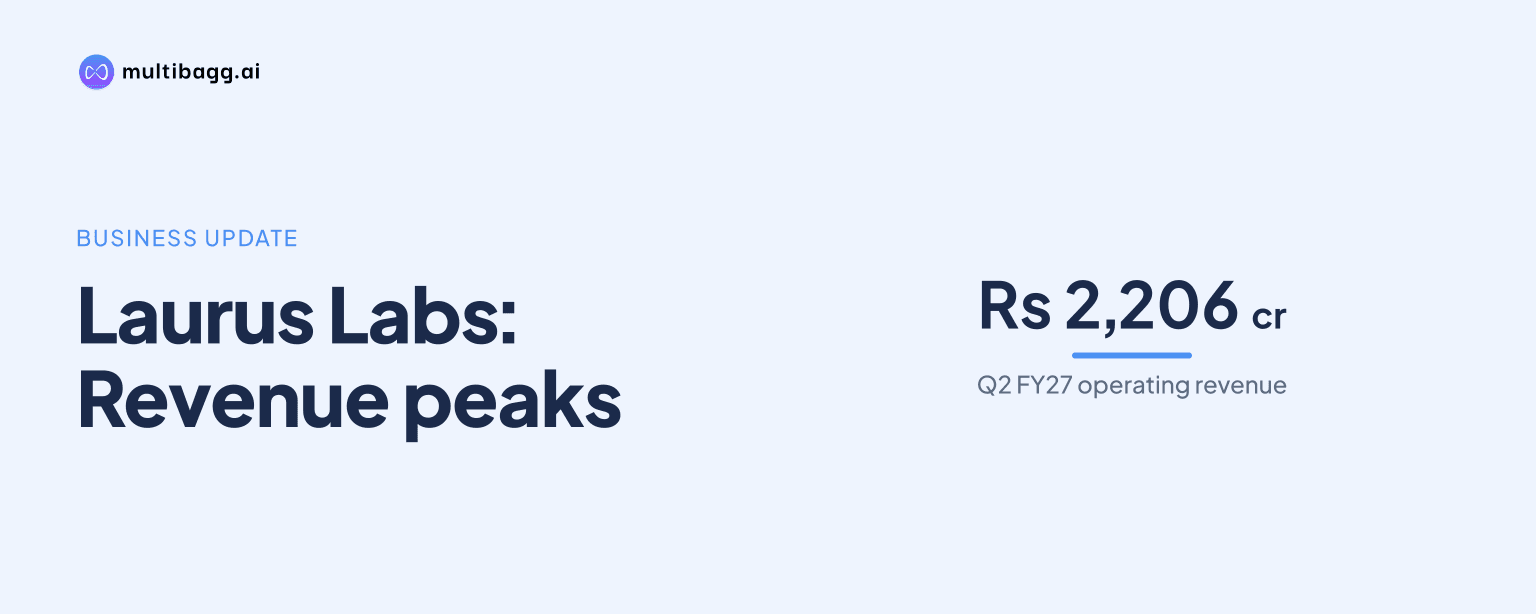
Laurus Labs Limited posted record Q2 FY27 revenue of Rs 2,206 crore, driven by an 86% year-on-year increase in contract development and manufacturing organisation sales to Rs 875 crore; earnings before interest, tax, depreciation and amortisation margin was 34.5%, management said on October 29, 2026.
Know Laurus Labs inside out
Results, valuation, peers and who's buying, in one view.
How did Laurus Labs perform in Q2 FY27?
Laurus Labs delivered its highest quarterly income from operations since inception, at Rs 2,206 crore in Q2 FY27. For the first half (H1) of FY27, income from operations was Rs 4,233 crore, up 31% year on year, while Q2 EBITDA was Rs 762 crore and profit after tax was Rs 441 crore.
Profitability increased during the reported period. Q2 gross margin was 63.0%, compared with 62.9% in H1 FY27, while Q2 EBITDA margin reached 34.5% versus 33.2% for H1. Management said Q2 EBITDA margin was 2.7 percentage points higher than previous quarters, supported by product mix, division mix and operating leverage.
What drove Laurus Labs' CDMO growth?
Critical late-stage programmes and commercial active pharmaceutical ingredient supplies drove Laurus Labs' small-molecule CDMO sales up 86% year on year to Rs 875 crore in Q2 FY27. H1 FY27 CDMO sales were Rs 1,710 crore, up 77%, and management also cited demand at newly commissioned human-health and animal-health assets.
Laurus Labs has expanded both manufacturing scale and technical scope. Its small-molecule API reactor volume in operation exceeded 9,000 kilolitres in Q2 FY27. Management said capabilities added since 2023 include biocatalysis, flow chemistry, flow hydrogenation and fermentation, and it cited a commercialised facility for payload-linker work.
Laurus Labs is pursuing integrated projects from preclinical development through finished drug-product services, rather than supplying peptide fragments alone. Management told an analyst it did not anticipate a near-term disruption from customer inventory build-up, based on current visibility, while noting that volumes across commercial programmes can vary and offset one another.
Got a follow-up? Ask IRIS
How did affordable medicines and Laurus Bio compare?
Affordable-medicines revenue remained Laurus Labs' larger disclosed Q2 business, at Rs 1,302 crore, while CDMO generated the faster growth rate at 86%. Affordable-medicines revenue increased 15% year on year in Q2 FY27 and 13% in H1 FY27, supported by order-book expansion and stable pricing in antiretroviral and developed-market portfolios.
Laurus Bio reported Q2 sales of Rs 29 crore and H1 FY27 sales of Rs 64 crore. Management attributed year-on-year variation to campaign phasing, while describing pipeline activity across animal-origin-free and CDMO programmes. Laurus Bio 4, a commercial fermentation facility, is expected to be operational by the end of 2026, with customer capacity reservations already being advanced.
Laurus Labs expects Phase 1 production blocks at its formulation joint venture with KRKA to begin operations in mid-2027, focused on high-potent and general oral solid dosage manufacturing. By H1 FY27, Laurus Labs had cumulatively filed 92 drug master files; its developed-market formulations business filed two dossiers and received two approvals during H1, taking cumulative product filings to 96.
What is Laurus Labs investing in next?
Laurus Labs invested about Rs 470 crore in capital expenditure in Q2 FY27 and Rs 864 crore in H1 FY27 across growth projects. Net debt stood at Rs 2,466 crore, while debt to EBITDA declined to about 1.02 from 1.28 in the preceding quarter, which management attributed to internal cash flows.
Laurus Labs commissioned a commercial-scale peptide manufacturing block with more than 16,000 litres of solid-phase peptide-synthesis reactor volume. Management said some commercial revenue from the peptide capacities under discussion is expected around 2029, although validation campaigns could utilise the assets earlier as programmes progress through approvals.
Laurus Labs announced agreements to acquire a 60% stake in Canada-based Galenvs Sciences and a majority stake in Hyderabad-based SI & C Resins during Q2 FY27. Management said the transactions add oligonucleotide, purification and fill-finish capabilities, and could bring peptide resins and chromatography stationary phases in house. Research and development spending was 4.3% of H1 FY27 sales, up more than 34% year on year, mainly for gene-therapy and antibody-drug-conjugate infrastructure.
Conclusion
Laurus Labs combined record Q2 FY27 revenue of Rs 2,206 crore with a 34.5% EBITDA margin as CDMO sales rose 86% to Rs 875 crore and affordable-medicines revenue increased 15% to Rs 1,302 crore. Affordable medicines remained the larger disclosed quarterly contributor, but CDMO provided the sharper rate of growth and a key part of the operating-leverage improvement cited by management.
The next disclosed milestones are the expected end-2026 start of Laurus Bio 4, the planned mid-2027 commencement of the KRKA joint-venture Phase 1 blocks, and commercial peptide revenue around 2029 for some current capacities. Management is also expanding peptide capacity, while H1 FY27 capital expenditure totalled Rs 864 crore.