










Laurus sees peptide validation batches within 12 to 18 months
Key highlights
- Laurus has disclosed more than 16 KL of SPPS peptide capacity and is expanding it.
- Laurus said peptide validation batches could start broadly within 12 to 18 months.
- Resin represents 10% to 20% of peptide raw-material cost, depending on fragment length.
- Laurus plans Rs 3,000 crore of capital expenditure across FY27 and FY28.
powered by IRIS
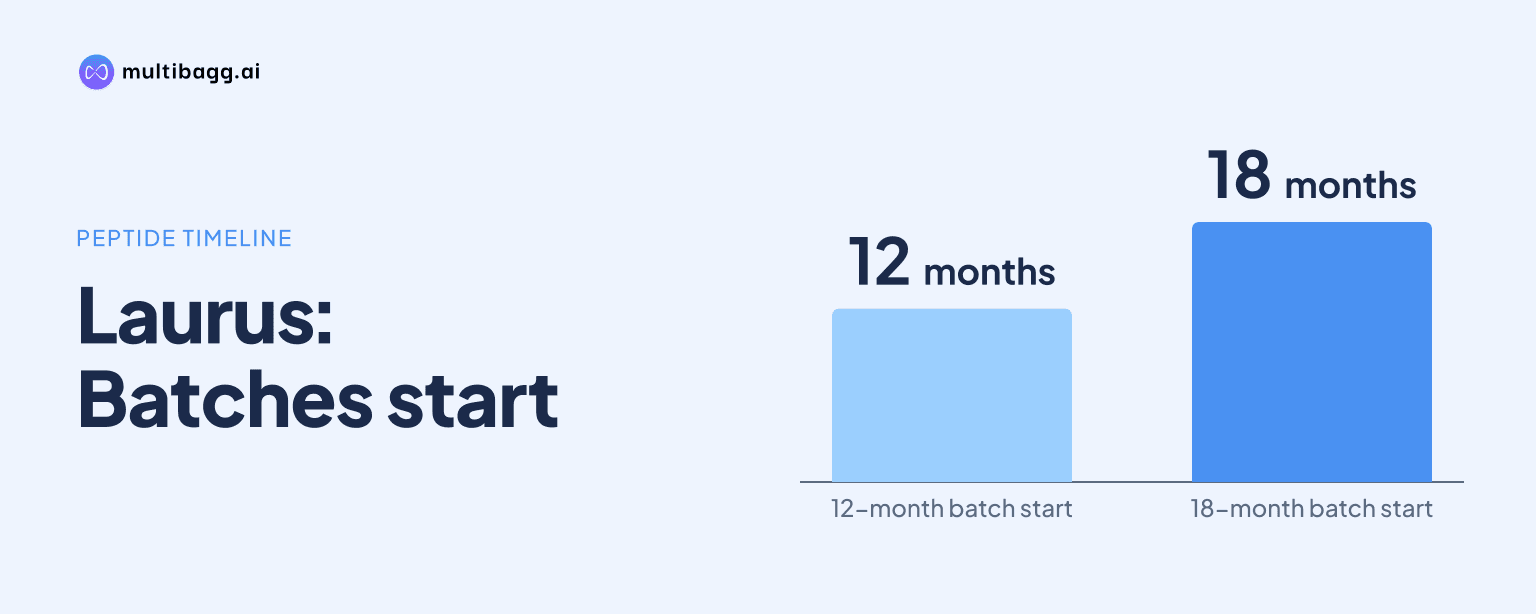
Laurus Labs said peptide validation batches could begin broadly within 12 to 18 months, supported by more than 16 kilolitres of disclosed solid-phase peptide synthesis capacity that it is expanding for anticipated clinical-program validation and commercial demand. Laurus did not disclose a date for peptide commercial revenue or committed customer capacity.
Know Laurus Labs inside out
Results, valuation, peers and who's buying, in one view.
When could Laurus begin peptide validation batches?
Laurus said peptide validation batches could begin broadly within 12 to 18 months, although it cautioned that clinical-program schedules can change. Management gave that timeline when asked when validation work could start at the peptide facility, rather than providing a date for commercial revenue from its more than 16 KL of solid-phase peptide synthesis capacity.
Laurus has not guided to an FY29, or any other, start for peptide commercial revenue. When asked about both the start of commercial revenue and the percentage of capacity already committed by customers, management declined to answer, citing confidentiality and strategic reasons. The 12-to-18-month indication applies to validation batches, which are distinct from disclosed commercial sales.
Management said peptide validation generally requires commercial-scale facilities because of the complexity of synthesis. A customer would not normally want to validate a program at one reactor scale, then shift it to another reactor, facility or manufacturing block for commercial supply. Laurus therefore built the existing block to perform validation and later meet commercial demand from the same manufacturing location.
What peptide capacity is Laurus expanding?
Laurus has disclosed a little over 16 KL of solid-phase peptide synthesis, or SPPS, synthesizer capacity and said it continues to invest extensively to increase it. The company did not disclose its liquid-phase peptide synthesis, or LPPS, capacity, the capital invested in the peptide facility, its peak asset-turn potential or the volume tied to customer programs.
Laurus is expanding because management said current capacity may not be sufficient for near- to medium-term requirements as early clinical programs approach validation. The plan is to move such programs into a commercial manufacturing plant at the validation stage, rather than build a separate small-scale validation platform. This is capacity being added ahead of anticipated program progression, not a disclosed response to a named order.
The disclosed peptide capacity includes the full manufacturing chain of synthesis, purification and isolation. Management said these three steps are broadly equally important from a complexity standpoint, describing the split as roughly one-third each. It did not provide a capacity split across synthesis, purification or isolation.
Which peptide manufacturing routes will Laurus use?
Laurus expects SPPS, LPPS, hybrid processes and fermentation-based manufacturing all to remain relevant over the next three to five years. Management said each peptide program has its own requirements, so it would not predict that one process would displace the others. Its current peptide programs are mostly based on SPPS, LPPS or hybrid methods.
Fermentation-based peptide production depends partly on the sequence and the number of natural amino acids involved, according to management. Laurus said short sequences are generally not suited to fermentation, while different process choices can be appropriate for different peptide structures. Management also said lead times are not invariably longer for peptides than small molecules because complexity varies by molecule and manufacturing route.
Laurus is developing resin capability as part of its peptide preparation. Management estimated resin at 10% to 20% of the raw-material cost of a peptide, with shorter fragments having a higher resin-cost contribution than longer peptides. It declined to provide a broader cost breakdown covering solvents and other inputs.
Got a follow-up? Ask IRIS
How will Laurus support peptide scale-up?
Laurus plans to support peptide scale-up through commercial-scale validation capacity, multiple amino-acid derivative suppliers and technology investments. Management said large partner programs typically require more than one source for key amino-acid derivatives, meaning Laurus can supply some derivatives while buying others from third-party vendors for validation programs.
The company described its investments as a way to fill capability gaps. It cited an investment in an oligonucleotide company to gain synthesis research and development expertise, an investment in a solid-support resin company for resin expertise, and Laurus Bio for enzyme and fermentation capabilities. Management said peptide-like purification and isolation overlap with oligonucleotide manufacturing, but it required additional synthesis knowledge.
Laurus also has fermentation infrastructure, although its capacity figures should not be treated as peptide-dedicated or entirely pharmaceutical-grade. It has a good manufacturing practice, or GMP, facility in Bangalore with capacity of up to 5,000 litres and food-grade and industrial-grade capacity of 200,000 litres in Tumkur. A further 500,000-litre food-grade and industrial-grade plant was expected to be operational in the current quarter.
A GMP-grade fermentation facility for animal-health products is expected to become operational in the second half of the following year. The contrast matters because the 500,000-litre facility is not GMP-grade, while the 5,000-litre Bangalore facility is. Management said the fermentation network provides process options, but current peptide work remains concentrated in SPPS, LPPS and hybrid routes.
How does peptide expansion fit Laurus's capital plan?
Laurus said peptide expansion forms part of a wider Rs 3,000 crore capital-expenditure plan for FY27 and FY28, with the majority of growth spending directed to active pharmaceutical ingredients, or APIs. Management did not disclose a peptide-specific allocation or divide the plan between peptides, oligonucleotides and other modalities. It said first-half spending was lower than the annual run rate but projects remained on track.
For the years after FY28, management said capital expenditure could remain around Rs 1,500 crore a year under its current understanding, although opportunities could raise that amount. That statement is a management expectation rather than a fixed multi-year commitment, and it does not identify a future annual outlay for peptide capacity alone.
Management linked returns on broader capital deployment to project maturity and asset utilisation, not to a peptide-specific target. Laurus said its average asset turn over the preceding six years was 1.1 times, compared with a current 1.0 time and a historical peak of 1.4 times. Its first target is to reach 1.1 times, with brownfield investments at Unit 4 and Unit 2 expected to support utilisation.
The broader contract development and manufacturing organisation pipeline offers context but not a peptide revenue forecast. Laurus said investors could still assume around 125 active CDMO projects, while noting that the count is dated and does not show revenue potential. Management did not disclose how many of those programs are peptides, at validation, or commercially supplying customers.
Conclusion
Laurus is preparing peptide operations for clinical-program validation by expanding more than 16 KL of disclosed SPPS capacity and designing the facility for validation and subsequent commercial production in the same block. The clearest disclosed timing is for validation batches, broadly 12 to 18 months away, while commercial peptide revenue, customer commitments and LPPS capacity remain undisclosed.
The next developments to watch are the beginning of validation batches, the progression of early clinical programs into commercial-scale manufacturing, and any further capacity disclosures. Management also plans Rs 3,000 crore of capital expenditure across FY27 and FY28 and expects annual spending around Rs 1,500 crore thereafter based on its current understanding, subject to opportunities.