










LIC H1 FY27 profit rises 21.5% as VNB margin reaches 22.3%
Key highlights
- LIC’s H1 FY27 profit after tax rose 21.52% to Rs 25,568 crore.
- LIC’s net VNB increased 33.95% to Rs 6,846 crore and its margin rose to 22.3%.
- LIC’s total premium income grew 11.64% to Rs 2.74 lakh crore in H1 FY27.
- LIC’s expense ratio declined 87 basis points to 10.41%, while its solvency ratio increased to 2.35.
powered by IRIS
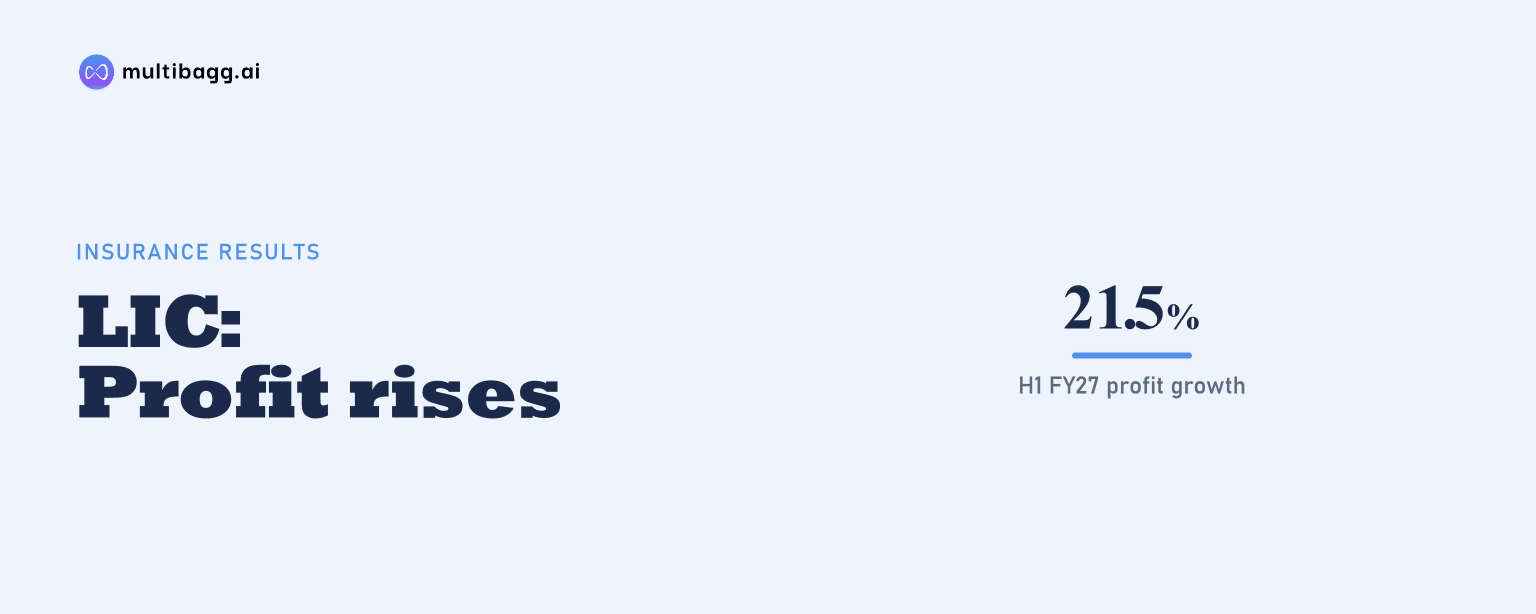
In H1 FY27, Life Insurance Corporation of India reported profit after tax of Rs 25,568 crore, up 21.52% year on year, while net Value of New Business margin increased by 470 basis points to 22.3%. LIC’s net new-business value rose 33.95% to Rs 6,846 crore, faster than total premium income growth of 11.64%.
Know Life Insurance Corporation of India inside out
Results, valuation, peers and who's buying, in one view.
How much did LIC’s H1 FY27 profit increase?
LIC’s profit after tax increased by Rs 4,528 crore to Rs 25,568 crore for the six months ended September 30, 2026, from Rs 21,040 crore a year earlier. The Board approved the standalone and consolidated results on November 5, 2026, while the performance update identifies its operating highlights as standalone results.
Total premium income rose by Rs 28,589 crore to Rs 2.74 lakh crore, compared with Rs 2.46 lakh crore in H1 FY26. Profit therefore grew 21.52%, ahead of the 11.64% increase in total premiums. LIC also reported net Value of New Business, or VNB, of Rs 6,846 crore, up from Rs 5,111 crore, representing 33.95% growth.
The premium mix shifted towards group business during the period. Total group-business premium increased 19.62% to Rs 1.14 lakh crore, while total individual-business premium rose 6.61% to Rs 1.61 lakh crore. Group business contributed Rs 1.14 lakh crore of premium, compared with Rs 1.61 lakh crore from individual business, but expanded at almost three times the individual-business growth rate.
What drove LIC’s premium and APE growth?
LIC’s premium growth was led by group business and individual new-business premium, while individual renewal premium increased at a slower rate. Individual new-business premium rose 14.86% to Rs 32,725 crore from Rs 28,491 crore, whereas individual renewal premium grew 4.68% to Rs 1.28 lakh crore from Rs 1.22 lakh crore.
Annualised Premium Equivalent, or APE, increased 5.72% to Rs 30,696 crore in H1 FY27 from Rs 29,034 crore. Individual business accounted for Rs 17,224 crore, or 56.11%, of total APE, and group business accounted for Rs 13,472 crore, or 43.89%. Group APE rose 13.55% from Rs 11,864 crore, while individual APE increased only 0.31% from Rs 17,170 crore.
LIC sold 70,97,094 individual policies during H1 FY27, down 2.25% from 72,60,573 a year earlier. The decline in policy count occurred alongside the 14.86% rise in individual new-business premium to Rs 32,725 crore. The release does not disclose average premium per policy, but its reported data show that premium income and policy volumes moved in different directions.
Why did LIC’s VNB margin rise to 22.3%?
LIC’s net VNB margin rose to 22.3% in H1 FY27 from 17.6% in H1 FY26, an expansion of 470 basis points, where 100 basis points equal one percentage point. Net VNB increased by Rs 1,735 crore to Rs 6,846 crore, outpacing the 5.72% rise in total APE to Rs 30,696 crore.
The individual product mix included Rs 11,364 crore of participating, or Par, APE, equal to 65.98% of individual APE, and Rs 5,861 crore of non-participating, or Non Par, APE, equal to 34.03%. Non Par APE declined 5.98% from Rs 6,234 crore in H1 FY26, and its share of individual APE fell from 36.31% to 34.03%. LIC thus reported higher VNB and margin despite a lower Non Par APE share.
Chief Executive Officer and Managing Director R Doraiswamy said LIC was pursuing product and channel diversification and sought to maintain Non Par products at about one-third of individual APE. He said Banca and Alternate Channels represented 7.53% of individual new-business premium in H1 FY27, compared with 7.12% in the corresponding period, and that this channel’s business grew 21.44%.
Got a follow-up? Ask IRIS
What do LIC’s costs, capital and retention measures show?
LIC’s overall expense ratio declined by 87 basis points to 10.41% in H1 FY27 from 11.28% in H1 FY26, while its solvency ratio rose to 2.35 from 2.13. Assets under management increased 4.16% to Rs 59.61 lakh crore as of September 30, 2026, compared with Rs 57.23 lakh crore a year earlier.
Indian Embedded Value declined 1.95% to Rs 7.97 lakh crore as of September 30, 2026, from Rs 8.13 lakh crore a year earlier. Yield on investments in policyholders’ funds, excluding unrealised gains, fell to 8.67% in H1 FY27 from 8.90%. These measures moved differently from the 21.52% increase in reported profit and the 470-basis-point VNB-margin expansion.
Persistency results were mixed across measurement bases and durations. On a premium basis, the 13th-month persistency ratio slipped to 74.69% from 75.29%, while the 61st-month ratio fell to 61.03% from 63.81%. On a policy-number basis, 13th-month persistency improved to 67.58% from 63.36%, but 61st-month persistency declined to 48.33% from 51.50%.
Which disclosed accounting matters will affect later LIC results?
LIC will adopt Indian Accounting Standards, or Ind AS, from April 1, 2027, after receiving a one-year forbearance from the Insurance Regulatory and Development Authority of India. The regulator’s amended 2026 regulations required insurers to prepare financial statements under Ind AS from April 1, 2026, but LIC prepared H1 FY27 results under Indian generally accepted accounting principles and the applicable insurance regulations.
LIC charged Rs 928.04 crore to the revenue account in H1 FY27 for amortisation of an additional family-pension contribution and reported a remaining Rs 3,712.13 crore balance as of September 30, 2026. That balance is scheduled for amortisation through the second quarter of FY29. The source states that the original Rs 9,280.37 crore contribution is being amortised over 20 quarters from the third quarter of FY24.
The company also disclosed two shareholder-account items scheduled through the fourth quarter of FY27. Rs 1,205.02 crore remains to be replenished from the shareholders’ account for excess Par-segment expenses of management, while Rs 912.85 crore remains to be charged for an additional Par-segment pension liability. LIC recorded Rs 1,205.02 crore and Rs 912.84 crore, respectively, for these matters in H1 FY27.
Conclusion
LIC’s H1 FY27 results combined a 21.52% rise in profit after tax to Rs 25,568 crore with a 33.95% increase in net VNB to Rs 6,846 crore and a 470-basis-point margin expansion. Group premium and group APE grew faster than individual-business measures, while the expense ratio declined and solvency increased, even as Indian Embedded Value and some persistency measures fell.
Next, LIC’s disclosed plan to maintain Non Par products at about one-third of individual APE will be relevant after that share reached 34.03% in H1 FY27. Investors can also watch the scheduled shareholder-account charges through Q4 FY27, family-pension amortisation through Q2 FY29, and the move to Ind AS on April 1, 2027.