










Logix says smartphone volumes fell 7.9% as prices hit record
Key highlights
- India smartphone shipments fell 7.9% year on year to 64.2 million units in H1 CY26.
- Q2 CY26 smartphone average selling price reached a record US$315, up 14.4% year on year.
- Q2 CY26 online smartphone shipments fell 19.8%, versus a 3.6% decline in offline shipments.
- Logix COCO revenue rose 35.0% to Rs 180 crore in H1 FY27, while e-commerce revenue declined 19.1% to Rs 142.6 crore.
powered by IRIS
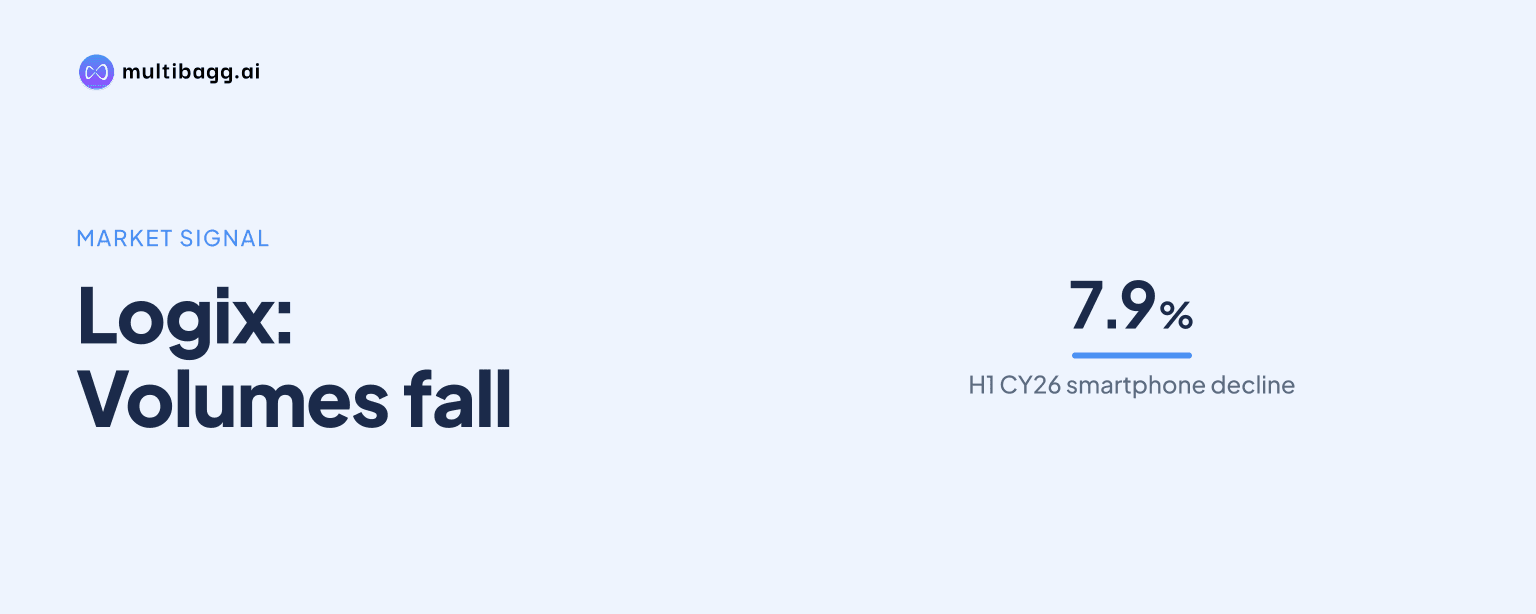
Logix Infotech Limited says India’s smartphone market shipped 64.2 million units in H1 CY26, down 7.9% year on year, while the average selling price reached a record US$315 in Q2 CY26, up 14.4%. Its presentation links the price rise to memory costs and identifies premium handsets and offline retail as relatively better-performing areas.
Know Logica Infoway inside out
Results, valuation, peers and who's buying, in one view.
Why did India’s smartphone volumes fall in H1 CY26?
India’s smartphone market contracted in H1 CY26, with shipments declining 7.9% year on year to 64.2 million units from 69.7 million units in H1 CY25. The first-half result followed 152 million units in 2025, compared with 151 million in 2024 and 146 million in 2023, showing that the H1 CY26 decline followed a relatively stable annual market.
The decline steepened in Q2 CY26, when shipments were 33.2 million units, down 11.1% year on year according to International Data Corporation, or IDC. Counterpoint Research estimated a 10% quarterly fall. Yet smartphone market value rose 3.6% year on year in Q2 CY26, indicating that higher prices offset lower shipments at the market-value level.
The market backdrop is relevant to Logix because smartphones are among the products distributed and sold through its four business verticals. Distribution generated Rs 257.8 crore, or 33.6% of H1 FY27 revenue, while Company-Owned Retail, or COCO, generated Rs 180 crore. The presentation does not disclose smartphone-only revenue, so it does not quantify the category’s direct effect on either vertical.
Why did smartphone selling prices reach a record in Q2 CY26?
Smartphone average selling price, or ASP, reached a record US$315 in Q2 CY26, 14.4% higher year on year, as a memory-chip shortage raised device costs, according to Logix’s presentation. The Q2 CY26 ASP was US$33 above the US$282 recorded in 2025, US$56 above 2024’s US$259 and US$90 above the US$225 reported for 2022.
The US$400-600 segment was the clearest premiumisation measure in Q2 CY26: shipments rose 60.3% year on year and its share increased to 8.6% from 4.8%. Apple’s share rose to 8.5% from 7.5%, while Samsung held a 16.4% share. These gains occurred while total Q2 CY26 smartphone shipments fell 11.1%.
Entry-level demand moved in the opposite direction. Phones priced below US$100 recorded a 74.3% year-on-year shipment decline in Q2 CY26, and their share fell to 4.5% from 15.6%. The US$100-200 segment held a 46.8% share, while Logix identifies lower-priced devices as a volume risk for entry-focused brands.
Got a follow-up? Ask IRIS
Are offline smartphone sales holding up better than online sales?
Offline smartphone shipments held up better than online shipments in Q2 CY26, declining 3.6% year on year versus a 19.8% fall online. Online’s share of smartphone sales therefore declined to 41.9% from 46.4% a year earlier. Logix attributes continued brand investment in offline channels to channel margins, in-store promoters and price programmes.
The channel pattern coincided with divergent H1 FY27 performance across Logix’s retail and online verticals. COCO revenue rose 35.0% year on year to Rs 180 crore, accounting for 23.4% of revenue, while e-commerce revenue fell 19.1% to Rs 142.6 crore, or 18.6% of revenue. The presentation identifies the offline trend as support for COCO and a headwind for e-commerce, without attributing all of the change to smartphones.
Logix operated 77 COCO stores across four states and about 38,125 square feet at 30 September 2026. The network included Samsung Experience Stores, Samsung cafés, HP World stores and multi-brand outlets. Store count rose from 53 in FY25 to 77 in FY26 and remained at 77 at September 2026.
How does India’s IT hardware market compare with smartphones?
India’s personal-computer, or PC, market was commercially led in H1 CY26, with about 8.3 million PCs shipped, comprising 4.4 million in Q1 and 3.9 million in Q2. Q1 shipments rose 31.1% year on year and Q2 shipments rose 12.1%, contrasting with the smartphone market’s 7.9% H1 CY26 volume decline. Logix says channel front-loading before price increases supported PC demand.
Commercial PC shipments reached 2.2 million in Q2 CY26, up 16.6% year on year, compared with 1.7 million consumer PCs, up 6.6%. Government demand grew 17.6% and education demand increased 24.8% in Q2 CY26. Logix’s mandates include HP, Dell, Lenovo and ASUS, as well as Tier-1 Samsung notebook distribution in West Bengal, Delhi-NCR, Uttar Pradesh and Haryana.
The second-half PC outlook is less favourable than the first-half comparison. Omdia forecasts a 22% decline in H2 CY26 PC shipments as component inflation takes effect after pre-buying, and forecasts a 2.6% CY26 decline to 15.4 million units. Logix identifies distributor inventory days as a measure to monitor; notebooks above US$1,000 rose 70.1% year on year in Q1 CY26.
Conclusion
Logix is operating in consumer-electronics markets with different demand patterns. Smartphones combined a 7.9% H1 CY26 shipment decline with a record US$315 Q2 CY26 ASP, while PCs posted about 8.3 million H1 CY26 shipments led by commercial demand. Within Logix’s channels, COCO revenue increased 35.0% to Rs 180 crore, compared with a 19.1% decline in e-commerce revenue to Rs 142.6 crore.
The next indicators to watch are memory and component costs, the stability of online’s 41.9% smartphone share and whether PC shipments follow Omdia’s projected 22% H2 CY26 decline. Management guides for 35-40% FY27 retail revenue growth, while 24 of Logix’s 77 stores had opened since April 2025 and were still within their first year of operation.