










Neetu Yoshi private customers reached 24.5% of FY26 sales
Key highlights
- Neetu Yoshi recorded Rs 24.06 crore of private revenue in FY26, equal to 24.5% of Rs 98.24 crore total sales.
- Neetu Yoshi’s Indian Railways revenue rose to Rs 74.18 crore in FY26 from Rs 70.59 crore in FY25.
- Uttar Pradesh accounted for 38.32% of Neetu Yoshi’s FY26 sales, while West Bengal accounted for 15.45%.
- Neetu Yoshi reported more than 25 RDSO-approved critical safety items and a Class A foundry classification.
powered by IRIS
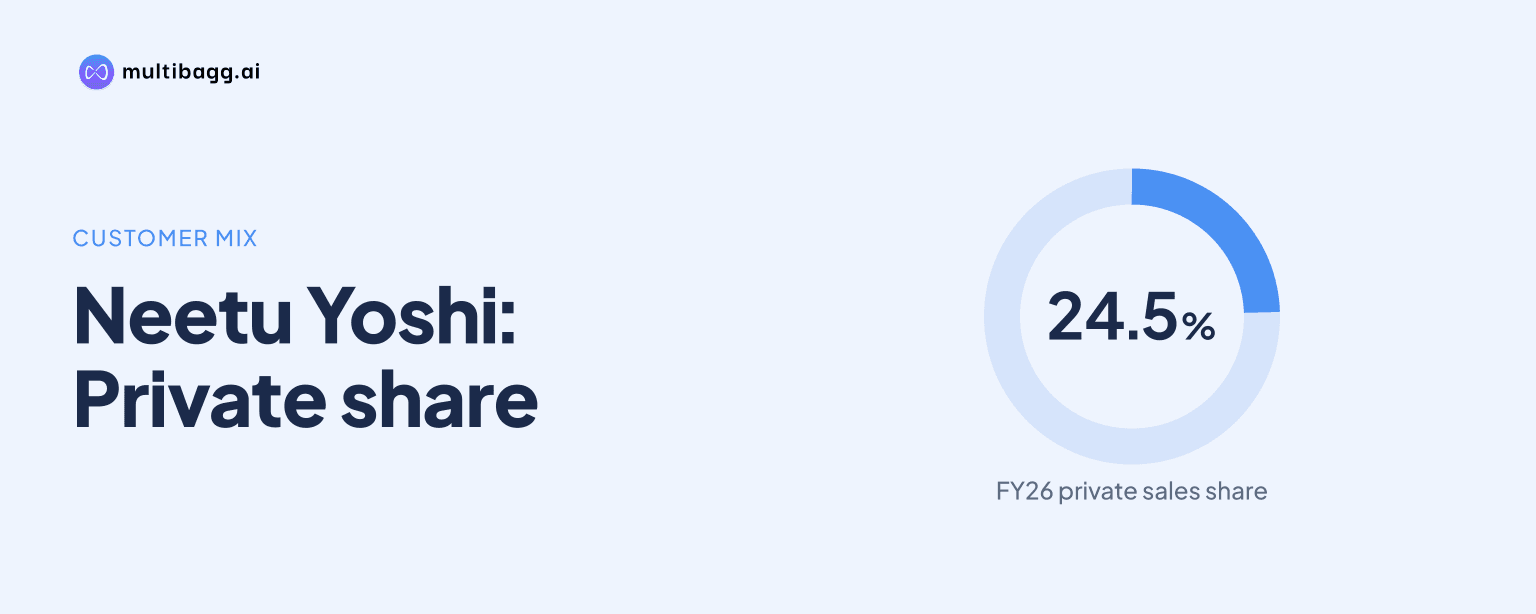
Neetu Yoshi Limited derived Rs 24.06 crore, or 24.5% of FY26 sales, from private customers. FY denotes financial year. Total revenue was Rs 98.24 crore in FY26, Indian Railways’ share fell to 75.5% from 100.0% in FY25, and Uttar Pradesh became the largest sales state.
Know Neetu Yoshi inside out
Results, valuation, peers and who's buying, in one view.
How did Neetu Yoshi’s customer mix change in FY26?
Neetu Yoshi’s customer mix changed in FY26 as private revenue rose from Rs 0.00 crore in FY25 to Rs 24.06 crore, while Indian Railways revenue reached Rs 74.18 crore. Private customers accounted for 24.5% of the Rs 98.24 crore total, while Indian Railways accounted for 75.5%. In FY25, the full Rs 70.59 crore customer-mix total was attributed to Indian Railways.
The FY26 mix also differs from FY24, when Neetu Yoshi recorded Rs 0.52 crore from private customers and Rs 46.71 crore from Indian Railways. Private revenue was 1.1% of the Rs 47.23 crore FY24 total, compared with 24.5% in FY26. The presentation does not identify the private customers or the products they purchased, so it does not establish whether FY26 private sales will recur.
What accounted for Neetu Yoshi’s FY26 revenue increase?
Neetu Yoshi’s revenue increased by Rs 27.65 crore in FY26, comprising a Rs 24.06 crore rise in private revenue and a Rs 3.59 crore increase in Indian Railways revenue. Total revenue increased from Rs 70.59 crore in FY25 to Rs 98.24 crore in FY26. On a calculated basis, private revenue represented about 87% of the total increase.
Indian Railways revenue still rose in rupee terms, from Rs 70.59 crore in FY25 to Rs 74.18 crore in FY26, a calculated increase of 5.1%. Its share of sales nevertheless declined by 24.5 percentage points, from 100.0% to 75.5%, because private revenue expanded from a nil FY25 base. The percentage shift therefore reflects the addition of private sales as well as higher railway revenue.
Neetu Yoshi identifies Indian Railways and its wagon and coach manufacturer network as its core customer base, built on repeat orders for safety-critical components. Its recent disclosed orders include Rs 17.12 crore from Integral Coach Factory, Indian Railways and an India-based manufacturer; Rs 14.76 crore from an India-based wagon manufacturer; Rs 7.39 crore from an India-based manufacturer; and Rs 3.00 crore from South East Central Railway. The Rs 7.39 crore order includes goods and services tax, while the other stated order values exclude it, so the amounts are not stated on a uniform tax basis.
Got a follow-up? Ask IRIS
Which states became Neetu Yoshi’s largest sales markets in FY26?
Uttar Pradesh became Neetu Yoshi’s largest FY26 sales market at 38.32% of sales, replacing West Bengal, which had led FY25 at 42.15%. West Bengal represented 15.45% of FY26 sales, a decline of 26.70 percentage points in its reported share. Chhattisgarh accounted for 12.70% and Haryana for 9.40% in FY26, although neither state was separately listed in the FY25 breakdown.
The geographic mix became less concentrated in West Bengal across the reported periods. West Bengal’s share was 82.09% in FY24, 42.15% in FY25 and 15.45% in FY26. Uttar Pradesh was not separately shown in the FY25 table, while Jharkhand, Gujarat and Rajasthan were separately disclosed in FY25 but were not listed separately in FY26.
The two FY25 disclosures use different sales totals. The customer-mix table reports Rs 70.59 crore, while the state-revenue slide labels FY25 sales at Rs 70.20 crore. Neetu Yoshi does not explain the Rs 0.39 crore difference, meaning the state percentages allow a geographic comparison but cannot be reconciled to the customer-mix revenue table using the presentation alone.
How does Neetu Yoshi pursue railway-linked sales?
Neetu Yoshi pursues railway-linked sales through product-specific approval from the Research Designs and Standards Organisation, or RDSO, which the presentation says is required for suppliers of safety-critical items to Indian Railways. Neetu Yoshi reports approval for more than 25 critical safety items and a Class A foundry classification. Once approved for a product, it can bid in tenders from Indian Railways, its production units and zonal railways.
The presentation lists FY26 approvals at Integral Coach Factory, Chennai, for a coach Buffer Assembly; Rail Coach Factory, Kapurthala, for CCA for Brake Support and FIAT bogie; and RDSO registration for manganese steel liners and wear plates. Each approval is product-specific rather than a general permission to supply all rail components. Neetu Yoshi says these approvals support tender eligibility and repeat orders, but it gives no FY27 private-revenue target or private-customer pipeline.
Neetu Yoshi’s stated sales process runs from RDSO eligibility to tender or enquiry, pre-sale engagement, a work order, delivery and repeat business. It includes online tenders and direct enquiries from railways and manufacturers, with design discussions, product feedback and cost estimation before an order. Marketing is led by Managing Director and Chief Financial Officer Himanshu Lohia, who has been with Neetu Yoshi since 2020.
Conclusion
Neetu Yoshi’s FY26 figures show diversification in customer type and geography. Private customers supplied Rs 24.06 crore after contributing no revenue in FY25, lifting total sales to Rs 98.24 crore, while Indian Railways revenue still increased to Rs 74.18 crore. Uttar Pradesh also took a 38.32% sales share as West Bengal’s share declined to 15.45%.
The disclosed items to watch are execution of the Rs 17.12 crore order scheduled from October 2026 to September 2027, the Rs 14.76 crore order due between May and December 2026, and the Rs 3.00 crore railway order with deliveries through July 2027. Future disclosures would also be needed to assess whether private revenue recurs and to clarify the Rs 0.39 crore difference between the two FY25 sales totals.