










Neetu Yoshi Limited FY26 income tops Rs 100 crore, up 43.1%
Key highlights
- Neetu Yoshi's FY26 total income was Rs 101.35 crore, up 43.1% from Rs 70.81 crore in FY25.
- Neetu Yoshi reported FY26 EBITDA of Rs 33.87 crore and an EBITDA margin of 33.42%.
- Neetu Yoshi's FY26 PAT rose 52.0% year on year to Rs 25.01 crore.
- Neetu Yoshi began commercial production at its 13,200 MTPA Haridwar facility on 13 September 2026.
powered by IRIS
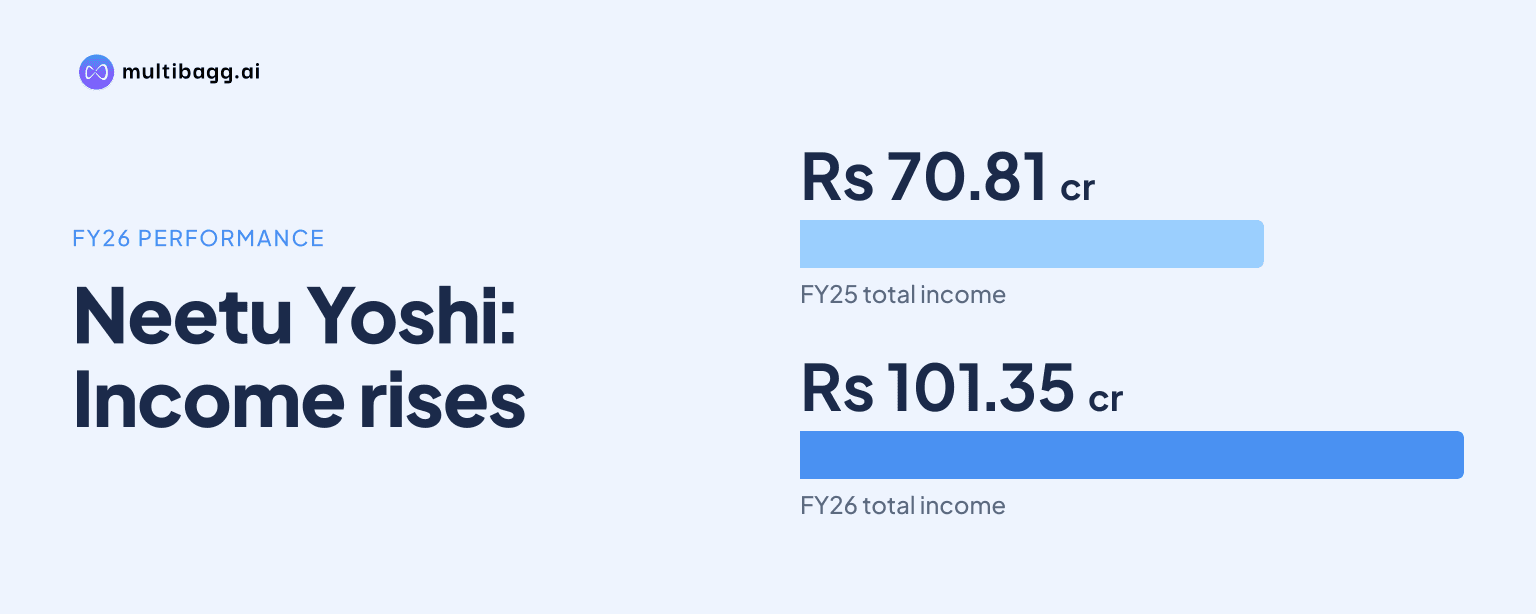
Neetu Yoshi Limited reported FY26 total income of Rs 101.35 crore, up 43.1% from Rs 70.81 crore in FY25, after a stated 46.1% compound annual growth rate from FY24. EBITDA was Rs 33.87 crore at a 33.4% margin, while profit after tax reached Rs 25.01 crore, up 52.0% year on year.
Know Neetu Yoshi inside out
Results, valuation, peers and who's buying, in one view.
How fast did Neetu Yoshi's income grow through FY26?
Neetu Yoshi's total income increased from Rs 47.45 crore in FY24 to Rs 70.81 crore in FY25 and Rs 101.35 crore in FY26, producing the company's stated 46.1% compound annual growth rate, or CAGR, over the two-year period. The FY26 increase was Rs 30.54 crore, exceeding the Rs 23.36 crore increase recorded in FY25.
Revenue from operations accounted for most of FY26 income, rising to Rs 98.10 crore from Rs 70.59 crore in FY25 and Rs 47.33 crore in FY24. Other income increased to Rs 3.24 crore in FY26 from Rs 0.22 crore in FY25, making it a larger part of total income than in either prior year.
The FY26 total-income growth rate of 43.1% compares with FY25 alone, whereas the 46.1% CAGR spans FY24 to FY26. Total income first exceeded Rs 100 crore in the three-year financial comparison presented by Neetu Yoshi.
Did Neetu Yoshi maintain operating margins during growth?
Neetu Yoshi reported earnings before interest, tax, depreciation and amortisation, or EBITDA, of Rs 33.87 crore in FY26, compared with Rs 23.43 crore in FY25 and Rs 17.19 crore in FY24. EBITDA therefore rose by Rs 10.44 crore in FY26 and by Rs 16.68 crore over the FY24-to-FY26 period.
The FY26 EBITDA margin was 33.42%, compared with 33.09% in FY25 and 36.23% in FY24. This means the margin improved by 0.33 percentage points from FY25 but was 2.81 percentage points below the FY24 level, even as total income increased by Rs 53.90 crore across two years.
Raw-material expenses rose to Rs 49.15 crore in FY26 from Rs 33.81 crore in FY25, while employee costs increased to Rs 5.72 crore from Rs 3.76 crore. Other expenses reached Rs 12.61 crore, and total expenditure was Rs 67.48 crore in FY26, compared with Rs 47.38 crore in FY25.
What happened to Neetu Yoshi's profit after tax in FY26?
Neetu Yoshi's profit after tax, or PAT, rose 52.0% to Rs 25.01 crore in FY26 from Rs 16.45 crore in FY25, after reporting Rs 12.58 crore in FY24. The presentation states a 41.0% PAT CAGR between FY24 and FY26, while profit before tax increased to Rs 30.16 crore from Rs 20.18 crore in FY25.
PAT margin was 24.68% in FY26, up from 23.23% in FY25 but below 26.51% in FY24. Earnings per share were Rs 6.91 in FY26, compared with Rs 5.84 in FY25 and Rs 7.39 in FY24.
Finance costs fell to Rs 1.55 crore in FY26 from Rs 1.73 crore in FY25 despite depreciation rising to Rs 2.16 crore from Rs 1.52 crore. Neetu Yoshi reported interest coverage of 20.50 times in FY26, versus 12.63 times in FY25, and debt to equity of 0.03 times, versus 0.31 times.
Got a follow-up? Ask IRIS
How did FY26 growth affect Neetu Yoshi's cash flow and balance sheet?
Neetu Yoshi generated operating cash flow of Rs 4.03 crore in FY26, down from Rs 12.10 crore in FY25 and Rs 7.67 crore in FY24. The presentation attributes the FY26 reduction to higher receivables accompanying growth, with trade receivables rising to Rs 31.88 crore from Rs 10.42 crore at FY25 end.
Investing cash flow was an outflow of Rs 58.81 crore in FY26, compared with Rs 16.94 crore in FY25, reflecting capital expenditure on the Haridwar facility and term deposits of unutilised initial public offering, or IPO, funds. Capital work-in-progress stood at Rs 38.16 crore in FY26, against nil in FY24 and FY25.
Financing cash flow was an inflow of Rs 56.11 crore in FY26, which Neetu Yoshi says reflected net IPO proceeds raised in July 2025. Cash and bank balances increased to Rs 11.86 crore from Rs 0.53 crore, while net worth rose to Rs 137.25 crore from Rs 44.60 crore.
What is Neetu Yoshi planning after FY26 expansion?
Neetu Yoshi commenced commercial production at its Haridwar facility on 13 September 2026, in the first half of FY27. The facility, established using IPO proceeds, is designed to manufacture complete bogies and couplers and adds 13,200 metric tonnes per annum, or MTPA, of capacity to the earlier 8,087 MTPA base.
Management said the Haridwar facility is expected to nearly double manufacturing capabilities and that it is focused on capacity utilisation, operating efficiencies and product expansion. In May 2026, the Haridwar facility was included in the Research Designs and Standards Organisation, or RDSO, Vendor Directory for freight bogies under the Developmental Vendor category, with approved annual capacity of 112,200 Constant Contact Side Bearer units.
Neetu Yoshi also received RDSO prototype approval for the Friction Wedge in September 2026, with item ID 3100430. A June 2026 Rail Coach Factory capacity-cum-capability assessment for Brake Support for FIAT Bogie remains valid until 13 April 2030, unless specifications change.
Conclusion
Neetu Yoshi's FY26 results combine income growth from Rs 47.45 crore in FY24 to Rs 101.35 crore with EBITDA rising from Rs 17.19 crore to Rs 33.87 crore and PAT increasing from Rs 12.58 crore to Rs 25.01 crore. EBITDA and PAT margins were below their FY24 levels but improved from FY25, while FY26 operating cash flow declined to Rs 4.03 crore as receivables rose.
The next disclosed factor is utilisation of the Haridwar unit, which began production on 13 September 2026 and adds 13,200 MTPA of capacity. Management has identified capacity utilisation, operating efficiency and product expansion as priorities, while the Rs 31.88 crore FY26 receivables balance and the 13 April 2030 product qualification validity are measures and milestones to watch.